
Wednesday, July 3rd, 2024
Distance ridden 243 kilometres
We were off again, only four days after coming back from Jeseníky. The lack of other opportunities for any breaks meant that we had to cram our trips together a little bit.
This time, as Lucie took her usual “Just about to leave home” picture, we were about to point the Harley west, in the direction of Germany. We still had a few “Hundertwasser” locations left on our list and thought we would try and tick some of them off.

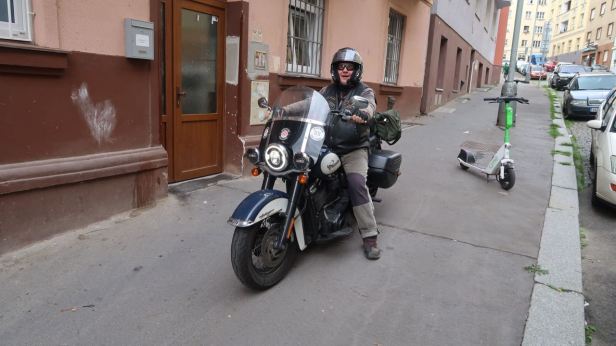
We left home at the relatively late hour of 09:30 and quickly passed through the centre of Prague to the D8 (E55) motorway that would take us north-west towards Dresden.


It was holiday time, so the traffic, apart from the inevitable freight lorries from all over Europe, was quite light. We never go really fast, but it was still an endless succession of overtaking the slower lorries whilst, of course, keeping a wary eye out for people testing their vehicle’s top-speed capabilities ….
We passed the legendary Czech mountain, Říp (where “Grandfather Čech” decided to stop and stay. His brother Lech, went on to Poland) and moved onto the still comparatively new stretch of motorway that crosses the mountains to Germany.

Most of these “mountains” are extinct volcanoes that jut, quite starkly in places, against the sky.


At this point, it rained on us briefly, but not enough to make us “Yellow-up” with our rain suits and it soon stopped. The road climbs quite a long way and some of the views are really great.

There is one bridge I like that, to me at least, resembles a twisted strand of DNA. It was not very warm though, so Lucie’s fleece went on at our first coffee stop, just before the border.

Directly before the border, near Petrovice, there are a series of tunnels. These were constructed at some expense (with cash from the European Onion) in order to go beneath and hence, not disturb, the breeding habitat of a rare woodland bird, the Western Capercaillie (Tetrao Urogallus) which is considered endangered.

We drove straight into Germany where the D8 becomes the A17 (but remains the E55) and quite soon had to slow down for the now familiar crawl past the police security which attempts to limit illegal migration. Then it was quickly onward to and straight through, Dresden, before taking the A4 and then A14 motorways westwards towards Leipzig.
When we came to the turning for Dӧbeln, we left the motorway and headed into the countryside towards the small town of Colditz, the location of the famous Colditz castle. Given that the castle was a famous WWII prison camp, specifically for those who had proved themselves adept at getting OUT of such places, it seemed weird to be heading TOWARDS it, but we did, through some quite delightful Saxony countryside.

We came to the town where the castle, because of its renown, was easily located as it is well sign-posted – and were able to park right outside.

The sun had finally come out and the castle, high on a rocky bluff, looked white and welcoming in the sunlight and not foreboding at all.
 These days it hosts not only a historical museum, but also a music school, so we were able to march straight through the front gate and move freely around the precincts.
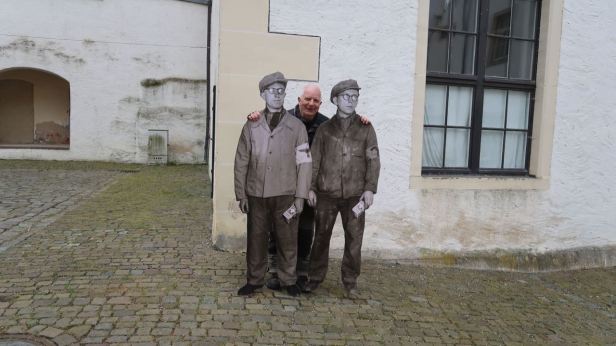

We did not have time to visit the museum, we tend to always spend way too long in such places, but wandered the various courtyards at will. To me, it seemed oddly cheerful considering that as well as being a prison camp, some pretty evil things were done there to those people that the Nazis considered “undesirables”.
We were hungry and, just outside one of the gates, we found the Restaurant Schlosswachter (Kirchberg 5, Colditz).

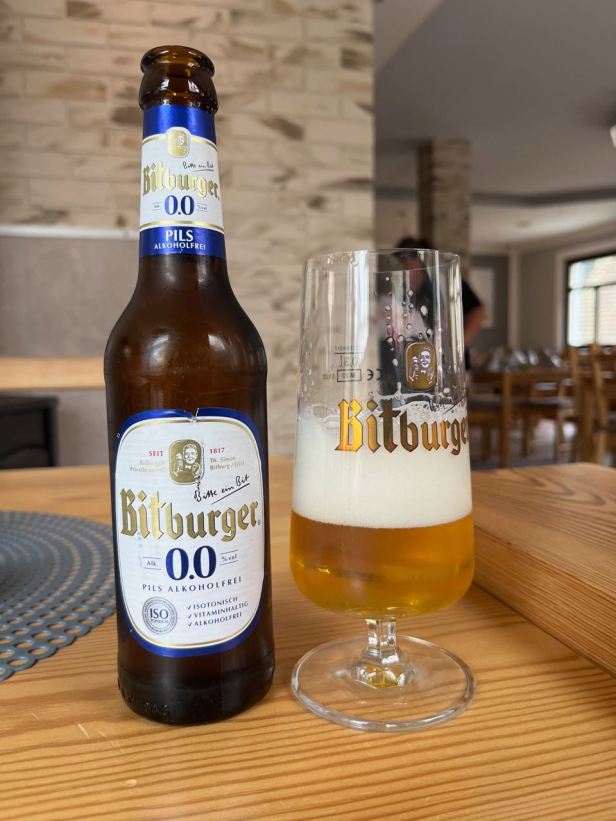
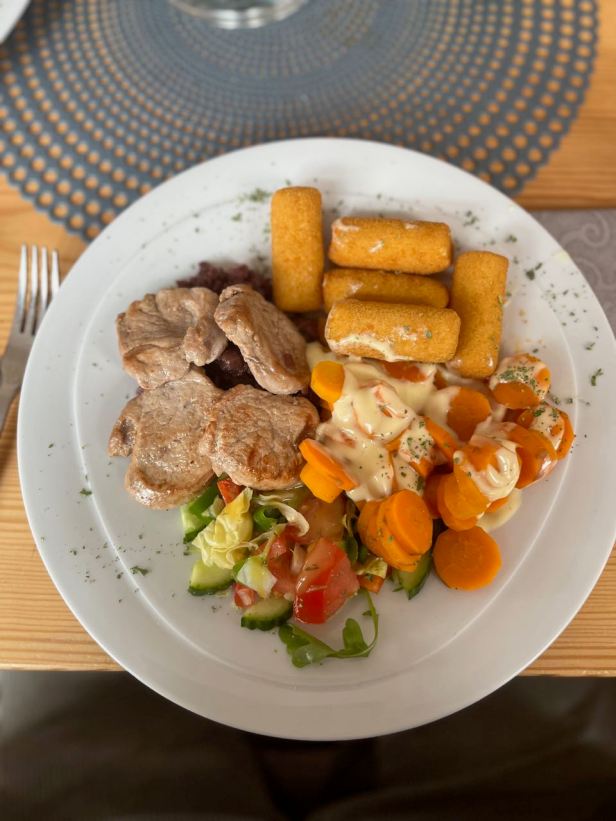
We were greeted cheerily (and in English) by the proprietor and enjoyed an excellent lunch of pork medallions for me a(nother) rabbit for Lucie and a couple of alcohol free beers.

Then it was back onto the Harley for the shortish ride through the town and onward to our overnight stay in the town of Grimma. We paused only to photograph the castle from a distance.
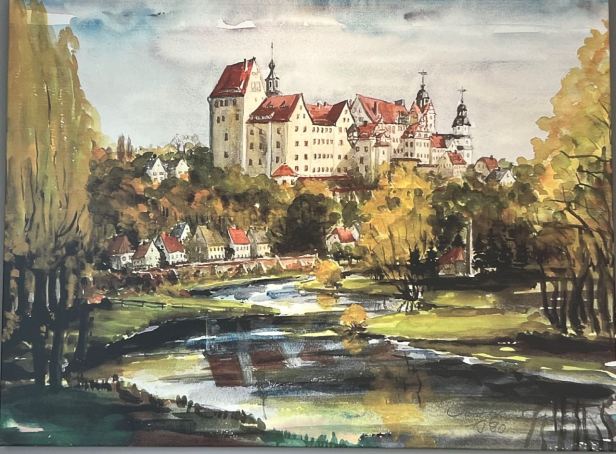

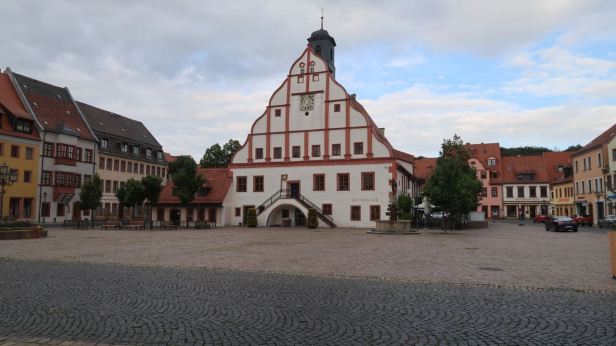
As usual. we found our destination easily. We were staying in the Hotel Goldenes Schiff (Leipziger Platz 6, Grimma), where we had a well fitted, if slightly compact, room.

With the Harley safely parked in the car-park of the on-site Greek restaurant, we took a short rest and then decided to explore the town. Our first stop was an ice-cream cafe, where we both helped ourselves to a very reasonably priced double scoop cornet which we ate on a handily placed bench. Then we walked across the road and onto the river bank.
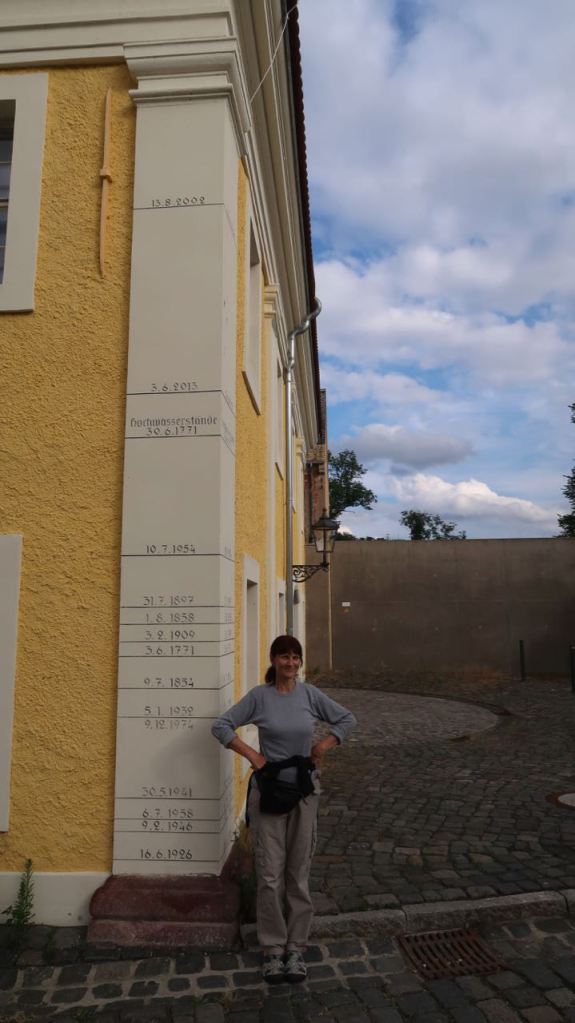
Grimma stands upon the river Mulde and it was moving slowly and somewhat lazily about six or seven metres below the level of the path, a veritable picture of tranquility. It soon became obvious, as we walked along, that such a peaceful flow was not always the case. We quickly noted that the older buildings, even those obviously recently restored, had no means by which they could be entered from “ground” level. There were no river-facing doors at all and all the windows were at least two metres above the ground – which was several metres above the placid waters below. As we proceeded, we found that any more modern construction was now protected by a substantial concrete wall, with clever, sealable apertures for any windows. All the streets and alleyways leading into the town were protected by large, iron gates. We thought this a bit curious until we discovered a marker which indicated the high water mark for floods in 2013 – which must have totally inundated the whole town !


We crossed the river, on the nice Muldebrücke, looking with new respect at the lazy flow below.
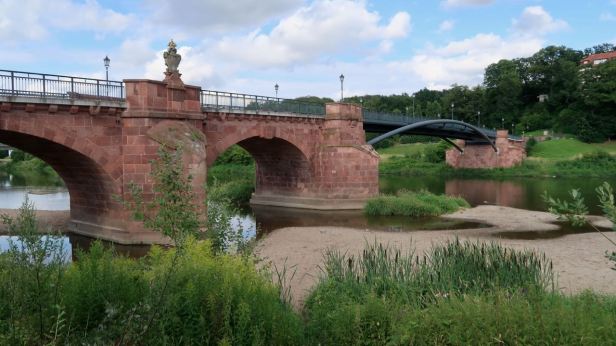
On the far bank was a pleasant, nature-walk with lots of informative plaques and displays to enable those walking the path to passively gain an understanding of what was around them in the trees and waters. It was very nicely done.
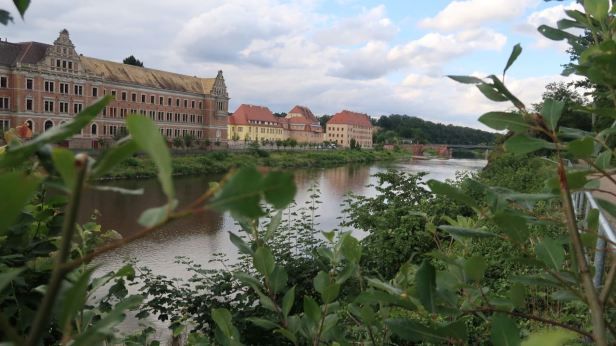
We walked the opposite bank as far as another, rather cute bridge, the Hängebrücke, at the top of the town.
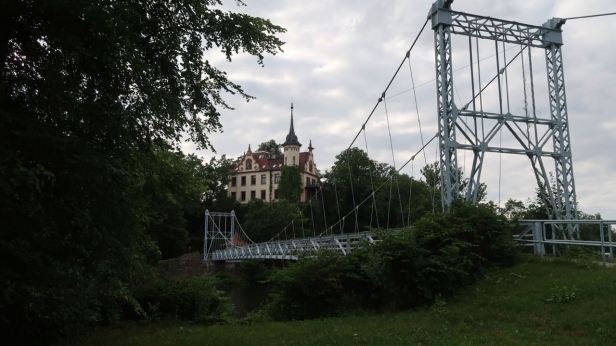
This was of the suspension variety and gave a good view over a weir and down river to where a branch in the flow had driven the restored mills we had seen earlier. On a rocky bluff, above the bridge, stood a pleasant chateau style building. It looked a bit like a castle, but was actually the Hotel Gattersburg.

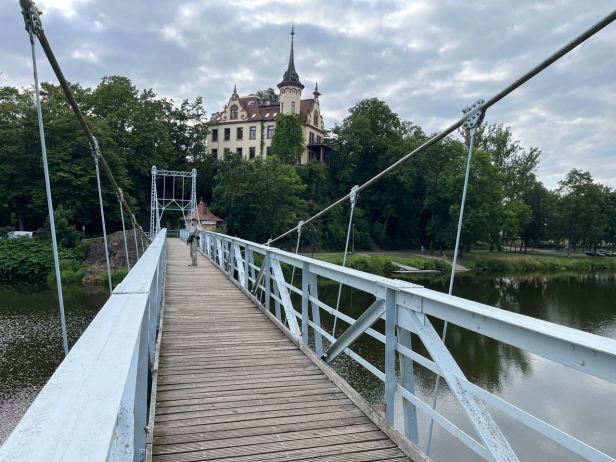
Then we walked back towards the top, that is upstream end, of the town to find that it, too, was surrounded by a high, concrete wall and that the whole road in could be sealed with an enormous iron gate. We wondered what those poor souls who live outside of the defences must think.

On a wall inside of the defences, we found another set of high-water mark indicators. To our surprise, these included one for August 13th, 2002, when the waters were way higher than in 2013 – and, even more surprisingly, this line was ABOVE the height of the new defences. That date was the same one on which flooding in Prague also reached what were referred to as “five-hundred year” levels. The good burghers of Grimma must assume they will never get that high again!
We set off in search of an evening meal, but small-town Germany on a Wednesday did not offer much unless we wanted an Indian takeaway or a kebab.
Despite the obvious perils posed by the river, there were a number of really quite ancient buildings in what are, admittedly, the higher backstreets. The German penchant for placing a plaque on a building when it is constructed, enabled us to “date” many of the obviously older ones. There were many from the 1700s and 1600s and even one reputedly from the 1500s. All were, as is the German way, extremely well kept and scrupulously maintained.

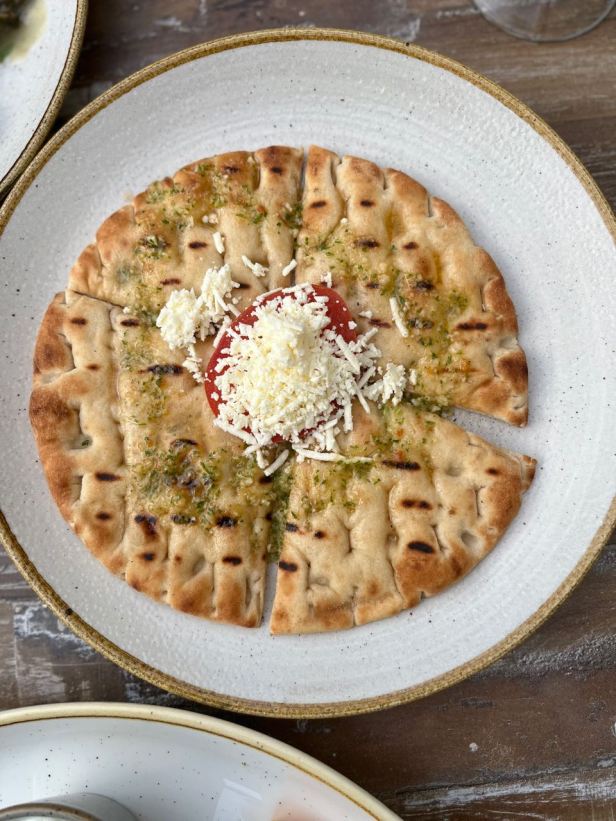
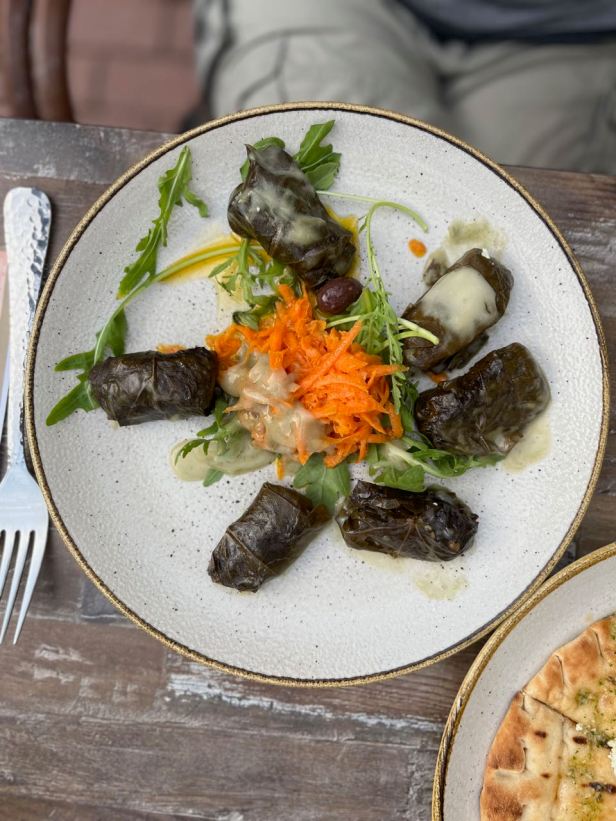
In the end, we settled for the Greek restaurant in our hotel which, judging from how busy it was, seemed to be the place of choice for most of the people in the town. It was actually very good. Lucie had dolmades, the stuffed vine leaves and I had some very nice grilled lamb. The local beer in both its alcoholic and non-alcoholic forms, complemented everything nicely.


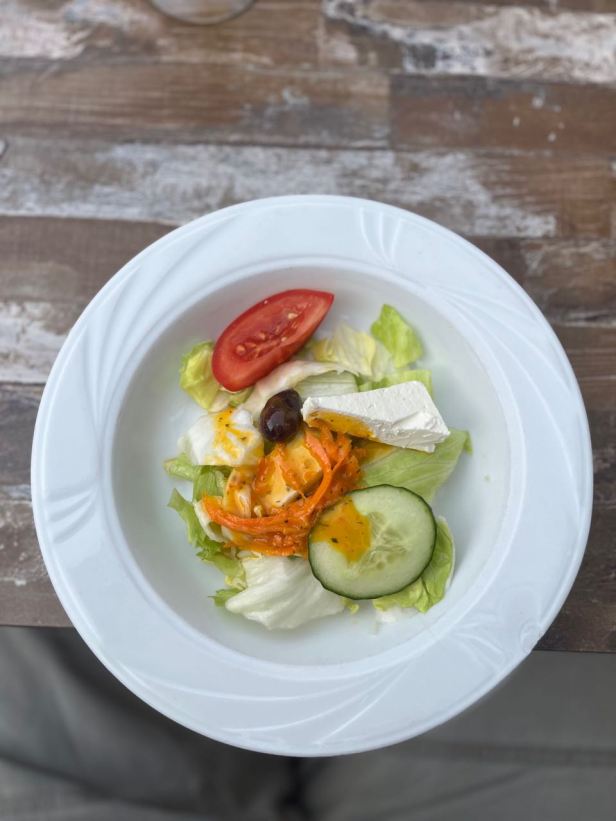

Our room was only seconds away and that meant I was asleep within a few minutes of finishing my dinner.
 Travels with my Harley