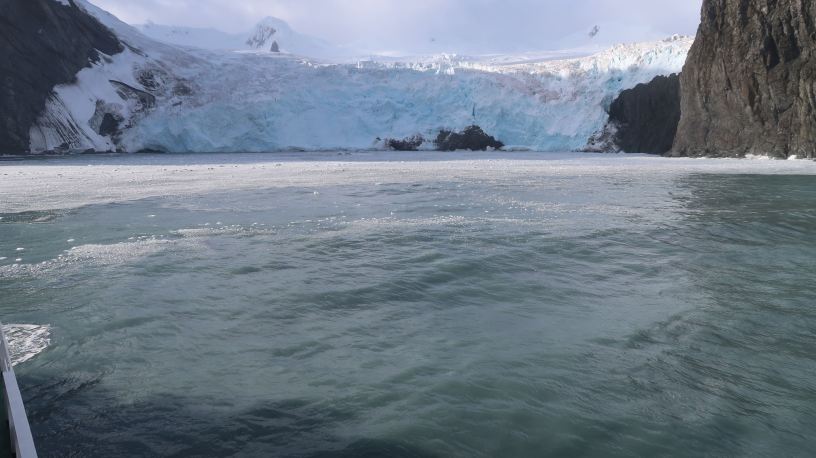
Tuesday, January 28th, 2025
Apparently, it was another very rough night at sea – but how would I know ?
I woke up quite early, but that was very much the norm and, in truth, it was not very smooth outside of our window. Lucie woke up too and we went for her first smoke together. All of the lower decks were closed, due to the rough seas. We climbed up to the bridge where the wings and small deck behind the wheelhouse were an elevated “smokers’ corner”.
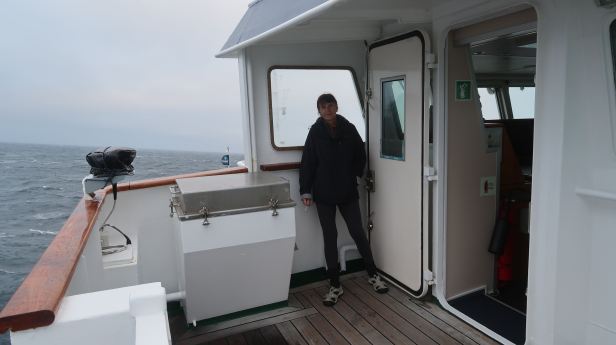
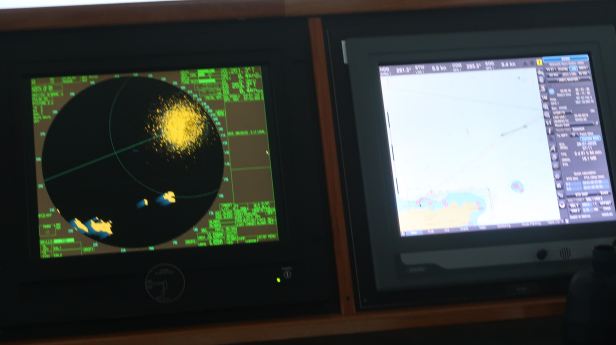
Although the displays for the driver (possibly, the “helmsman”) did show how close we were to Elephant Island, it was not yet visible to the naked observer.
I went down to the lounge for a cup of tea and, almost before I got the milk in, there was a darkening to the fog on the Port side. Moments later, the snowy peaks of Cape Valentine (the end of Elephant Island’s “trunk”) appeared out of the mist. The REAL Antarctica was just outside the window. I found I was taking deep breaths.
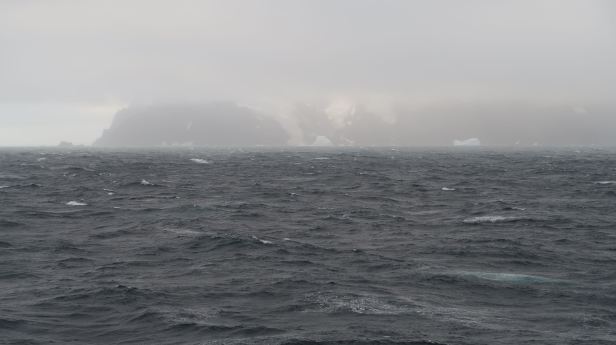
Cape Valentine was actually where Shackleton’s three lifeboats made their first landfall after escaping the ice of the Weddell Sea. However, it was wild, exposed and inhospitable. So the men got back into their fragile craft and travelled about seven miles along the northern coast of Elephant Island to a place now called Wild Point. This is named after Frank Wild, who led the remaining group of twenty-one men through the five long months that it took Shackleton to make his epic journey to South Georgia and return to rescue them all.
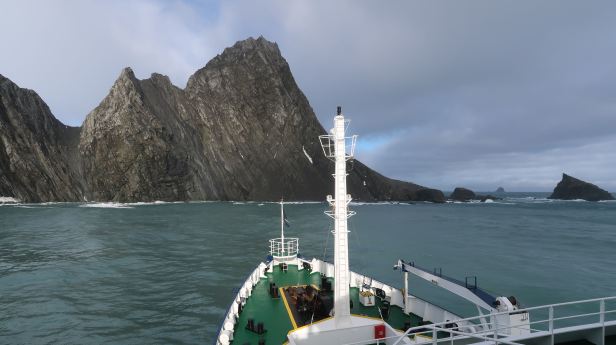
According to the ship’s log, our position was 61°05.9’S / 054°52.2’W
The Plancius dropped anchor in the small bay beside Wild Point. Although we had already been informed that rough sea conditions and ice would prevent us landing there, the sky was very blue and the sun had come out. At the same time, all the decks opened and everyone on board poured out onto them. After two days of sailing, there was general euphoria and, although it was quite cold, nobody seemed to notice.

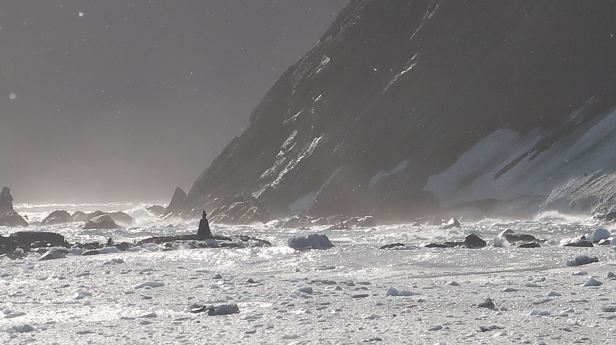
After his epic journey, it still took Shackleton five attempts to reach the bay because of frozen ice floes. Eventually the rescue was achieved with the aid of a boat from Chile, the Yelcho. The captain of the Chilean vessel, Luis Pardo, is commemorated with a bust on a plinth, which is set on a small islet in the bay. We could just see the bust from the Plancius. There is an inscription too, but, unable to land or even go out in a Zodiac due to the ice in the bay, we were limited to taking somewhat distant snaps of the bust.


The gang went for breakfast (Coco-pops, bacon, beans and egg for me) and it was soon obvious that the storm tossed night had not affected anybody’s appetite. Before the trip, I had been worried that I would not be able to eat and would need to buy trousers of a different size when I got home. The first part was, so far, totally wrong but the second might still be proved right !
The Plancius, meanwhile, had turned around and sailed back around Cape Valentine in search of calmer waters where we could either go ashore (hopefully not for five months) or take a Zodiac cruise.
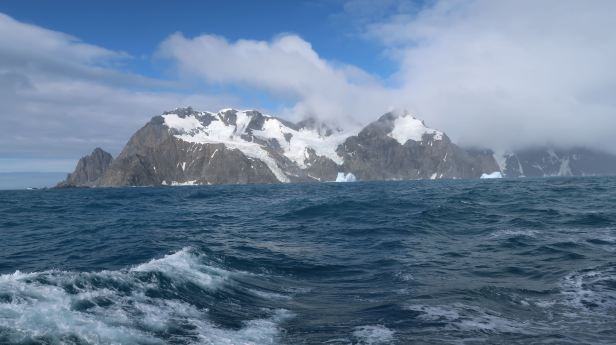
No sooner had we rounded the cape than we were alerted to the presence of Fin whales nearby and, moments later, to the presence of a large pod of Orcas.
This was good news for us whale watchers but, ultimately, the worst possible news for one young adult Fin whale. This was not Orcas playing, this was Orcas on a hunt. As has been mentioned here ad-nauseam, the Orcas are clever, but a Fin whale, even a young one, is a BIG whale. Unable to kill it outright, the Orcas concentrated on weakening it and then, ultimately drowning it (well, ultimately eating it, I suppose ….) The bigger Orcas took turns in streaking in, taking a bite at a fin or the tail and then retiring. All the time they were literally herding their quarry towards shallow waters which would further limit its chances of escape.

At one point, the chosen Fin whale dived right beneath the keel of the Plancius and emerged just at the point where Lucie and I were leaning over the rail. It was less than twenty feet away and made a nice photo.
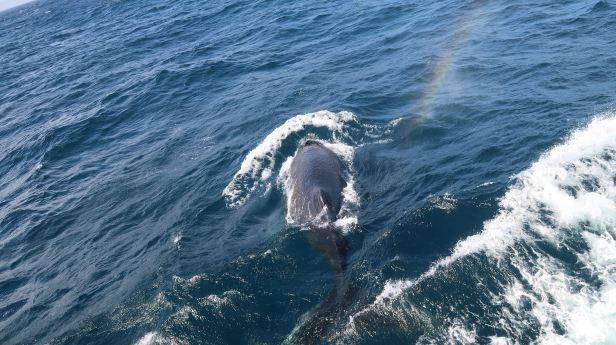
The evasive maneuver did not help it, the Orcas were waiting and, in its panic, the Fin did what they had probably planned in advance and ran into the shallows of a nearby islet.
The Plancius which had been maneuvering to stay with the Orcas, could not follow them into the shallows. It turned back towards the west, leaving the Fin whale to its slow, but inevitable, fate. Another example of nature being red in both tooth and claw – and it had happened right beside the ship.
Then it was lunch (soup, vegetable curry with rice and fruit) which was just as well, because apart from a few cookies, I had not (over)eaten for almost four hours !
In the afternoon, we still could not launch the Zodiacs because the seas were to rough. In the lounge, Hélène gave a nice little lecture in Frenglish about bird ringing and the advances in bird tracking technology. There is a huge “science” behind the study of this ringing and tracking.
Sometimes, with wary species, a selection of coloured plastic rings are used that effectively creates a detailed “bar code”. This enables bird data to be collected by people lurking in the bushes with powerful binoculars …. I think I have seen people like that in Stromovka park in Prague ….
Some of the technologies used to track birds are also quite astonishing. Miniature data collecting SIM cards, solar powered beacons that weigh only a few grams and allow satellite tracking – and even mini, solar powered, transmitters. Best of all was a new device that can be fitted to long-distance sea birds like the Giant Albatross. These have now often been shown to fly over three thousand kilometres a week. But there is more ! The same device can detect radar signals from ships and has already proven extremely efficient in helping the authorities detect illegal fishing vessels out on the ocean ….. and then grab them when they try to land.
That almost brings us back to the Ancient Mariner and might finally solve the mystery of why he REALLY shot the Albatross ….
It was a Tuesday ! As we were, yet again, surrounded by the ocean, Wendy snapped us drinking (tea) in front of a penguin motif for our TND buddies back in Prague …

Next, we had a talk on early polar explorers by Natalya. She is a Russian national, but now, when not on the ship, lives in Spitzbergen/Svalbard.
The first part was devoted to Antarctic explorers, from Captain Cook who missed it completely (although he was actually looking for it) through various other people who also got near, but never landed there. Of course, she had been taught at school that it was the Russians who were there first, but, in truth nobody is really sure and she made the whole thing into quite a humorous tale. In the early days, there were numerous episodes of startling hardship and endurance. Even some stranded Swedes had to be rescued by the Argentines of all people.
Natalya finished with a tale of some mass deaths in a remote house in her home of Svalbard. After a century of censure, because of inaccurate reporting, these turned out to be from lead poisoning. The house where it happened is still thought to be haunted …..
Then it was the daily recap, with much enthusing about what we had seen. I am not sure how the poor young Fin whale would have felt about it. Ali said that, although it is known to happen, in fifteen years, she has never before seen Orcas hunting another whale. Apparently even the BBC, after many attempts over three seasons, only managed to capture it briefly.
Having been prevented from landing anywhere that day by the wind and the swell, we were now heading to the less than originally named Penguin Island. This is also the cone of a (hopefully) extinct volcano. There would be a hike available, besides the obvious delights of the penguins, but it would mean another early start.
Next, there was a brief talk from the person who was seldom seen, but who was, nonetheless, the most popular person on the whole of the Plancius. It was the head chef, Khabir. He told us how he “did it”, by which I mean kept everything fresh – and gave us a few figures on quantities. He had loaded a thousand kilograms of meat and fish, for instance and three thousand eggs at the start of the voyage. The recipes for the meals, as Lucie had actually already surmised, were cleverly structured so that anything not used up one day would be part of the ingredients for the next one. A quick bit of mental arithmetic assured me that I have been eating less than my putative “share” of meat. That was a relief ! Of course, the finale, where Khabir said that on some occasions the seas had been so rough that passengers were confined to their cabins. When this had happened, sandwiches were delivered there, by hand. That caused a murmur or two. The Drake Passage was, after all, somewhere in all of our collective futures …
Finally, Szymon, the Orca expert, informed us that the Orcas only hunt other whales in order to eat ….. their tongues …..
The rest is abandoned to all of the other scavengers, little is left to sink to the bottom of the sea. Incidentally, even a juvenile Fin whale can top the scales at a startling one hundred tons – and the tongue can weigh FOUR tons – which can keep even a large pod of Orcas happily fed for at least two weeks ….
We needed to be fed more regularly than that, though, so we headed down to dinner (spicy lentil soup, some oriental beef and rice dish, fruit). We were becoming a bit of a raucous bunch – and none of us were even drinking !
Then, with another early start in mind, I wrote all this stuff and went to bed.
 Travels with my Harley