Sunday, January 26th, 2025
I kept wondering what the expedition leaders could possibly do next to keep up their very high standard – and, just before breakfast I found out.
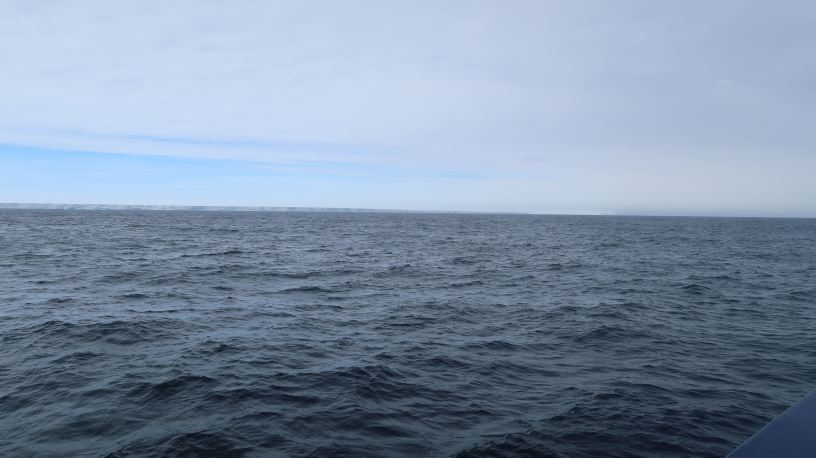
There, on the horizon, was the iceberg A23A. In reality, the horizon WAS the iceberg A23A ! All three billion tons of it.
According to the ship’s Log our position was 56°30.6’S / 040°01.9’W

Thanks to the sensationalist media coverage, we had all, at some point, I am sure, seen it already. Of course, the bulk of that coverage was from aerial photography. It looked big from the air – but that conveyed no real sense of scale. Up close and personal, to use a hackneyed term – and in what was quite a small ship – its sheer, uncompromising immensity was almost beyond my ability to describe in words.
There was previously at least one known iceberg that was bigger. Before we had satellite technology, of course, there may have be many we did not know about. That was called B15 (icebergs are prefixed A, B, C or D depending upon which compass point of the Antarctic continent they calve from) and that was three times bigger ! B15, however, broke up really quickly. The giant we were approaching was still virtually intact after forty years.
A23A was roughly square, very roughly, but that meant that each of the towering ice cliffs that formed its sides were approaching sixty kilometres long. Our initial approach was towards its front-right corner. The whole thing slowly rotates, so to use compass bearings would be pointless. I only used “front” because we were sailing towards one of its faces, I do not think that it was actually drifting our way …..
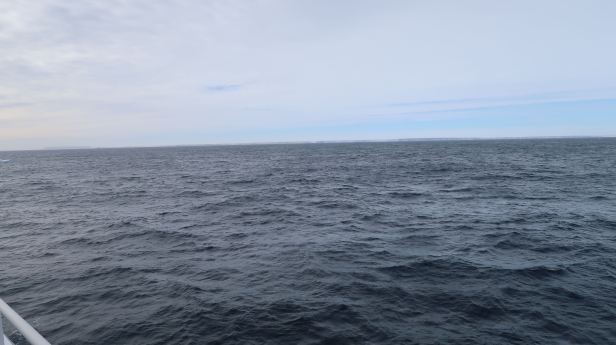
Anyway, as we approached, there was a discernible “corner” to the cliffs we could see to our front-right. That meant the huge iceberg stretched as far as the eye could see, presumably to the horizon, on our left. As I said earlier, it was staggeringly immense. Our course took us around the corner we could see ahead and then along what I can only call, from my earlier attempt at orientation, its right-hand side.
Maybe there are some unforeseen effects associated with an iceberg of this size. As soon as the sun rose properly, the warmth/cold combination caused a thick fog to arise which completely obliterated the whole view of the ice wall. We sailed along, with the big ‘berg somewhere off of to the Port side. We could not see it – but it was there. I hoped the radar was working well – and that, because there usually seemed to be nobody at what the nautical folks call “the helm”, our elusive captain was actually driving !
The mighty A23A never reappeared and eventually we left both the fog and its concealed behemoth, somewhere astern on the Port side.
AUTHOR’S NOTE
Iceberg A23A finally grounded about thirty miles west of South Georgia on March 4th, 2025.
We were now en-route to Elephant Island, where the crew of Shackleton’s ship, “The Endurance” was marooned in 1916. The vessel itself, after being trapped in the pack ice of the Weddell Sea for some months, finally sank. This was instrumental in the whole crew, in three life boats, making a harrowing journey north until, unable to go further, they landed on Elephant Island. After strengthening the best lifeboat, the James Caird with parts from the other two, Shackleton and five of his twenty seven man crew made their epic seventeen day voyage, in an open boat, all the way to South Georgia. A distance of eight hundred miles (thirteen hundred kilometres). It is generally regarded as the greatest open boat sea crossing in recorded history. Alerted by Shackleton, a rescue was launched to Elephant Island. Because of pack ice, the ships took over five months to get through. Every man in the crew survived.
At sea, the expedition staff gave lectures about what we had seen or were going to see.
Koen, gave a quite fascinating talk on whales. It was quite long, because there are a lot of types of whale, but it was delivered with an infectious mix of deep knowledge, humour and something almost akin to love.
Whales are basically divided into those that are vegetarians and those that are predators. Most whales feed mainly on crustaceans, which they filter and eat. A whale can filter and eat up to two tons of Krill a day. The largest Blue whale that has been documented (think “Moby Dick”), measured almost 30 metres in length and weighed 199 tons. The blue whale is also the largest animal ever known on earth. It was stated that Blue whales are so rarely seen that, if any of us managed to spot one on this expedition, there would be a reward !
At the end of the lecture, Koen showed us photos from his own diving with whales experiences. In one of them, another diver had taken a picture of him about a metre from the head of a Humpback whale. He was holding a camera in his hand and the two were looking directly at each other. He said that it was an absolutely incredible moment. Koen said that, given the size ratio, he first instinctively swam away. The Humpback whale came closer again, looked at him and sang. Then it gently lifted him to the surface its snout before swimming away. Koen said that everyone can think what they want, but he is absolutely convinced that the whale was trying to communicate with him.
He also played some whale songs for us and explained that each species has a different type of song. It is also thought quite possible that each pod also has a different song, just like we have languages and dialects.
The key “takeaway” point was that all dolphins are whales – but not all whales are dolphins.
Koen was followed by Szymon, who has a particular passion for Orcas and gave us a lot of information that we might not even have ever considered. We used to call an Orca a Killer Whale, but it transpires that this was actually a mistranslation of the Spanish “ballena asesina” which means whale killer. It was named by sea-faring Basques who had seen the Orcas (which are actually big dolphins) killing their far bigger cousins. An Orca can swim at up to fifty-six kilometres an hour, our boat had a maximum speed of around twenty. The brain of an Orca weighs over ten kilograms and, in an organ where the number of folds (and believe me, there is an official scale of measurement for them) counts towards reaction time, it gets a score of 5.7. A mouse scores 1.6 and a human 2.2. You guessed it, in the speed of neural transfer, humans are only just above mice and way, way, short of Orcas. The stuff we know !
Orcas are very clever and pods are families and led by the senior female. Young males need to mate with females from another pod. They are known to use a number of different tactics when they are hunting, which they adapt according to the situation.
There are a number of videos of this on YouTube (not taken by us !). A good one is
https://m.youtube.com/watch?v=fs8ZveNZQ8g
They prefer to eat Weddell seals and will actively ignore seals of other species ……
Lunch was, mercifully composed of food that I did not really fancy eating, so I went with a salad.
After lunch, Lucie decided she wanted a nap, so she missed Susie’s talk on Krill. It may sound more boring than embroidery but, in reality, it had a great number of fascinating facts.
The Krill is a tiny crustacean that, besides having a very weird and wonderful life-cycle of its own, manages to figure in the life-cycle of more or less every creature that lives in the Antarctic, except our old and elusive friend, the South Georgia pipit.
Blue whales and their cetaceous relatives strain them from the sea by the ton, seals eat them, penguins eat them – and the things that do not eat them directly, gobble up the other things that do ! A Krill is a tiny creature with a huge impact. Unfortunately, Krill is now being fished commercially for things like its Omega 3 content and to add colour to farmed salmon which would, otherwise, be white. This fishing has increased to the point where it is becoming an issue to the whole eco system. Benjamin Franklin said it first and I did in my writings about Buenos Aires, “For want of a nail !”
Our next treat was a showing of a film about Shackleton’s daring deeds mentioned above. It was a clever mixture of modern cinematography and archive footage shot by the camera man of the actual expedition, Frank Hurley. In detail, the depiction of the events somehow seemed even more heroic than mere reading had made them. The film had been slightly “doctored”, no doubt to suit the Americans in the audience. The numerous husky dogs in the archive footage suddenly ceased their appearances. The crew ate them, but this was not mentioned. The voice of Sir Earnest, when excepts from his diary were being voiced-over, was that of Sir Michael Gambon. I could not help it, I kept thinking of Albus Dumbledore !
The daily round up only lasted about five minutes, because all we had really done was sail sedately up to the world’s largest iceberg, pop around its edge – and then spend a few hours wondering whether it was about to erupt from the fog of its own creation and crush the Plancius like a tiny ant. Of course, that last part could have just been me.
Then we had a couple of eco “pep talks” about conservation issues in South Georgia – the eradication of rats and the worrying decline in numbers of, you guessed it, the South Georgia pipit !
The aim of the above talks was to loosen our purse-strings for an auction in aid of the future conservation works. The proceeds would go to the South Georgia Heritage Trust.
An auction is a weird thing. Almost everything on offer had come from the souvenir shop in Grytviken – where Lucie and I, after a careful perusal, had decided there was nothing at all that we wanted. People who had all been in the same shop battled with each other to pay far more for the same items they could have already had. Eco-Ego, maybe ! It was a bit surreal. In case you think we are stingy gits, when we were unable to find anything in the shop we wanted, we had made an unostentatious donation.
Then, it was time for the dinner – and there was a more than passable fish and chips ! Hooray !
Life was good !
 Travels with my Harley