Saturday, January 25th, 2025
Unsurprisingly, after the rigours of our hike, I do not even remember actually closing my eyes. I sleep well as a general rule – but this was probably “extra” well.
Although I am not what I would call a “fretter”, I must, subconsciously, be one because, when I know that I have to get up early, my brain always gives me a prod ahead of the alarm. We had set our alarm for 05:00, to avoid being blasted from our slumbers by Ali’s dulcet tones over the tannoy. My brain though, had its own agenda and I was wide awake before 04:30. Strangely, so was my good wife.
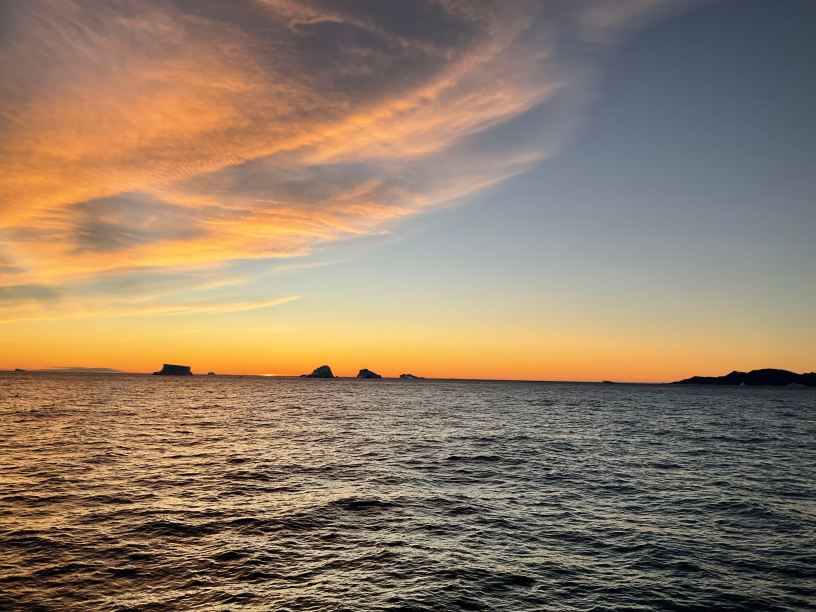
When we opened the curtains, it was starting to get light, but the sun had not yet risen. Nonetheless, it was more like looking at a travel poster than looking out of a window.
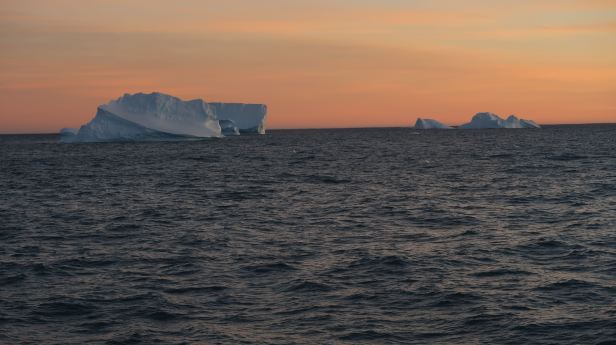
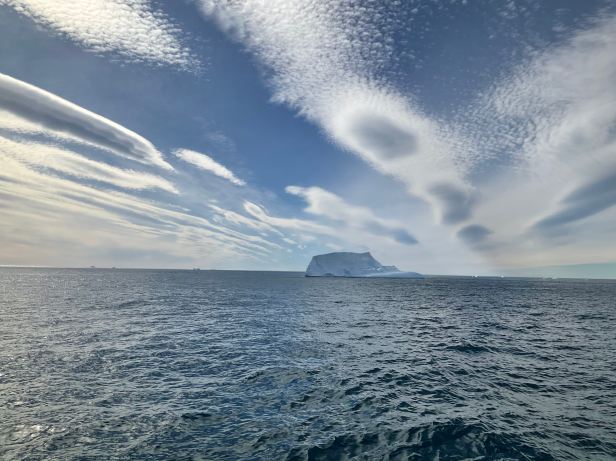
 There were some fairly substantial icebergs in the middle distance on the Port side which, as we we were slowly chugging south, it meant we were looking east. The first glow of sunrise suddenly began to illuminate the horizon, so Lucie and I grabbed her iPad and the camera and went up on deck.
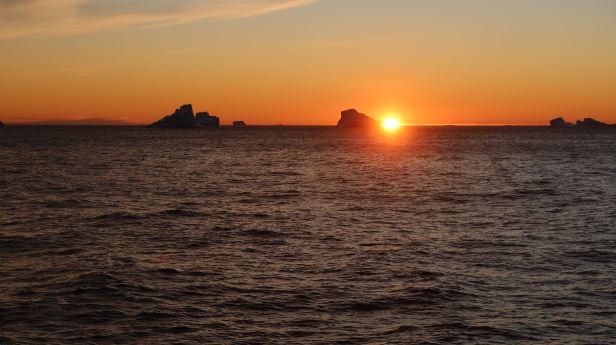
There were icebergs everywhere. The South Georgia coastline, on the Starboard side, was an almost kitschy line of snow capped mountain peaks and glaciers – but the air was so warm that I scarcely needed my fleece.


We snapped the sun rising between the icebergs. It was so lovely that I was sure that I could feel my heart beating. Apart from Lucie and I, there was just one other photographer.

Everyone else in board missed one of the most beautiful sights that I had ever seen.
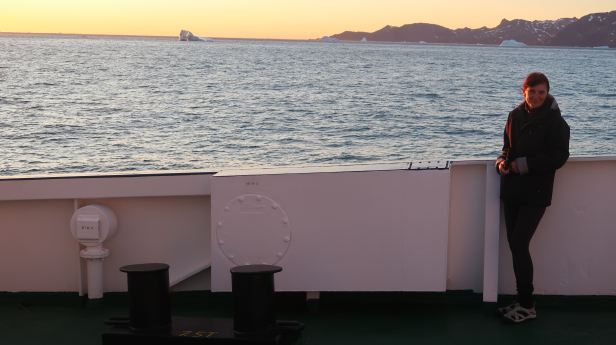
A snack type sub-breakfast was served in the lounge to prevent us all dying of hunger (and becoming breakfast ourselves for the prowling skuas) whilst on the beach. Then it was time to suit-up, it is amazing how quickly we could do it by then, before jumping in the Zodiacs and heading to the beach of Gold Harbour.
Gold Harbour
According to the ship’s log, our position was 54°37.3’S / 35°56.1’W
I had thought that I might be getting a bit “penguin happy” because what else could they reasonably be expected to do ? But I was wrong – they just had that uncanny knack of being constantly amusing.
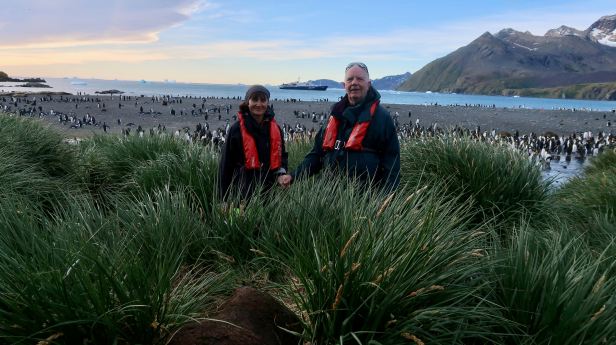
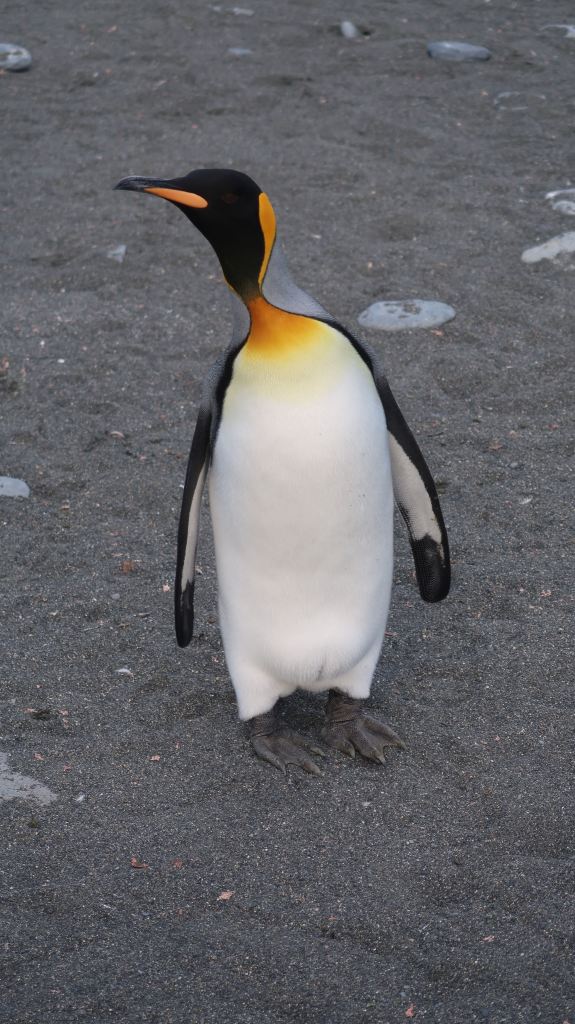
Gold Harbour beach was quite a narrow strip of sand, backed, as ever, by a thick tangle of Tussock grass. Even on the sand, it was difficult, if not impossible, to maintain any distance from the wildlife, so we were instructed to move slowly at all times. Two King penguins were actually pecking at our Zodiac as soon as we disembarked.
Both Elephant and Fur seals were in the Tussock grass. Some were in plain sight. Others, particularly the more active and aggressive Fur seals, were lurking out of sight, ready to disconcert the unwary who strayed too far from the marker poles.

The narrowness of the sand bar, though, meant that most of the seals, together with thousands of King penguins, interspersed here and there with their Gentoo cousins and the constantly lurking skuas, were all quite close together. The whole thing was like a microcosm of everything we had already seen in South Georgia, but so tightly packed together that you could revisit everything without even having to move your head. All of this was in front of an almost magical backdrop of mountains and waterfalls.
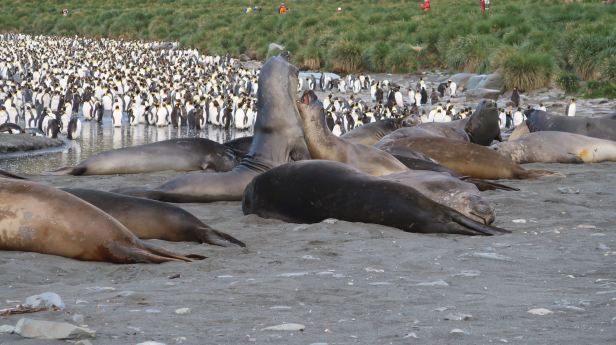


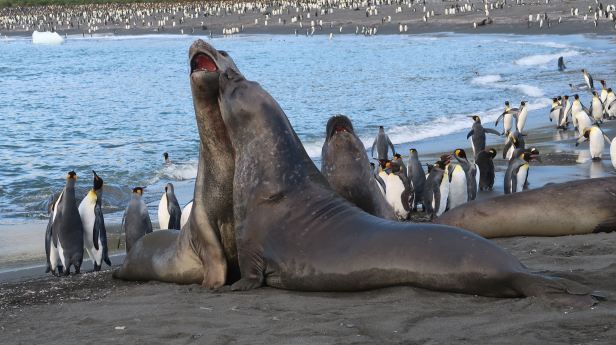
The young Elephant seals on the beach were again often engaged in some frantic bouts of training for their future supremacy battles. Most of us have seen it on television, but in real life, despite the fact that they were not fully grown males, it was awesome to behold.
To the joy of the “birders”, we saw a new species of petrel, the Snowy and then, to what can only be described as their collective and breathless delight, a South Georgia pipit was also spotted ! Spotted might actually be a slight exaggeration. The fact that it was brown, tiny and so far away that it was only visible through powerful binoculars or a ten foot long camera lens did not detract, by as much as an atom, from their glee. Someone helpfully pointed it out to me, so, were I the type to keep lists, I could have ticked that box. However, whilst I did see it flit, in truth it was so far away and so tiny, that it could easily have been a mosquito !
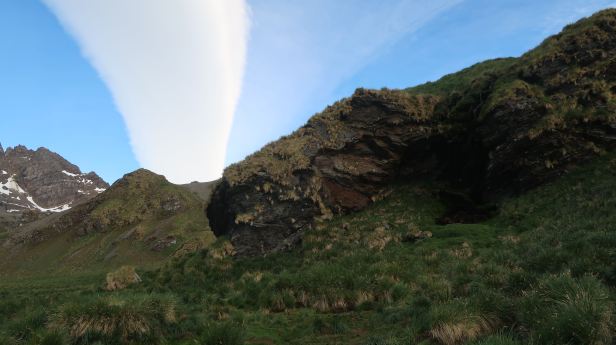

The whole panorama was simply breathtaking – birds and animals wherever you looked.


Back on board, we had a proper breakfast (Weetabix and poached eggs on toast). An American guy, Charles, from the USA somehow managed to infiltrate our table because Wanda was still doing cork impressions somewhere out on the increasing swell in the bay. I had thought it was only us British that are obsessed with the weather, but Charles had an iPhone that was taking pleasure in letting him know that, back at his home in Minnesota, the temperature was minus eighteen centigrade. Outside our window, in the Antarctic, it was plus eight of the same scale ….
Whilst we were eating, the Plancius moved off in the direction of our next destination, Cooper Bay, where we would have another “Zodiac cruise”. Almost at once a large pod of Humpback whales was all around the ship. They were not as obligingly docile as their cousins in Kaikoura had been, instead they were a blur of rapid, collective, movement. It was the classic scenario that, if you saw one, it was gone before you could even grope for your camera. As a consequence, whilst I saw a lot, maybe as many as twenty, they were usually too distant and/or too quick to capture. At one point, a group of four did the “tail thing” one after the other – and I have no photos. Lucie did manage to video some action with her iPad, but it was still a long way off.

We anchored in Cooper bay and we were again split into two groups for the cruise. Unaccountably, group two (the poor people from steerage) were allowed to go first this time. Perhaps there were hungry Orcas near the ship. Who knew ?
Cooper Bay
Our turn came, we got the call and suited up yet again. The Zodiacs returned and disgorged (a popular term in these parts, particularly with penguin chicks …) the poor people. They all seemed to be still there. Our driver was Tiphanie, so there was no collision drama at boarding. We got straight on board and away we went.


However trite it may sound, this holiday just kept on giving. Our first destination was actually a small, secondary bay just around the headland. Tiphanie, who first steered a bout when she was only ten years old, expertly guided us over a shallow reef and into “Chinny” Bay. It has that name because it contains the most northerly colony of yet another species of penguin, this one the Chinstrap. The plumage is black and white, which, as they are penguins is not really that surprising. The white front, on this species, is interrupted, just below the head, by a line of dark feathers, hence the “Chinstrap”. They also have pink feet.
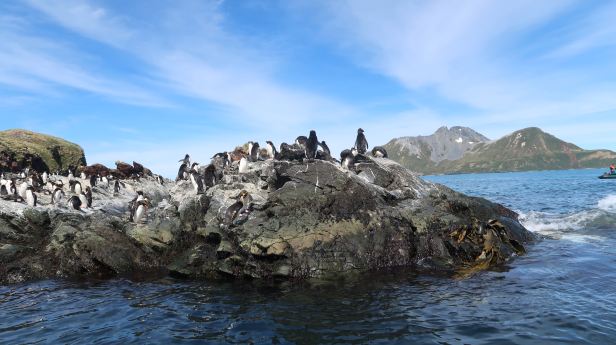
Oddly, Chinstraps are argumentative, even amongst themselves and although they still co-mingle with other species, they are markedly less social. Having said that, although the Chinstrap colony proper was at the top of a slope, some way from the beach, there were four penguin species, Chinstrap, Macaroni, Gentoo and King, all milling about on the shoreline.

Penguins never fail to delight. There was the tiny remains of an iceberg, bobbing in the shallows of the bay. The Chinstraps were laboriously climbing up it – then just jumping off again. It was hilarious.

Swimming around in the bay, with a vigour that made it almost impossible to photograph, was a Leucistic Fur seal. This was not a separate species. Leucism is a genetic defect that renders just the fur a light shade, a sort of creamy white. It is not albinism. Although a number of these are born regularly, few survive, as this one had, to adulthood. This is not due to health reasons but more because the light colouration renders them easier to see and makes them easy prey for Orcas, Tiphanie said that is also why penguins have white fronts and dark backs. An Orca in the sea below a penguin looks up and sees white, similar to the sky – an Orca above one, looking down, sees black, like the darkness below.
Next we motored back to the main bay and trailed along about fifty metres out from the sand. The Fur seal population in this particular bay had been severely affected by the avian flu and, compared with other places we had seen, the fauna was a bit sparse at the water’s edge.
Tiphanie manoeuvred us deftly around a large iceberg that appeared to be grounded in the shallows. Its dappled surface was indicative that it had flipped over more than once as it slowly melted.
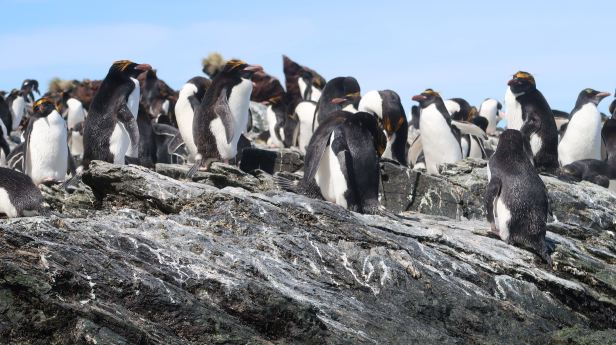
On the other side of the bay was a large colony of Macaroni penguins, starting high on the slopes of a rocky gully and coming right down to the water’s edge. Because of the way the rocky ledges were formed, we got really close to these. Close enough, in fact, to be able to see (and, of course, smell) the adults regurgitating partly digested food into the beaks of their rapacious chicks.
After that we returned to the Plancius. The swell out in the bay was noticeable, but not unpleasant. When we were trying to disembark, the same wave motion was actually moving the Zodiac up and down by around a metre, relative to the gangway. Tiphanie and the crew handled this as if it was nothing unusual and nobody, not even me, fell in.
Due to it being a two phase lunch, the steerage passengers had already eaten and the dining room was half empty. The same could not be said for me, half an hour later, after a splendid luncheon of soup, pasta and fruit custard.
Drygalski Fjord
By then the Plancius was en-route for our final treat of the day and, sadly, what would be our last view of South Georgia before resuming our voyage to the south.
This would be the scenic Drygalski Fjord. On the way there we passed countless icebergs which were pretty scenic themselves. The fjord extends about fourteen kilometres, deep into a gap in the mountains. It is named after a German explorer. At the far end, where we could finally go no further, we anchored between two separate glaciers that were once joined together. Ali, over the tannoy, announced that the water we were in was once part of the conjoined glacier, but was quick to point out, for the peace of mind of nervous American passengers, that did not mean we were sailing in “uncharted waters”. The water beneath the keel was also five hundred feet deep.


The mountains flanking the fjord were up to two thousand feet high and, on remote, inaccessible ledges, the Snowy petrel makes its nest. Geologically, these mountains are the oldest part of South Georgia and the ancient, very black, non-sedimentary rocks were once part of the super continent, Gondwanaland.
For information, Gondwanaland consisted of today’s South America, Africa, Arabia, India, Australia and Antarctica and was formed six-hundred million years ago. An even larger supercontinent, Pannotia, separated into Gondwana, Laurentia, Baltica and Siberia. Pannotia disappeared and Gondwana remained. At that time it was the largest continental block on the planet and stretched from the South Pole to the Tropic of Cancer in the northern hemisphere. During the Paleozoic era, smaller subcontinents began to separate from Gondwana but even in the Mesozoic era, it was still possible to get from southern Gondwana to Greenland on dry land. Fossil evidence proves that some dinosaurs did this.
Surrounded by history so ancient it made my head swim, I stood on deck as the Plancius turned carefully around and sailed back up the fjord. As we proceeded, I saw, for the first time, another vessel at sea. It was a big, multi-decked liner. Like us it was on a visit to the far south, but probably as a cruise, not as an expedition. When it came to the last bend before the glaciers, it hove-to (as I mentioned, I did learn some nautical terms) because it was too large to go all the way in. All that extra money and those on board got less than we did !
I stood at the back of the boat (what the nautical types call the “stern”, lest I commit another breach of contract) and slowly watched the glaciers, towering, snow capped cliffs and the lighter blue areas of water caused by glacial melt, recede into the distance.

I loved South Georgia. I would not want to live there, it is too remote, but as an oasis of natural wonder, it surely has few, if any, peers.
Almost as soon as we left the fjord, the whole ship was surrounded by a huge pod of Orcas. There must have been at least fifteen and they quite literally frolicked in plain site of us all for about half an hour. Lucie managed to shoot a couple of great videos with her iPad before we finally left them behind. The expedition staff were as excited as we were. One crew member said he had never seen anything like it in over twenty years at sea.

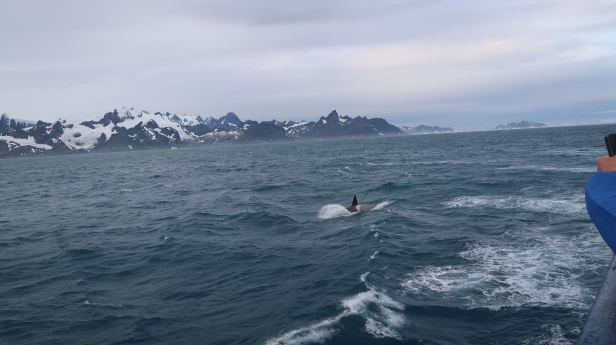
Slowing down to view the Orcas had disrupted the schedule a little and the evening briefing turned into a little party to celebrate our 100% score with the bio-safety regulations. We all got given a glass of prosecco.
We then faced another couple of days at sea. We were told that, if the weather held (we had also been told that so far, it had been exceptional) we might get to land on somewhere called Elephant Island – but that would be in the future. We could only wait and see with that.
What we were going to do, for sure, was to set a course that would bring us within sight of the notorious giant iceberg, dubbed A23A. This had broken off from the Filchner ice-shelf almost forty years previously, in 1986. It grounded almost at once and got stuck for many years, before floating free. Then it became entrapped in a current vortex for several more years. Now free once again, it was heading for South Georgia.
A23A had a surface area of over three thousand five hundred square kilometres (twice as big as Greater London) and was estimated to weigh up to three trillion tons ….. Yes, TRILLION !
At the time, its approach to South Georgia had recently sparked a number of scare stories in the media – even the BBC seemed to have joined in the eco-threat frenzy.
People on the Plancius who knew people in the South Georgia part of the British Antarctic Survey, insisted that the stories were mainly sensationalist rubbish. It would ground, long before it hit the island, the southern/western coast is constantly buffeted by the “Roaring Forties” winds, so most of the wildlife is on the north/eastern coast. The same strong winds and warmer seas would soon break it up. It WOULD make the islands a little colder, but that might not be a bad thing and it would change the salinity levels of the seas. That last thing was the only impact it was considered that might have any sort of adverse effect.
Anyway, we were told we should see it the next day, watch this space.
AUTHOR’S NOTE
Iceberg A23A finally grounded about thirty miles west of South Georgia on March 4th, 2025.
Dinner continued in the same cheerful spirit, which was mainly ensured by Wanda at our table, who had not only downed two proseccos but also ordered some wine. Before we had even finished dessert, the whole ship came alive again. A pod of a previously unobserved whale, the Long-finned Pilot whale, had appeared around the ship. It was already getting dark, so it was impossible to photograph them. If you care, like a lot of whales, they are related to – and look a bit like, dolphins.
That night, our westerly course meant we would get our hour back. My iPad had never changed, so it would be correct again, but how long it would take our iPhones and Lucie’s iPad to readjust again, who knew ?
It had been a very long and incident packed day. I typed this and went to bed.
 Travels with my Harley