
Wednesday, January 22nd, 2025
The Log Book entry for today said: “the sea is slightly rough, seals are staying close to the ship, the first iceberg has appeared on the port side”
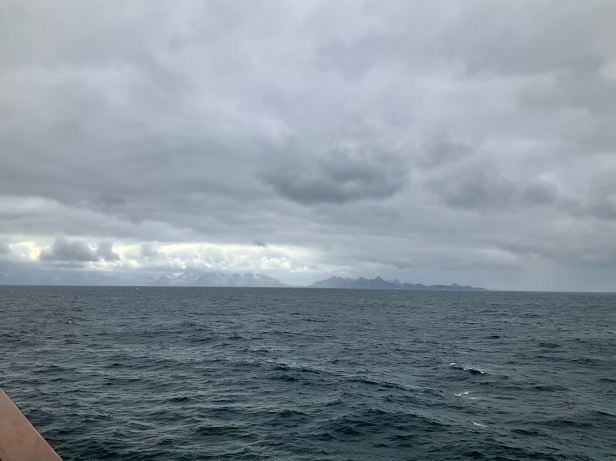
I did not wake up at 04:30. In fact, I slept so deeply that, for the first time since I came on board, I was awakened from my slumbers by the ship’s tannoy. After another night with the curtains closed, we opened them to reveal the first sight of South Georgia.
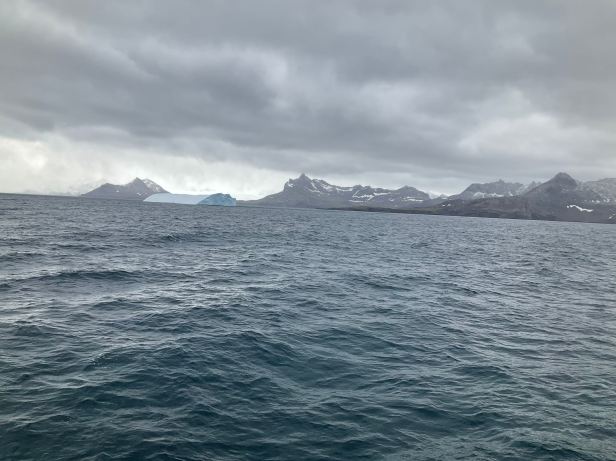
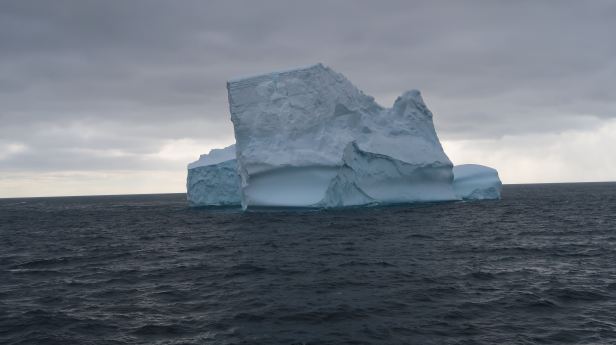
This was followed, a few minutes later, by our first iceberg ! It was not, in truth, some huge, Titanic threatening, behemoth, but it would not have fitted into the bottom of a crystal glass either ! Wow ! I think your first iceberg is something you will never forget !

We had passed into the lee of South Georgia which, because of the prevailing wind direction, was its eastern side. The main island and the smaller offshore ones are, in fact, the peaks of an undersea mountain range. Although not that high above the sea, the general chill and cold means that the peaks are snow-capped. The blue-grey sea was a lot calmer, but only in nautical terms, the wind was still around twenty-eight knots out there. A brief spell on deck also revealed that it was rather cold. The wind was very chilly indeed. I thought that I might need my hat when we landed !
Breakfast (weetabix, poached egg and fruit salad – Bingo people) was eaten in an air of almost breathless anticipation. As I have already remarked, none of the other passengers that I had spoken to thus far were exactly novices at what is now termed “adventure travel”. That said, you could almost touch the collective excitement. One Chinese lady, Wanda’s cabin mate, Ya Ping, commented that the Antarctic “is the last place that most people go”. I certainly hoped that was not the case. Clacton was still on my list and I would not have wanted to miss going there !
We were still passing icebergs, one was of a considerable size. The wind conditions, last night while we were sleeping, meant we were a tiny bit behind schedule. According to the tannoy, we should be ready to play in the Zodiacs at around 10:45. It was all about to get very real !

Right Whale Bay
According to the ship’s log, our position was 53°51.9’S / 038°13.2’W
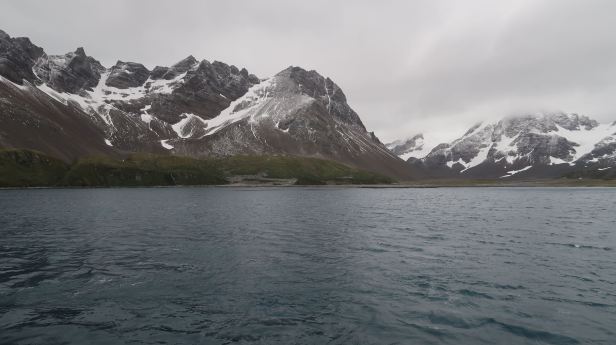
The call came and we togged up. We were getting better at it, so it did not take long. I even put on an extra layer and then we joined the slow shuffle towards the gangway. The sea was surprisingly smooth, but there was a fierce wind whipping across the surface. It is hard to describe exactly how I felt as we droned across the bay. There were snowy peaks on all sides and it was already possible to discern King penguins and Fur seals all along the approaching tide-line.

We pulled onto the black sand and into a small gap between creatures that we had only previously seen in wildlife documentaries. By virtue of her seating position, Lucie was first out into the waves and, because the first lady on the other side was a bit slow, I was the second. We made our way to the life-jacket storage bags by literally picking our way through inquisitive Fur seal pups. It was all a little surreal and we were still less than ten yards (British Protectorate) from the Zodiac. The guides had emphasised that we should try and keep at least five yards from the wildlife but, quite frankly, it was impossible.
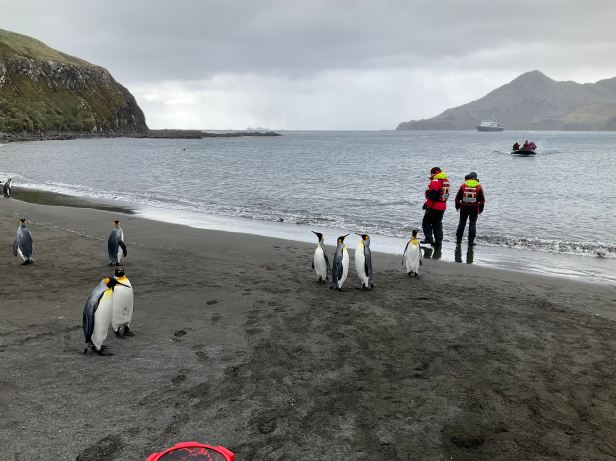


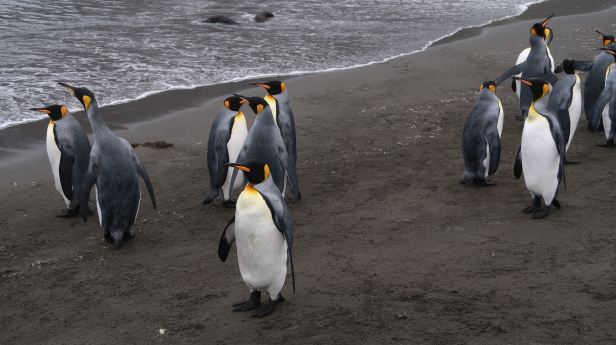
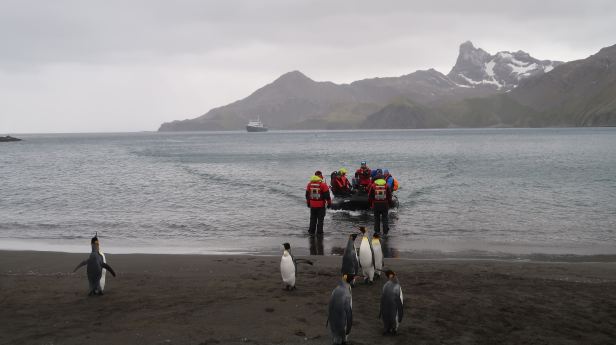
We were in a place called Right Whale Bay and, backwards from the high-tide line, the land descended into a flattish valley below the mountains. Streams, with pools in places, crossed the low lying ground. Everywhere and I really do mean everywhere, there was some exotic mammal or bird. Fur seals, in all stages of development, were scattered across the sand, in the pools or amongst the ubiquitous Tussock grass. We even saw a young, Leucistic Fur seal. This is a white variant that is not an albino. Sadly, the light colour of their fur means that they are far more likely to be predated upon and few live to adulthood.

Fur seals are an aggressive species, even down to the tiniest pups and many came humping towards us in what (to another Fur seal) could have been construed as a threatening manner. Standing tall was normally enough to bring them up short and we had been advised that raising a boot would also deter them. Whilst I did stand tall, rather than raising a boot, I merely stated clearly to any onrushing seal that I needed a new pair of gloves. That did the trick !
The seals were interspersed with groups of King penguins often dozens strong.

The main King penguin colony, however, was on the beach and slopes to the south and this ran into the tens of thousands. It was a veritable sea of black, white and orange. There were youngsters of various ages in different stages of moulting. These ranged from the brown, downy fluff of the chicks to the older, but still not mature birds, having their final moult before achieving adulthood. All around was the trumpeting and braying of various birds.
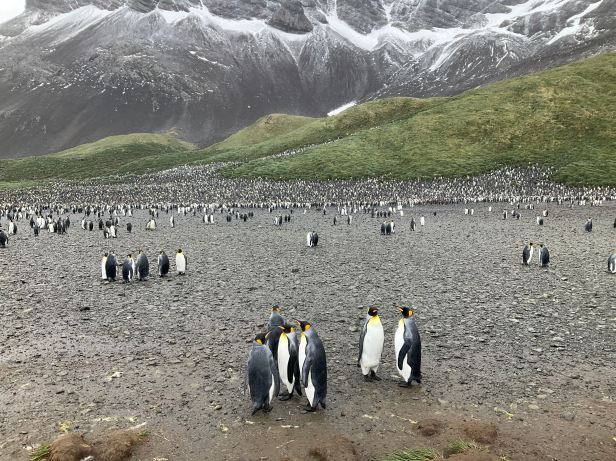

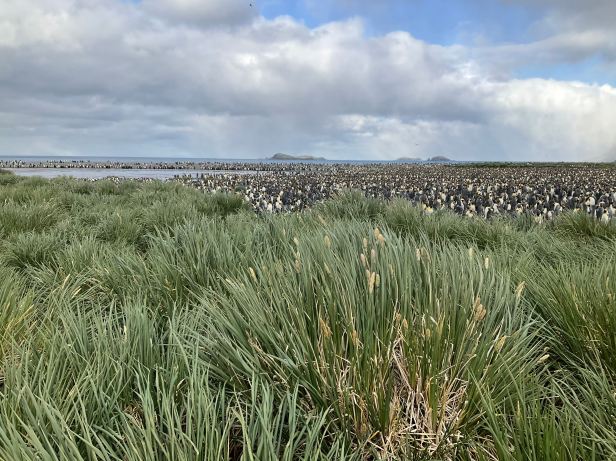

The wind was stiff, with occasional bouts of stinging, sleety snow. This had the effect of largely negating the awful smell usually associated with a penguin colony.
There was the odd dead seal or penguin, laying here and there. Whether they had died from natural causes or from avian flu, we could not tell. The carcasses were providing lunch for the large Giant petrels and groups of skuas that patrolled continuously backwards and forwards.
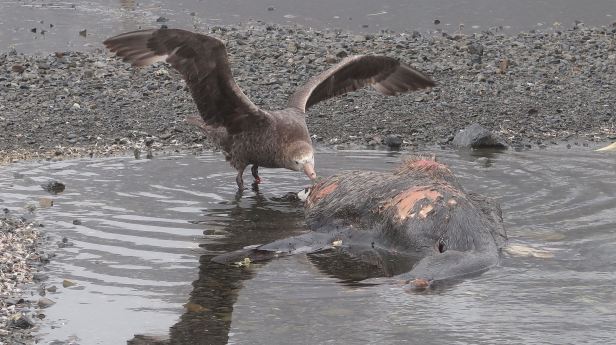
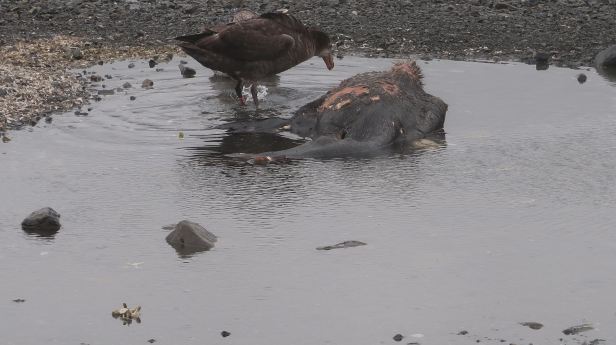
Here and there, were Elephant seals, but only females and juveniles. The huge, four and a half ton, males were presumably somewhere out at sea. There were sections of whale vertebrae scattered along the beach. Their huge size providing testimony to just how big a whale, in this case presumably a Right whale, can be. I could go on like this for hours, but could scarcely add anything significant to what I have written. By the time we re-boarded the Zodiac for the ride back to the Plancius, we were both in a stage of magical enchantment.
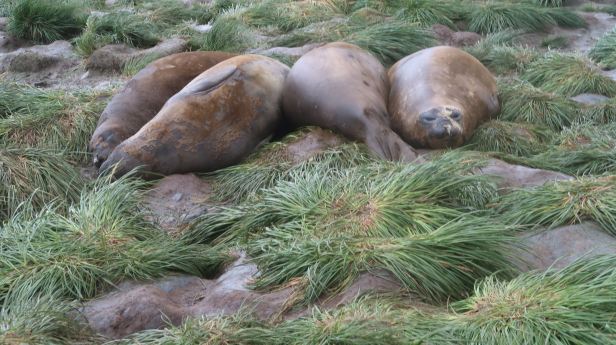
Once we had decontaminated, including taking a paper clip to the logos on our boots, of course, it was lunchtime. Although I could not have been, I felt hungry and it was most welcome. The Plancius, meanwhile weighed anchor and set off south again in the direction of another landing site called Salisbury Plain.
After lunch, we dressed up again. It was quite a palaver, but I will say that not a drop of moisture made its way through my clothing at any point and, despite the very high winds and occasional bouts of driving sleet, I was never even the tiniest bit cold.
Salisbury Plain
We landed without drama. It was amazing just how quickly climbing into a small dinghy, in what we would previously have thought were slightly risky conditions, had become commonplace. The terrain was a bit different to that of the first landing. The plain was a lot greener than Right Whale Bay had been, with Tussock grass in the distance. Only the awesome backdrop of mountains and glaciers was the same.

The prime reason why we went to Salisbury Plain was its immense colony of King penguins. The considerable numbers we had seen on our first outing on shore simply paled into a paltry insignificance when we got there. There were small groups of Kings scattered across the plain and quite considerable numbers of fur seals too.


The vast main penguin colony, on the southern side of the bay, contained a simply mind-boggling amount of birds. It was estimated that there were in excess of seventy thousand breeding pairs. That is a fairly simple sum to calculate. The King penguin chick, however, has a two year trip to maturity, so there were also countless, year old, juveniles plus, of course, there were this year’s chicks, mostly still in their brown downy fluff. They do not all, sadly, survive and some adults could be seen fishing in the waters of the bay. There was much debate on the actual number there, but my estimate was that at least one hundred and fifty thousand birds could be seen in one glance.

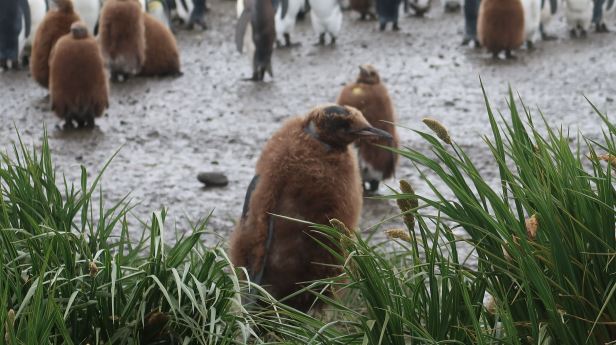
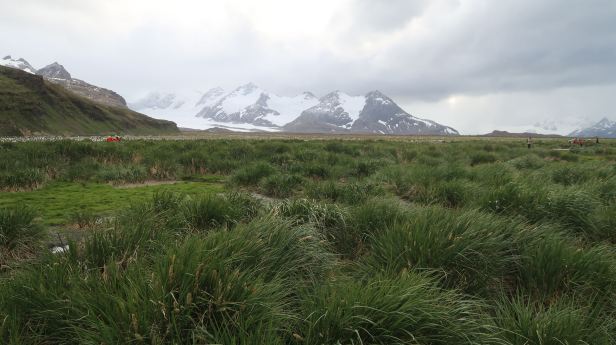
Most of us have seen shots of colonies like this on television, but nothing that I have ever seen comes close to the reality. As a lover of hyperbole, I will go for jaw dropping and awe inspiring. Breath taking, I will omit, because even in the strong wind, the stench from such a huge colony was considerable – and breathing, of any gradation, was not something you really wanted to do when you were close to it! I think it is safe to say that the sight will remain with me always. I WILL try and forget the smell, but I am unlikely ever to be successful.
We wended our way back across the plain. It was still a bit overwhelming to be so close to everything.
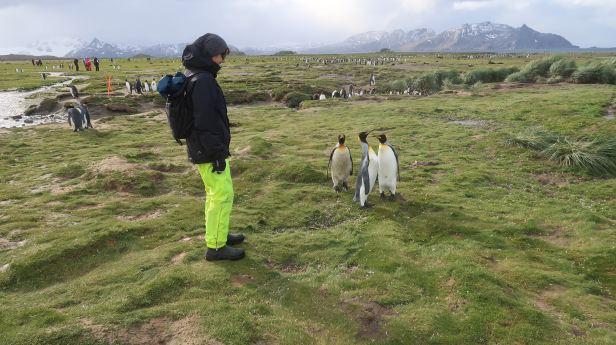
 We had been cautioned not to get too close to the wildlife. Sadly, or perhaps luckily, depending upon your point of view, the wildlife had not been cautioned not to get too close to us. Most penguins simply ignored us and just went about their penguin lives as if we were not there. Some, though, were as interested in us as we were in them. Not all the creatures, in this shot, for example, are King penguins.
There were again, sadly, quite a few carcasses of both seals and penguins on the plain. How much was due to natural wastage and how much was due to avian flu cannot, I am certain, be calculated. Nonetheless, to be on the safe side, the cleaning regime both before and after boarding the return Zodiac was very rigorous indeed. Penguins, swimming in the shallows, watched our efforts !

This rigour was, in a way fortunate as I had managed to get something that I can only describe, in the interests of complete accuracy, as penguin shit, on the back of my trousers. Naturally, we still needed to also check our boot logos and Velcro fastenings when we got back to our cabin.
Various delays had destroyed the daily schedule, so a buffet style dinner was enjoyed before the daily briefing.
The following day, we were told, we would get a Zodiac “cruise” in a quiet, narrow bay where we should be able to view the elusive Macaroni penguin. This species tends to nest on precipitous cliffs (probably to avoid the amorous attentions of Rockhoppers) and can only really be observed from the water.
In the afternoon, we would land at Grytviken, the capital of South Georgia. It seemed our passports (or the skilful forgeries) would be stamped, before we would be allowed to land. On shore we would be able to see the grave of Sir Earnest Shackleton, the great explorer, we would be able to send some postcards and we could buy some souvenirs. Plus, of course, some of us would have our bio-safety preparations microscopically examined by government officials before we could leave the boat ……
That was it for the day. I went back to the cabin to tweezer my Velcro …..
 Travels with my Harley