Friday, January 24th, 2025
Today the Log Book entry read: “The sea is calm, ice floes are floating around the ship“
After another night with the curtains closed and, once again spent rocking at anchor in a quiet bay, I woke up early.
I have mentioned that South Georgia is in a different time zone to the Falklands. Lucie’s iPad had apparently realised this, but our iPhones and my iPad had not. Then Lucie’s ‘phone caught on – but mine did not. Anyway, when I woke up, I checked my ‘phone and it said 04:30 so, assuming that to mean 05:30, I got up to go and have a cup of tea – only to discover that somehow in the night, my iPhone had corrected itself. It WAS 04:30 ! My iPad remained, with stolid resolve, an hour behind. You have to love “First World problems” !
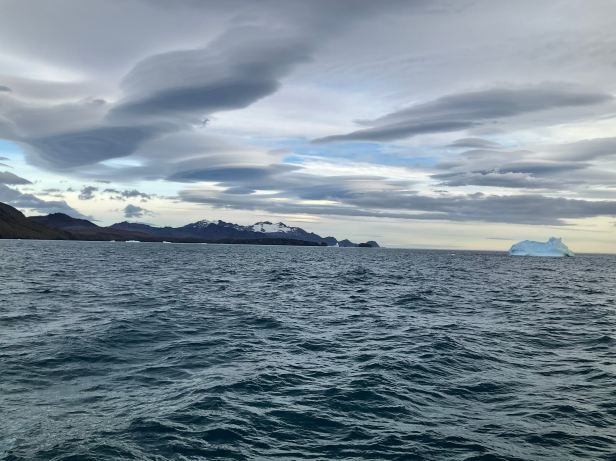
I did not mind the early rise though. The Plancius was, by then, moving to our next destination. so I got to spend a quiet hour in the lounge watching the coast slide very slowly by as it got light. South Georgia does look like “the land that time forgot”. Perhaps its repair efforts, which have actually reversed some of the damage wrought to its eco-system by mankind will eventually make it “the land that time remembers” !
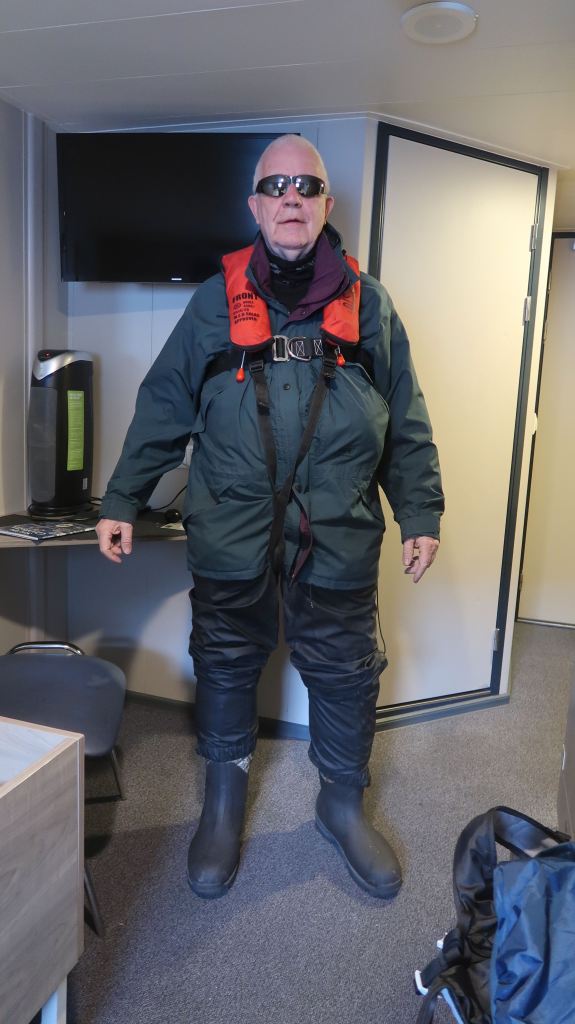
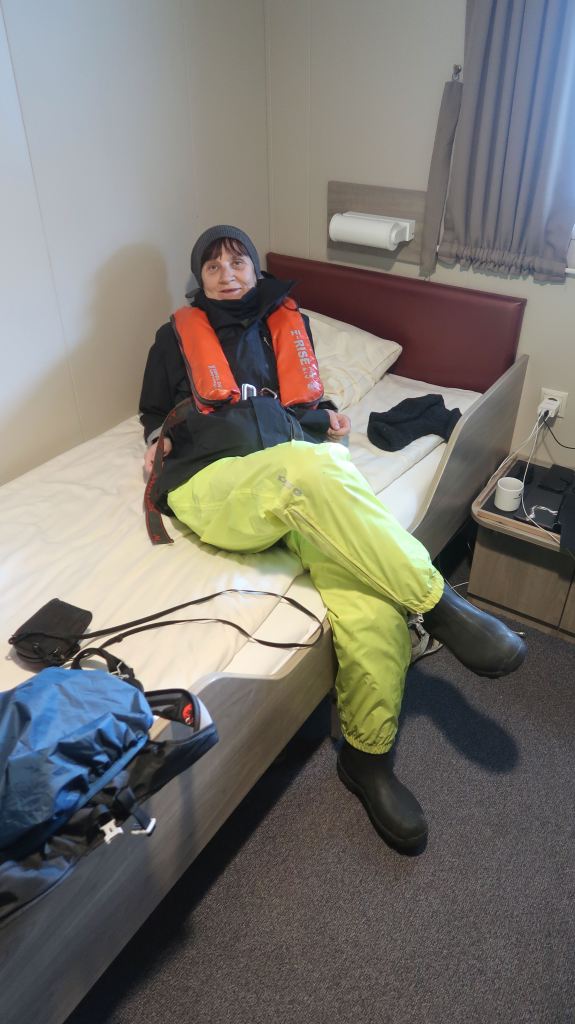
After a prompt breakfast (Coco-Pops and fruit) we had to suit up, as always, for our morning’s fun. The rubber boots are tight and not easy to get into and, as usual, Lucie helped me with that bit. Also as usual, she asked me which boot I was going to put on first. Is there, I wondered, no Czech version of “The Hokey-Cokey” ? You put your LEFT leg in ! Anyway we managed ….
Saint Andrew’s Bay
According to the ship’s log, our position was 54°26.1’S / 036°10.4’W
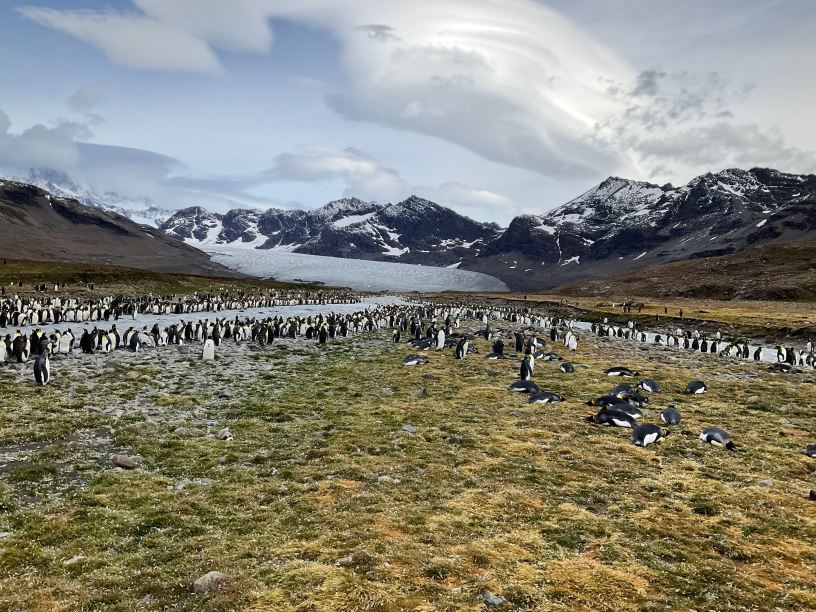
We landed in Saint Andrew’s Bay, which was another wide plain backed by mountains and glaciers. The beach had the customary steepness from the tide-line, but then fell away to a grassy expanse which contained the odd rocky outcrop and undulation. There were King penguins everywhere and it was quite difficult for the expedition staff to find a place to even land the Zodiacs.
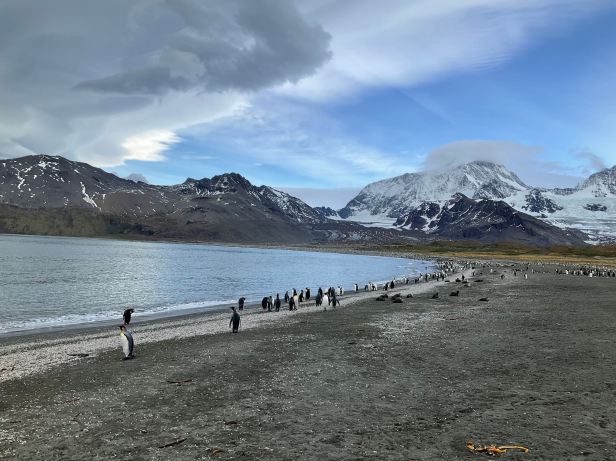
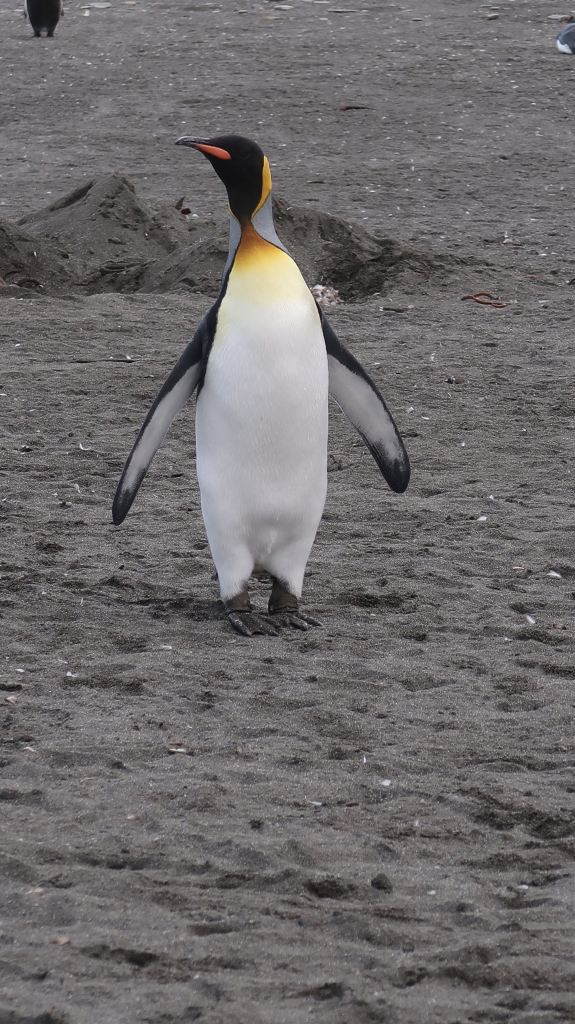
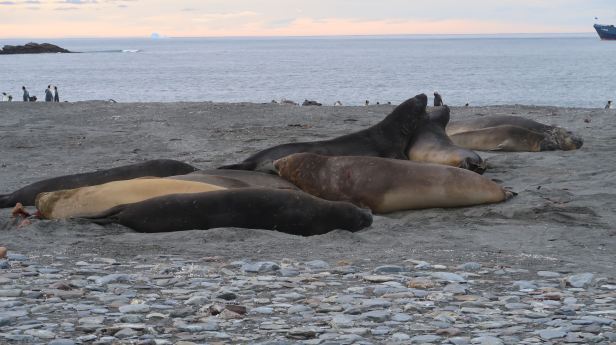
There were also hundreds of Fur seals and a lot of juvenile and female Elephant seals. Some of the juvenile Elephants were obviously young males because they already had miniature versions of the distinctive nose. The larger ones amongst them were already practicing for the battles they would need to be able to win, in later life, if they wanted to breed. Even at half their adult weight, that was something to see.
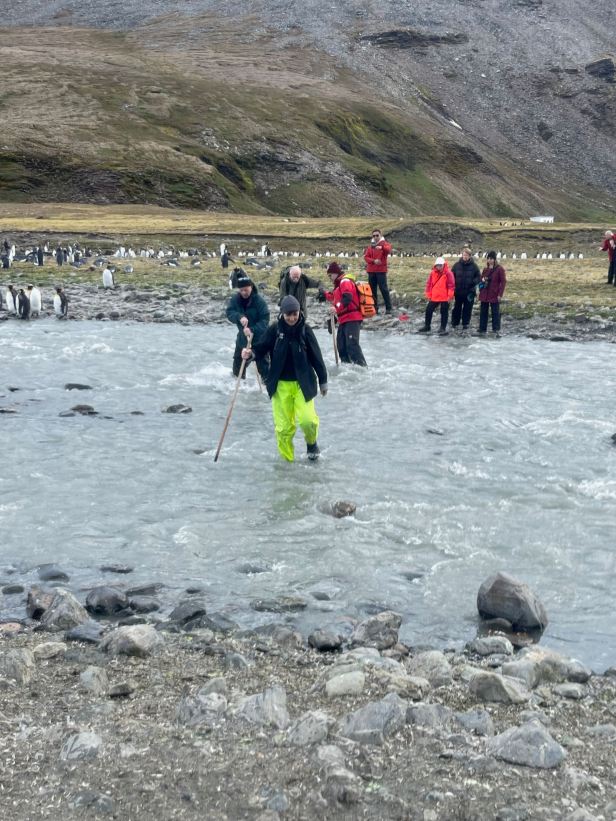
We had landed on the far right of the bay and, needless to say, the huge colony we had come to see was at the left extremity. This not only meant a walk of over a mile, but also the need to ford (as in wade through fast flowing, knee-deep and icy-cold water) two small rivers. It was quite difficult as the bottom was very uneven, but we managed it unwashed. Lucie noticed that, almost implausibly, her boot had a leak. That would mean more wet socks and another pair of boots (her fourth) when we got back to the ship.
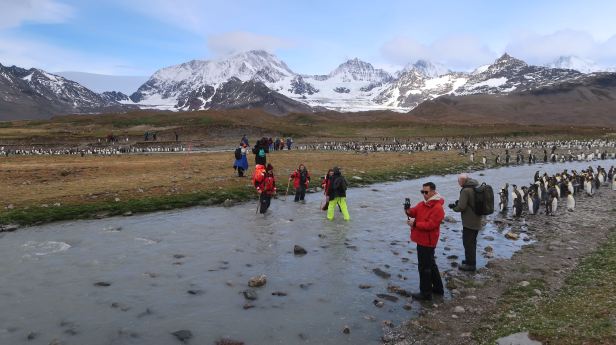
The banks near the ford were lined with curious King penguins and some sat in the rushing waters, downstream of the fording point. I wondered aloud how many that I would knock over if I slipped …… The new sport of ten p(engu)in bowling …..
The full glory of nature was, quite simply, all around us.
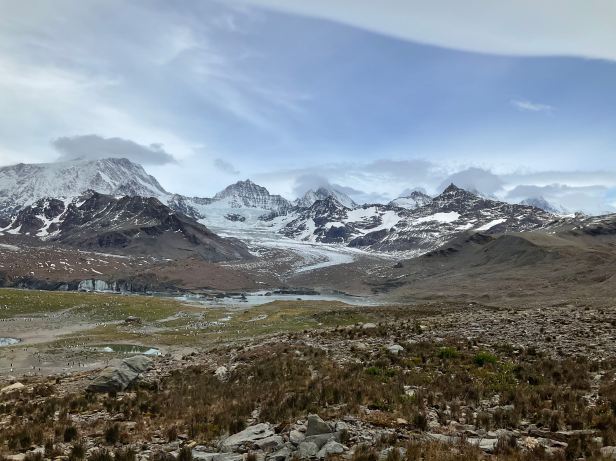


After quite a trek, we came to a proverbial high place where we were shown not “all the countries of the world” but, seemingly, all of the penguins. By some estimates, there were over a million of them on the flatter ground beneath us. No words can really describe and no photograph can capture, the seemingly endless array of black, white and orange that filled the low area beneath us. I remarked that it was like a nature version of “Top Trumps”, no matter what wonder you saw one day, the next day would produce something to top it !
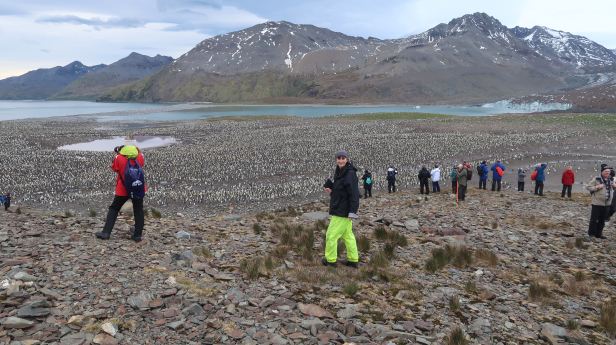
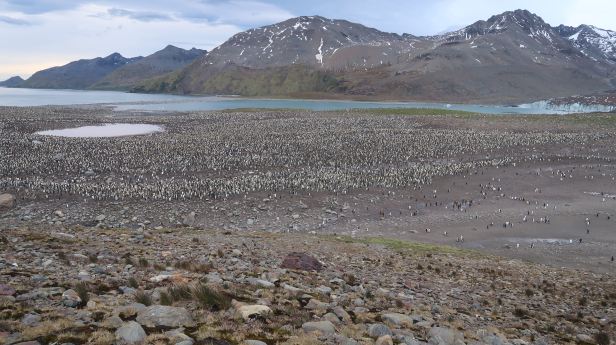
The weather was unseasonably warm and the wind was more of a balmy zephyr. On the plus side this meant we were not at all cold, on the minus side, it meant that the stink that you always get around a penguin colony was magnified. It was simply nauseating. There were plenty of “shit chickens” flitting around. More eating, less flitting, say I !
Almost reluctantly, although the stench did strengthen our resolve, we turned to make our way back to the Zodiacs. We shall, I strongly suspect, never see the like of that again. Away from the hubbub (and aroma) of the massed ranks, there were literally thousands of other Kings standing or lying everywhere.
Some of the Elephant seals were ensconced upon the high ground, a long way from the sea. The sheer effort that it must have taken to get those huge bodies up the slope was mind boggling. Although much smaller than the gigantic males, even the females can weigh over a ton.
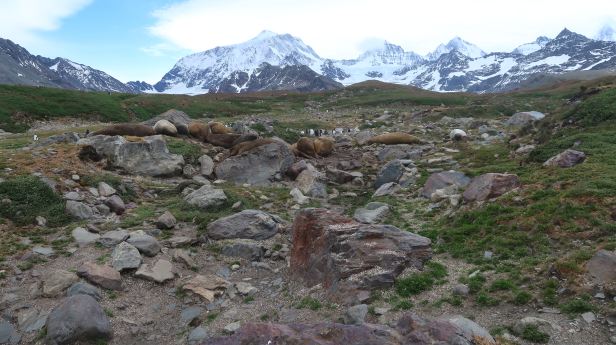
With many a backward glance from our seats in the Zodiac, we regained the ship – and Lucie collected yet more new boots. Thrice bitten, she put them on and went to stand in the disinfectant container until she was certain that they were, at least at that point, watertight.
Lunch, including truly excellent lasagna, was eaten with most of the gang. Meanwhile, the Plancius set off, oddly back the way we had already come. Our afternoon destination would be Godthul (Good Cove) where we hoped to do a hike. Out at sea, it had become very choppy, with winds of twenty-seven knots. How soon we forget ……
Godthul
Luckily, Godthul lived up to its name and, once the ship was inside the bay (cove, at least in my mind, implies a far snugger place, usually with ponies and smugglers) the sea was relatively calm. A couple of icebergs, one far larger than the Plancius, floated in the shallows. Icebergs needed to be watched carefully. They melt slowly, but unevenly and, because of that, from time to time, their centre of gravity shifts and they can suddenly roll in any one of four directions.
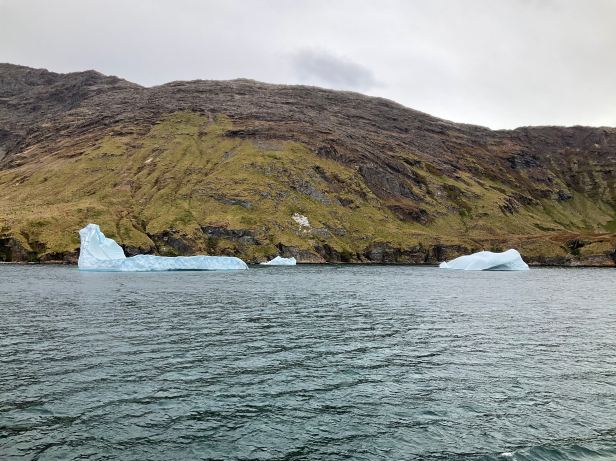
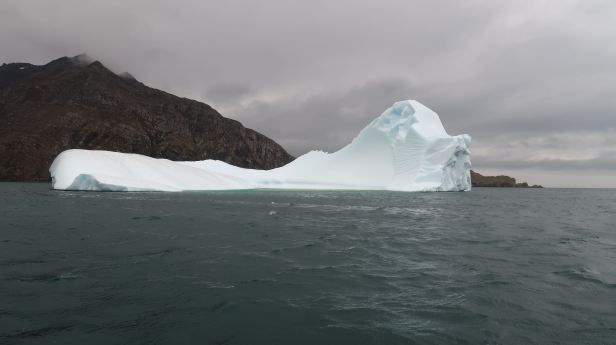
Even to hike we needed to be fully suited up. This meant the initial steep climb, up through the thick Tussock grass was warm work indeed. At the top, Ali gathered us under her wing and led us past three Gentoo colonies to the base of our presumed objective, Edda mountain. From the colonies, long and ancient tracks, called “Penguin Highways” led down to the sea. Gentoos, with either full or empty bellies were walking in both directions. Each penguin consumes between four hundred and a thousand small fish and crustaceans, which collectively weigh about a kilogram, every day. This is then regurgitated to its chick in the form of, let us face it, vomit. However awful this sounds, the chicks love it and there were many voracious chicks pursuing their running mothers, begging for a second helping.
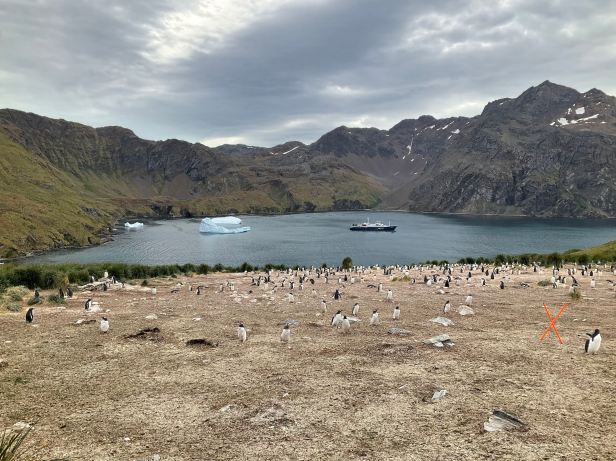
High above the bay the wind was strong. At one point, near the most elevated Gentoo colony, a massive gust showered us all with grass and guano (which is a polite word for dried penguin shit). All of our protracted bio-security preparations went out of the window in about half a second. My plaintive cry of “Save the velcro !!!” was lost in the raging gusts.
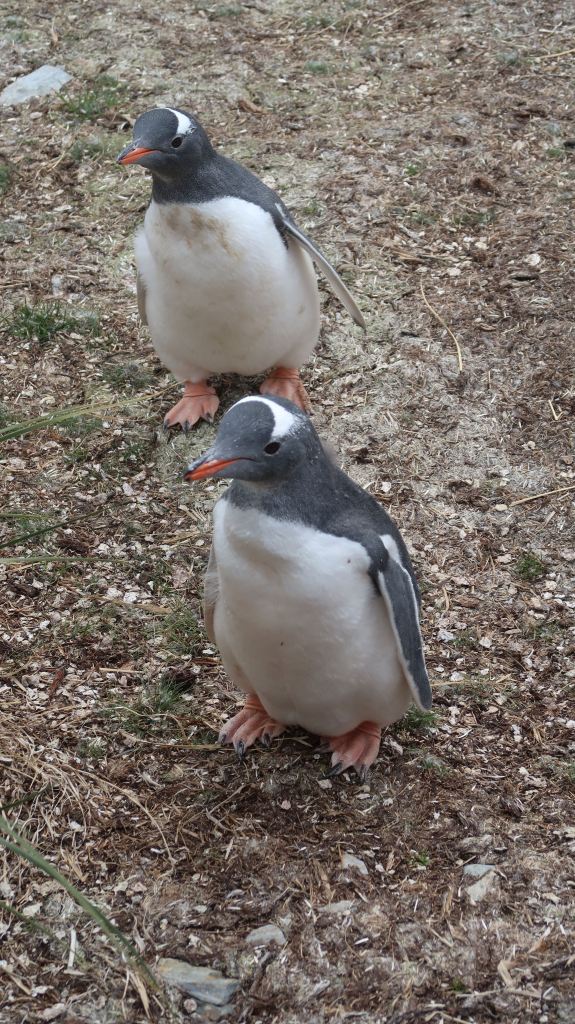

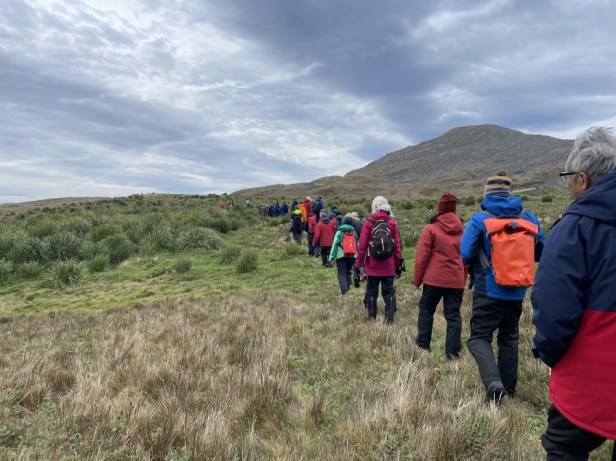
We trekked further up the mountainside. Despite the promised toughness of the hike, there were fifty-five participants – just over half of the total number of passengers.
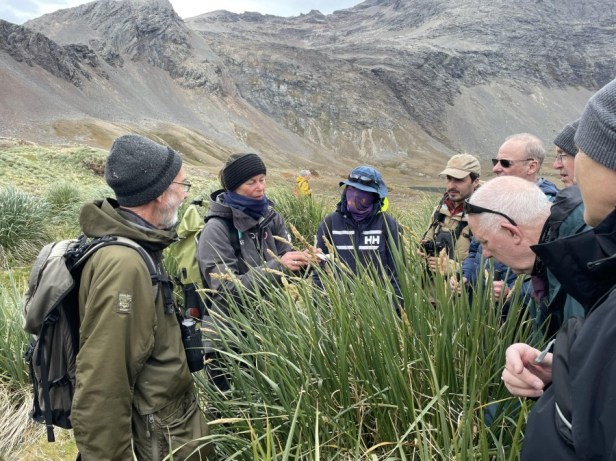
Strangely, as we had usually been forbidden to actively touch anything, Ali showed us how to peel the stalk of the Tussock grass and eat its sweet centre.
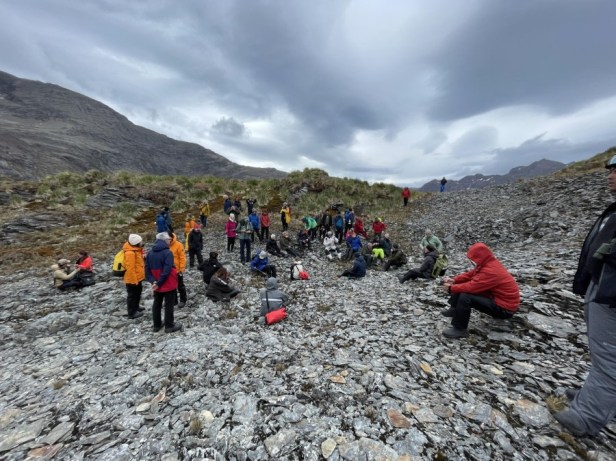
Higher and higher we climbed and the wind got stronger and stronger. It was really tough going. The terrain was either really soft, spongey grass or loose sedimentary rocks. This would have been hard enough in proper hiking boots, it was extra hard in wellingtons. During our onshore excursions, for bio-safety reasons, we could not sit down. However, on some rocks that she was certain were not contaminated with anything, Ali did finally allow it. That would normally have been cause for celebration, had not Lucie sat on a sharp projection and ripped a small hole in the seat of her waterproof trousers within five seconds of taking a seat.
The wind had, by then, become so brutal that, for safety reasons, Ali decided that to ascend to the very summit would be too dangerous. There was a sheer drop of about a thousand feet waiting for anyone who put a wind-assisted foot wrong. Sadly, it was the correct choice, I was nearly blown off of my feet several times at our lower level – and I am not a lightweight !
As an alternative, we traversed just below the summit to two lookout points which offered stunning views along the mountainous coast.
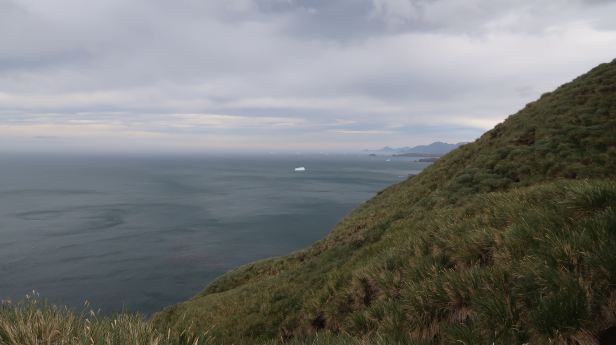

Then it was carefully back down. Our circuitous descent finally brought us to a series of “penguin highways” that we needed to cross. Up close, the antiquity of these routes was obvious. These tracks were literally worn into the vegetation and, sometimes, even the rocks, by thousands of birds ascending and descending from and to the sea over countless generations.
The Gentoos like to nest in Tussock grass, but each season, the area of the colony gets totally denuded of all vegetation. This means that they move the colony slightly every year. The routes to the water, however, remain fairly constant and, in the late afternoon, these were still very busy in both directions. Because the penguins have the right of way, it took a long time for our group to cross the highway. It was oddly reminiscent of the rush hour in Prague.

Finally, we got across and made the difficult descent down to the beach. Going down is always tougher than going up and, in tussock grass, in rubber boots, it was particularly trying. Never was I more pleased to put on my life jacket and board the Zodiac. To be frank, after more than three hours, I was exhausted.
The lateness of our return meant that the evening meal was served almost at once. Venison or poached cod was on offer. I once saw “Bambi” when I was young, so you can guess what I had.
The briefing, after dinner was short, brutal and to the point. The next morning, our first shore excursion would start at 06:00, so it would be a 05:15 wake-up call.
I decided I had better go to bed !
 Travels with my Harley