Saturday, February 1st, 2025
Despite the fact that it was a sea day, Lucie and I were out and about quite early. The smoke alarm went off at a fairly ungodly hour. Not the one on our ceiling, luckily, but the one inside Lucie’s head and her stirrings woke me up too.
We both adjourned to the lounge for tea/coffee and, outside of the windows, the horizon was foreshortened by mist. Ever since I had seen the localised climate created by the mighty iceberg A23A, mist at sea had made me nervous. Realistically, I knew there was no way that the ethereal curtain of moisture could be hiding three billion tons of marauding ice, but I still kept checking.
I had often mentioned the term “Roaring Forties“to Lucie. This related to wind speeds at the lower latitudes and we had felt their full force (on land) in Roaring Bay in New Zealand. Naturally, that led her to enquire further and, after a little study of the map and terminology, she decided that it should really be the “Furious Fifties“. That is the term used by sailors for the area between 50 and 60 degrees of latitude south. In other words, it could be even worse. Some of the strongest winds on earth blow there. Their force is not blocked by any landmass with the partial exception is the southern tip of South America and the Falklands. Even at a higher latitude, on the outbound journey, it had been far from pleasant.
At the previous evening’s briefing, Ali had announced that it looked like we would experience the “Drake Lake”. This is a term used for the rare periods when the strait is calm. The opposite of this term is “Drake Shake”. Some people on previous expeditions had complained to Ali that they would have liked to experience a real storm in this area. Ali had assured them that they were wrong. She had experienced it many times herself, so she knew what she was talking about. Once, the waves were fourteen metres high. The bridge is thirteen metres high, so looking ahead, a wall of water was rolling over the ship.
The problem with a storm at sea is that it does not pass in an hour or two. The waves have inertia and once the surface gets rough, it can take hours or even days before it calms again. In addition, it slows the ship down to half speed, which has to be factored into the travel plan. That is why Ali monitored the forecasts several times a day.
We were both still chuckling over Szymon’s penguin poo lecture of the previous evening. I found it amazing that not one, but two universities had funded such research. As a scientist, Lucie was more supportive. She posited that, however unsavoury the subject, a hypothesis had been made and then proven – and that, in itself, added to the pool of human knowledge. Of course, because I like breathing, I agreed with her.
I could imagine though, the following post-university job interview scenario:
HR: Do you have any special skills ?
Candidate: I am very good at measuring the anus diameter of an Adelie penguin – and, I know how far back I need to stand while I am doing it.
HR: Please close the door on your way out – and leave the building immediately !
Breakfast (Coco-pops, scrambled egg, toast) was a quiet affair. Whether, that was down to people overdoing it the previous evening or the rougher seas outside the window, I had no idea. Wendy appeared and her bandaged ear attracted a lot of sympathy and comment. Almost everyone seemed to know, by then, about her ear tattoo….
While we were at sea, we got talks by the guides and these were usually interesting.
First up was Szymon again, but this time with a more serious subject, “Global warming and climate change”. As usual, he gave us the various salient facts, but in a way that was informative, challenging and non-combative. We all, probably, think that we know about Global Warming, but there are a number of external factors that are not generally mentioned. For instance, the Earth has been warming steadily and more or less continuously since space debris first coalesced into planetary form. It started as bare rock upon which no life was possible and, over four and a half billion years, came to where it is today. Szymon used a “volunteer” from the audience, a young German girl called Joy. With with both her arms extended, Szymon took her right fingernails as the date of coalescence and, to show the time-scale, her left elbow as the time when single celled life first appeared. Human existence began at her left fingertip. With a nail file, she could have erased all recorded history with a couple of strokes.
Climate Change is a little different from Global Warming. Although the Earth has continually warmed, all by itself, over countless aeons, it is basically only since the time of the industrial revolution, hardly three hundred years ago, that human activity has added another factor, that of change, into the equation. Of course, if we do not find a way to curb our voracious appetites for goods, the damage we are doing can only increase. There is no easy answer. Incidentally, a Serbian astronomer and geophysicist, Milutin Milankovic, noted in the 1920s, a correlation between the various tiny axis changes upon which the Earth rotates, the sequences of sun spots and the timings of the various ice ages to which the Earth has been subjected. The ice ages appear to follow an almost rhythmic sequence – and we are about due another one. Maybe ice might be our collective salvation, if A23A does not get us first.
The next talk was from Ali and about women who had made a contribution to Antarctic exploration.
In the early days, the ladies usually contributed by staying at home. Emily Shackleton, for example, was a huge support for Sir Earnest, but would never have dreamed of heading south. Kathleen Scott, the Captain’s wife (and a direct descendant of Robert the Bruce), was a bit more active, almost to the point of interfering. She never set foot on the ice, but she did sail with him to New Zealand, in order to see him off. The first woman to set foot on Antarctica was Caroline Mikkelsen, the wife of another captain, but this one of a whaling ship. That happened in 1935. Many other women have done so since, but Ali was mainly implying that they only get remembered because they were women. Some of the later ones, Ali had actually met.
That took us nicely to lunch. I had squid and a nice fish with rice, but I also made myself a cheese sandwich. I needed to start training for the return to a harsher eating regime !
The afternoon lectures were kicked off by Susie and were about things that were not seen in the sea in Antarctica. I thought, at first, that she might be referring to me !
In fact, she was talking about the microscopic plants and animals that are there, but are invisible to the naked eye. These include phytoplankton that are individually microscopic, but which form chains and occasionally multiply to such an extent that the “blooms”, as these agglomerations are called, can be seen from space. Invisible to the naked eye, but vital to the eco-system. The plankton chains beneath the ice flows feed the Krill (I knew she would get that in somewhere). The Krill, as we know already, features in the diet of almost everything else in the Antarctic, or helps fatten those creatures that do eat it for the other predators.
The final talk was by Koen, detailing his escape from corporate life into being a whale watching guide. His love for whales was a palpable thing and he talked about them in a mixture of joy and reverence. He has led whale watching tours in places as far apart as Iceland and Tonga. In the latter location, you can actually swim with Humpbacks and his pictures were mesmerising. The talk ended with a short film that was a combination of video clips of mother Humpbacks and their calves, with an appropriate soundtrack and some whale song. It was a stunning way to end. There were tears in all of our eyes and the applause, from us all, was truly heartfelt.
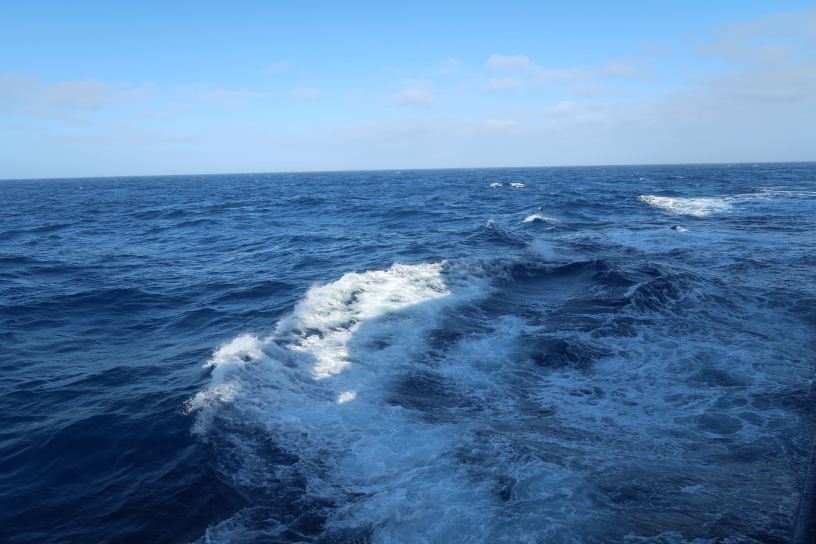
The Plancius was still motoring across the Drake Passage and would be for at least another day. The sea was a bit rough, but the sun was out and the sky was blue. Relax lady, there is nothing to see !
The daily recap was short, well it would be, we had not done anything. Ali did show us the wind chart, it was a pleasing shade of green, which meant nothing serious ahead. There was a tiny bit of a more strident colour, away to the west, but if our luck continued to hold, we would be in the lee of Cape Horn before it arrived. Fingers crossed.
The hotel manager then explained to us how we could pay our cabin bills and told us we would be sent a questionnaire which, if completed, would gain us a couple of free drinks each.
There was a quick presentation from Hélène about Antarctica’s one and only insect. This is a fly, with no wings, called Belgica Antarctica. At only six millimetres in length, it is also Antarctica’s largest land based animal. The fly has a weird lifecycle. It can spend up to two years as a larva, which can dehydrate itself to survive being frozen, but it lives for only ten days after metamorphosing into an adult. The adults cannot eat, they mate, lay eggs and die. Species continuation at its starkest. The fly has the shortest genome in the insect world.
Hélène was followed by an almost breathless Natalya who explained that the above fly was found, in 1898, on a Belgian (yes, a Belgian) Antarctic expedition. The expedition was publicly financed and led by a guy called Adrien Gerlache. Lack of money meant that the crew had to be unpaid volunteers and not enough Belgians could be found. Luckily (probably for him) a Norwegian called Amundsen was allowed to join, as was a doctor from America called Cook. The whole thing was a bit farcical, some crew members died, others went mad. The only way to prevent the crew deserting at the earliest opportunity was for Gerlache to make absolutely certain the ship, which was called the Belgica (hence the fly name, Belgica Antarctica), to get stuck in the ice and thus be forced to overwinter in the Antarctic. Despite the general ineptness of the whole thing, in addition to the fly, several other previously unknown species were discovered. Amundsen, for it was, indeed, Roald, was able to use the experience gained to better plan his own successful attempts on both poles. Cook, on the other hand, became a complete charlatan. He claimed to have successfully climbed the highest mountain in Alaska ( he did not) and to have been to the North Pole (he did not do that, either). He was jailed for sixteen years ……
Then it was time for our penultimate dinner. Now the adventuring was done, the atmosphere was completely different, much noisier to the point of hubbub. The food remained truly excellent. Gravlax, steak and a good fruit salad. I would miss the cuisine.
I actually felt very tired. I think I had been running on adrenaline for two weeks and I did not need it anymore.
I wrote up the day – and retired to my little bed.
 Travels with my Harley