Sunday January 19th, 2025
Another fine mess you have gotten me into ……
….. Stanley, or rather, in this case, Port Stanley. That was our initial destination for the day.
I had expected to see it outside of our window, when we woke up, but heavy seas had edged our arrival time steadily backwards. So, it was not until I was eating a light breakfast (shredded wheat and fruit-salad), that the town could be seen bobbing up and down outside of the restaurant window. Hang on, it was the Plancius that was bobbing up and down, the small port was as rooted to the earth as it has always been.
My low-calorie breakfast did have an underlying purpose and it was not to spoil anybody’s fun, but if any of you are playing my recently introduced version of “Breakfast Bingo”, you may as well quit that now !
We had been told that, as Port Stanley had a proper jetty, we could wear our normal boots as we would not be getting out into water. The other strictures, waterproof clothing, a life-jacket and so on remained in place.
According to the ship’s log, our position was 51°30.6’S / 057°44.8’W
Before we were allowed to disembark, local officials came on board and examined all of our passports. Then, it was time to go. Because the waves in the small harbour were big ones – the capacity of each Zodiac was reduced from ten passengers down to eight and that meant quite a wait until we were finally allowed to walk down the gangway. The small rubber vessel, which was rising and falling an alarming amount with every roll of the dark green water, looked tiny against a backdrop that can only really be described, in sea terms, as “roiling”.
Once safely on board, we were powered confidently towards the shore, but some waves, nevertheless, found their way over the sides and we all got a comprehensive soaking from the spray. Our motorcycle waterproofs really paid off on that trip. I have to say (or maybe brag) that I never felt at all scared, our helmsman exuded competence, but the elderly lady sitting opposite me was as white as a sheet.
Once safely on land we divested ourselves of the, then, unnecessary waterproofs and set out to explore the tiny town. With only around three thousand people living on the islands, it is probably one of the smallest national capitals in the world.
The first thing I did was to buy two postcards and stamps in order to send them to two people in Prague who had requested them. Given the remoteness of the island, we also took a photo to prove they had entered the stereotypical “in the post” phase. (They were delivered in about three weeks).
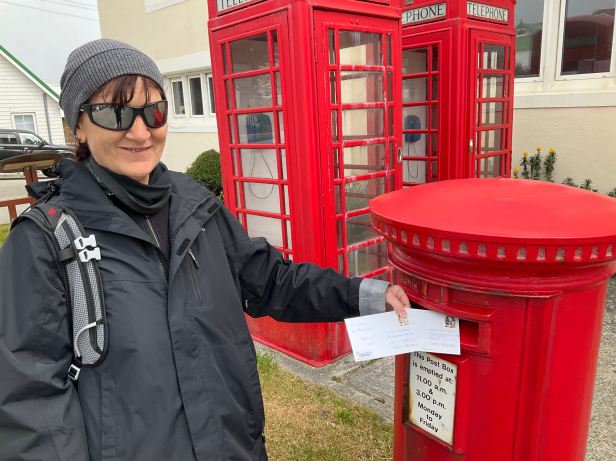
Then, for ourselves, we bought a bauble for our Christmas tree – which was a little unfortunate, because we saw a far better one in the next shop, so now we have two !
Missions accomplished, we set out to look around. Because of the war in 1982, Port Stanley had an eerie familiarity to me at least. Much of it looks now, as it did then, like a small, provincial town from the 1930s.

The local newspaper had an amusing name !

One thing that was post-war and situated on the harbour front, was the memorial to those who gave their lives in order to liberate the Falklands and South Georgia following the Argentine invasion of 1982. The names include three female civilians, killed during fighting on Mount Longdon when a shell, tragically from a British ship, hit the house in which they were sheltering. The monument was comprehensive, thoughtfully presented and beautifully kept. The huge gratitude felt then has not, it appears, diminished by one iota in the intervening years.

A bust of the British Premier, Margaret Thatcher, overlooks the monument. Her pronouncement, before sending a fleet to retake the islands was “they are few, but they deserve to live in peace and in the system they have chosen and to speak their own language” and is something most islanders seem to know by heart. Mrs Thatcher is practically a saint to the Falkland Islanders.

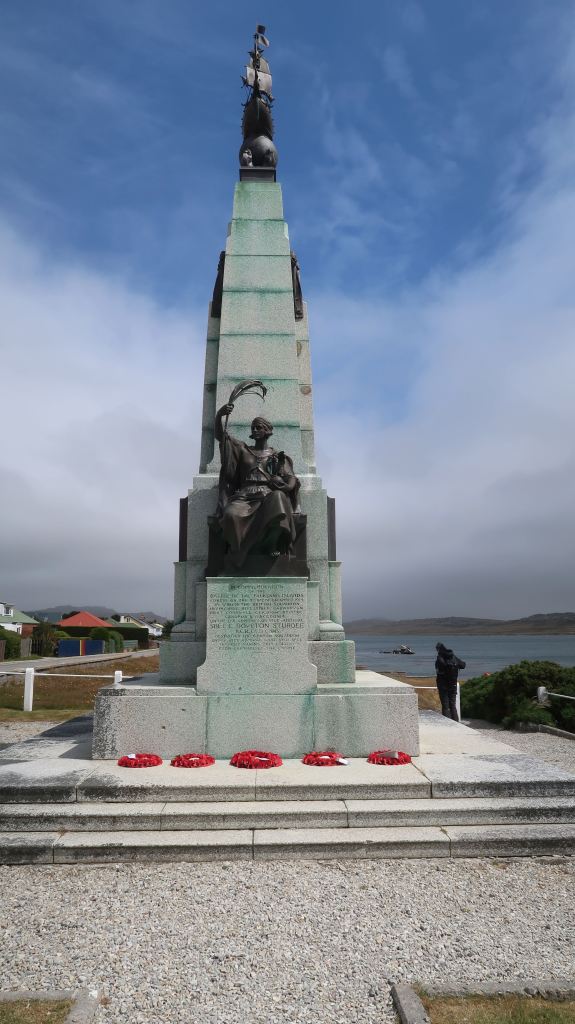
We could see another monument style structure a little further along the coast, so we walked there to see what it was,

The monument was to the dead of two other battles. It is a little known fact that two significant naval engagements of the First World War took place nearby. The first was the battle of Coronel. A tiny, Falklands based, British force was ordered to engage a far larger German one and they came together off of the coast of Argentina. The British were wiped out to a man.
The second was when a German fleet under Admiral Graf Spee arrived to occupy the islands, only to find a British fleet already there. The Germans fled, while the resting British fleet was still getting steam up. It did them no good, the British soon caught them up and sank them all but one. Admiral Graf Spee was killed, as were two of his sons in two other German ships.
As an aside, in World War Two, the battleship Graf Spee, named after the same German admiral, was cornered by the British navy in Montevideo in Uruguay (just across the river Plate from Buenos Aires). In the end, to avoid destruction or capture by the British, the captain scuttled his own ship. Another three away points for the White Ensign.
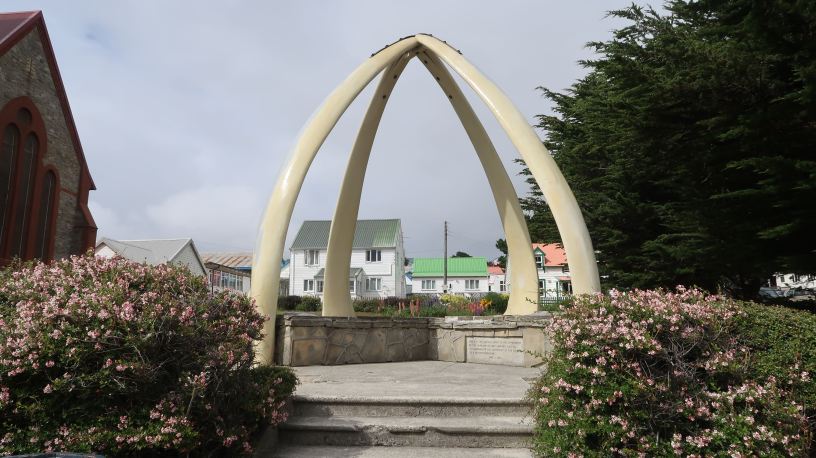
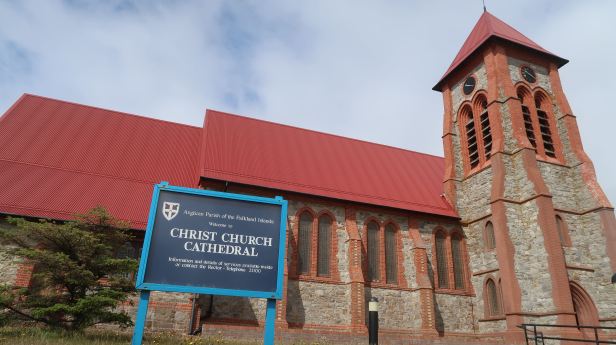
Just along the road back towards town, was the impressive local cathedral, the Christ Church. In the grounds is an arch, constructed from the jawbones of two massive blue whales. The Whalebone Arch is impressive, but it is hard to imagine that the unfortunate whales were very impressed.

We visited the local museum, which like everything else, was on the waterfront. It offered a fascinating peep into what must have always been tough lives. Oddly, there were some things there, like a tin for “OXO” cubes, that I could remember from my own youth … I wondered if that was because of my age, or because product runs were longer in days gone by.
There was also an impressive wildlife section where the most distinctive local fauna were displayed thanks to the wonders of taxidermy. We were able to get even more up close and personal with some of them than we had been able to in the wild – and to see, for instance, exactly how big the talons of a Caracara really are.
The Falklands have had a long and far from easy history crammed into the time since the British first discovered them in the late sixteenth century.
Probably the most significant event was the war of 1982 and this was extensively documented with some impressive visual displays. It is still very fresh and raw to a lot of the people and it appears unlikely the Argentines will ever be forgiven for their actions.
We spotted some old cannons along the waterfront. There are some things that I can never resist doing !

I had two final, personal “goals” and they both went unfulfilled. Firstly, I wanted fish and chips, but both places that sold it were closed on Sunday. Secondly, I wanted a locally brewed beer. With time running out, we could not locate an open pub and, although the cafe we tried had local beer on the menu, it had run out. Strike two ! There was a shop selling locally produced gin, but we do not drink gin, so there was no need to go there. Many of our fellow passengers, however dragged some “clinking” bags back to the ship …
Thanks to the vagaries of the weather, the return to the Plancius was like a gentle ride across a mill pond. At least there was fish for lunch, so I did get to eat some in Port Stanley.
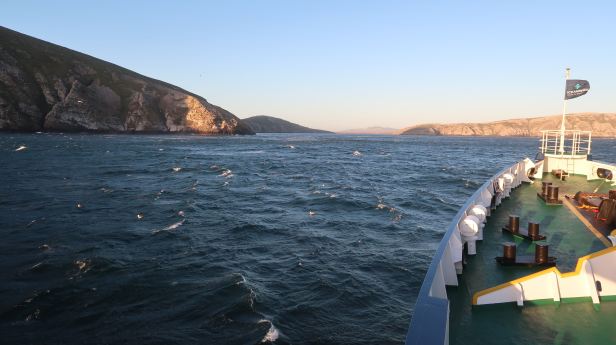
After lunch, up came the anchor and we set off for South Georgia. This would mean two and a half days at sea. If the large swells we encountered as soon as we left the bay continued, that would not be a lot of fun. These were serious seas – far rougher than even the first day – and there was no immediate end in sight according to the wind charts. It was hard to walk and moving around the ship required forethought and care. The tannoy gave the announcement “one hand for yourself, one hand for the ship”. We would hear that quite a few times as the days went by.
Our afternoon lecture, given by Ali, about life in the Falklands during the COVID period was another fascinating look at a life lived very differently.
In truth, it was not really about COVID, as it was practically non-existent in the Falklands. It was more about how, when COVID came and she found herself out of work, because expeditions were suspended. Having originally come to the Falklands as a teacher, she returned there and started doing it again. Then she moved on to Sea Lion Island, which belongs to her friends who run a Bed&Breakfast there. Since tourism had stopped completely, the local government began a programme of giving out vouchers to local people to travel around the islands in order to help those who made a living from tourism survive. It was quite an interesting talk because running accommodation in a place where a boat only brings supplies once every three weeks was definitely a challenge. A lot of improvisation with every piece of material available was obviously required. Although the shots of the morning cup of tea in the company of penguins were fascinating, it is a completely different way of life that also has its costs and in Ali’s case there was clearly no room for a partner or a family.
After the daily roundup, Martin expounded on bird eyesight and Susie gave us a chat about lichens that Lucie (at least) found fascinating.
While Susie was talking, a really huge wave hit the ship. As we were all sitting, we scarcely noticed, but it caused chaos in the kitchen. At supper time we were reintroduced to deprivation, because the above impact had managed to destroy the soup course. What could we do, but manfully grit our teeth and try and make the best of it. It was very much a case of sitting in the first available seat you could find so, instead of being with our gang, we ended up sitting with a couple from Phoenix. We had met them earlier in Port Stanley, where we had photographed them in the red telephone boxes. Outside of the windows, the sea did look fairly alarming. I have never seen the film “Titanic”, but those who had assured me that the view was very like when the ship began to sink in that movie …
Never one to miss the chance to look at a weather App, Lucie found “Windy” on her iPad. Looking at the results, I really wished she had not !

Then, as always, it was back to our cabin to write all this down. We had both decided to see if we could manage without the sea-sickness pills. I apparently could and I fell asleep almost immediately. Lucie was not so lucky. She was not ill, but she did have difficulty sleeping.
Given the sea conditions, the following day threatened to be a l-o-n-g one !
 Travels with my Harley