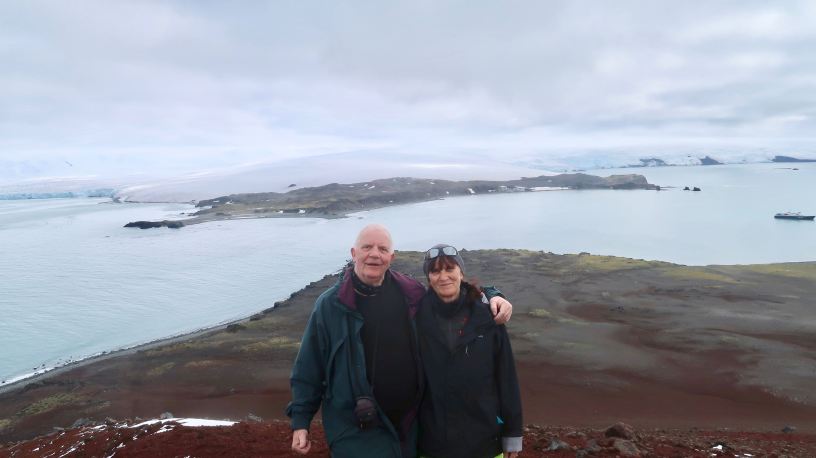
Wednesday, January 29th, 2025
As was usual, I slept like dead person. If the Chinese passengers were riotously celebrating their New Year, they must have been silently amalgamating pictograms, not singing songs.
We woke early and, in the pre-dawn gloom, it was just possible to make out shapes that were not icebergs on the Starboard side. As it grew steadily lighter, the Plancius slowed and by then, on the Port side, the extinct volcanic cone that was Penguin Island came into view. The sea was placid, so the landing would happen.

We tripped lightly off to join our pals for breakfast (Weetabix, beans, fried eggs, potato waffles and, in honour of the Chinese New Year, errrr a mandarin … *). After three days on board we were all desperate to clamber into our hot and unwieldy gear and take a proper walk.
* it might, in truth, have been an orange, but the sentiment was there !
Penguin Island
According to the ship’s log, our position was 62°05.4’S / 57°54.79’W
It was tog up and ship out. The trip across the water was smooth, but it was a very rocky, or at least a big, smooth, slippery, pebbly, landing, so getting out of the Zodiac was fraught with desperate peril **
** for clumsy buffoons !
On the top of the beach it was far smoother and we walked along whilst Chinstrap penguins hopped comically from rock to rock, interspersed here and there with the odd Gentoo. A whale had obviously met its fate of some kind on that strand, there were large bones everywhere, including some massive vertebrae.
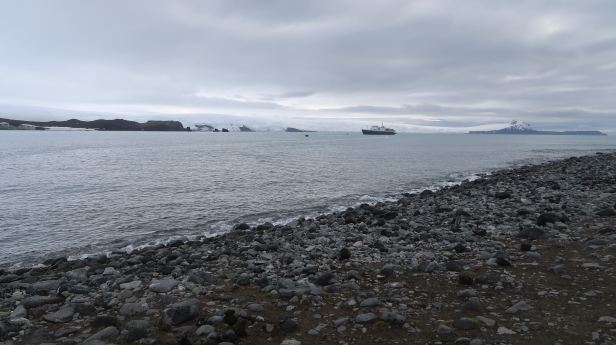
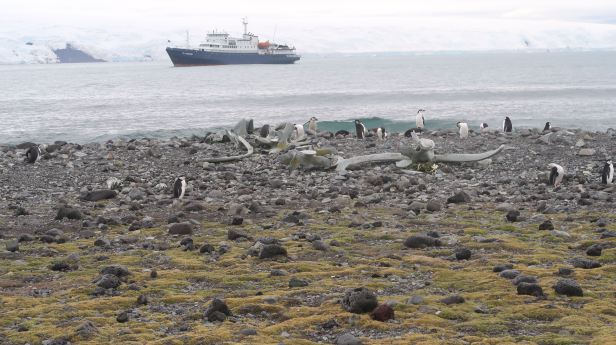
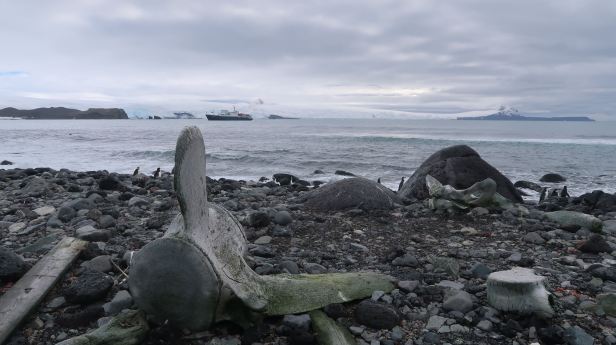
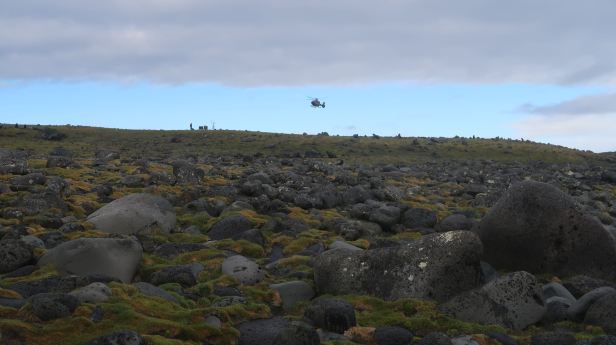
Whilst we were in the process of landing, the peace of the bay was shattered by the arrival of a helicopter. It seemed strange to see such an “alien” object. Apparently, the aircraft was from a nearby, Chilean, base and it deposited two people at a weather station just above the beach. The Fur seals scattered, somewhat hilariously, but the penguins ignored it. It returned, whilst we were still on the beach and retrieved the pair of interlopers. Apparently, its flight-path contravened a lot of official guidelines. Ali reported it, she was not a girl to mess with !
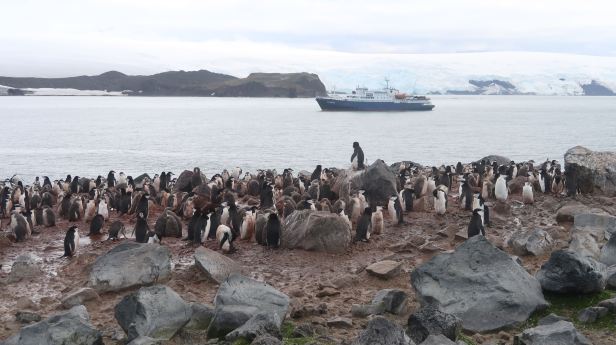
We walked to both Chinstrap colonies. The nesting sites were bare of any vegetation and very wet. At both sites, the penguins, both adults and nearly fledging chicks, were covered in something brown and sticky which I hoped, for their sakes, was mud.
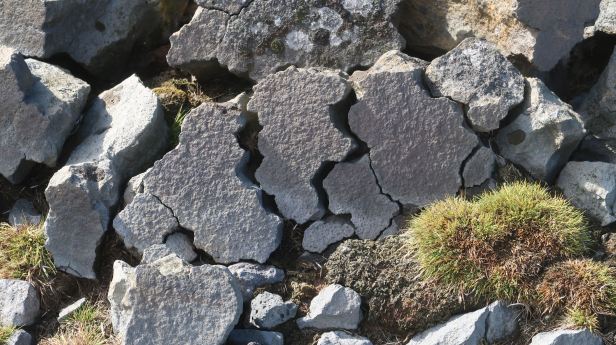
As usual there were “penguin highways” worn into the soft ground and the sparse vegetation. In some places, the harsh winter weather had caused rocks to fracture into neat little completed jig-saw shapes.
There was the opportunity to climb the volcano and hike around the rim. The sun was fully out by then and it was rather warm. I was glad that I had resisted the temptation to put on too many layers. On the slopes, we found a couple of places where there were piles of egg shells. The Chinstrap penguins, as I noted somewhere earlier, lay two eggs – and then abandon the first. Nothing goes to waste in those parts and the skuas steal them, smash them on rocks and eat them.

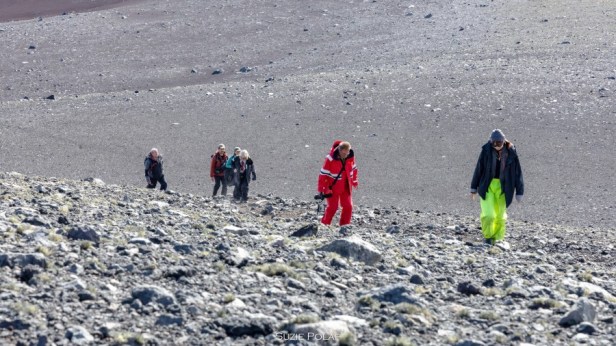
We made the trek up to the rim of the crater. The loose surface made it a far from easy ascent.
 The volcano last erupted in the early 1700s and the caldera, known as the Petrel Crater, contained a huge rock.

Despite the time lapse since the eruption, the loose stones had not really settled and the surface, particularly on the ascent and descent, was a little bit treacherous. The lava itself, mainly tiny bead-like rocks, varied in shade from terracotta to a really dark black.

We climbed to the very highest point, known as Deacon Peak, which is three hundred and fifty metres above sea level.
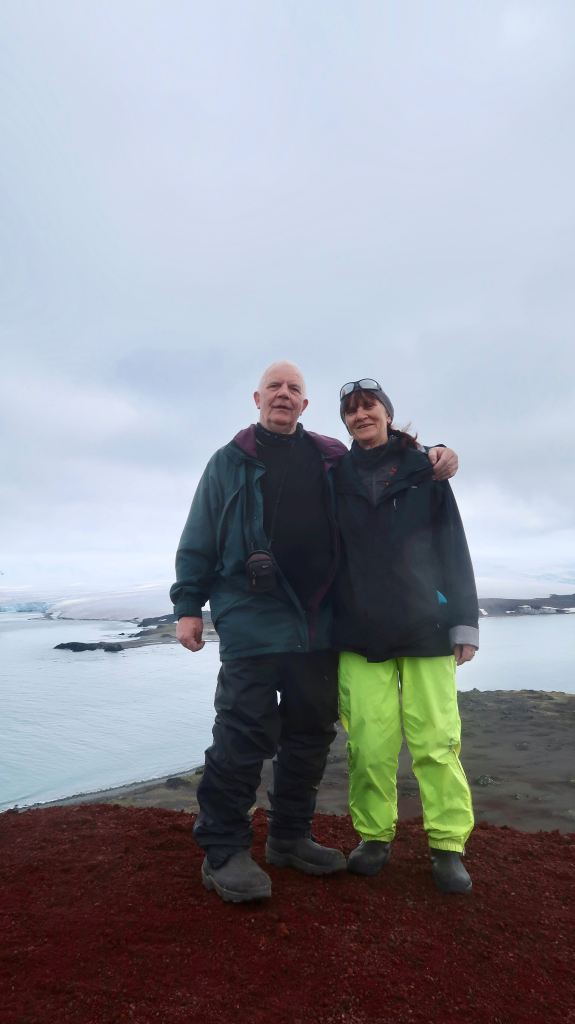
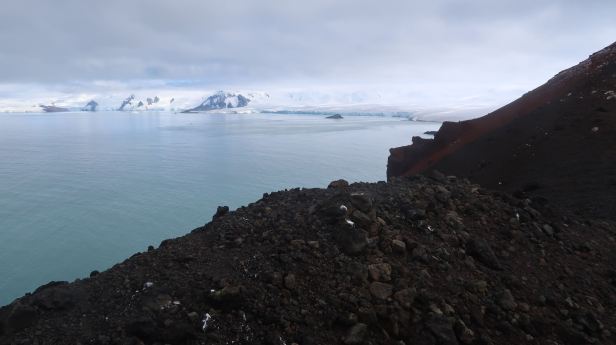
The views, over the bay, from the rim of the crater and the peak, invited further hyperbole from me. Suffice it to say that, in the bright sunshine, the panoramic view over the steel grey waters, where a tiny Plancius lay at anchor, to the distant glaciers and snowy peaks of he neighbouring King George Island was the very reason (apart from the South Georgia pipit) why we had come. Antarctica was finally beginning to look the part.
Because the only alternative was to hide and then try and survive by catching and eating penguins until rescued by a passing Chilean helicopter, we took a Zodiac back to the Plancius. As we crossed the water, the sky in the distance began to look black and very ominous.
Lunch was beefburgers which sounds a bit ordinary, but it certainly was not. Khabir, the chef, assured us that it was the very finest beef and with no preservatives. That is, naturally, what anybody would say when you have them by the throat – but mine was better than any burger that I have ever had. In fact, they both were….
Sadly, the swift deterioration in the weather meant that the afternoon activities had to be altered. There could be no landing on King George Island, so we would do a Zodiac cruise around Turret Point instead. There was no difference in the suiting up phase, just no foot on the ground on the opposite side of the strait.
Turret Point
From our cabin window, the sea looked quite placid. That did not prove to be the case once we were on the gangway. The rise and fall of the swell was over a metre. I think that, whilst standing on the bottom platform of the gangway as it sank beneath the waves, I was deeper in the water than in any of the “wet” landings we had done thus far …..
Actually getting into the Zodiac was a roll of the dice. One or two people just hopped in as normal, others had to wait for the Zodiac height to match that of the gangway platform. The boarding procedure was that the guy at the bottom of the gangway held your arm in a “seaman’s grip” (mutual hand to wrist, to allow minimal slippage) and the guy in the Zodiac did exactly the same thing with your other arm. You then put your first foot on the tube, your second on the step and, hey presto, you were safely in the boat. It usually worked well and felt secure. Of course, when my turn came, no sooner had both my wrists been grasped, than the swell dropped the Zodiac like a stone – and away from the gangway. For what felt like an eternity, but was probably only two or three seconds, it was MY body that was holding the Zodiac to the Plancius – whilst I stared at what seemed to be an ever widening gap above the heaving brine. Then the Zodiac came up and in I stepped a little shakily aboard. Knowing my tendency for self-harm, Lucie was a bit pale, but I am laughing about it …… NOW !
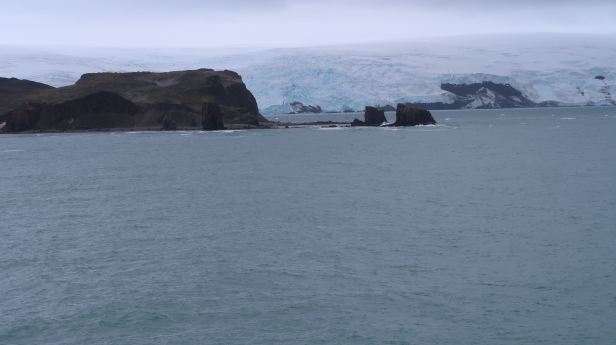
The cruise itself was quite exhilarating, but the increasingly turbulent seas meant there was nothing really to see. So, apart from some big rock columns, called the Three Sisters (after three sisters that reportedly drowned in a shipwreck there), some basalt rock formations and a few hardy Chinstraps out fishing, there was little to catch our interest. We went with Martin again and the whole way we chatted about his work, the crew, other expeditions, how it works on other boats and what the safety rules are for launching Zodiacs. Martin explained to us that although a Zodiac can capsize if it catches a side wave wrongly, that wave would have had to be much bigger than any of those we were experiencing in the bay.
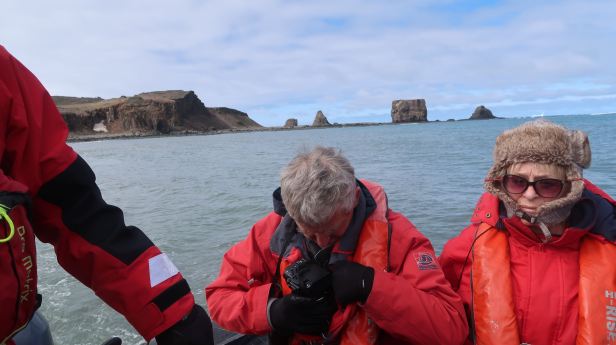
Later I found out that passengers on other Zodiacs were not quite so comfortable and that some had been quite scared. It was Martin’s birthday, so we all sang “Happy Birthday to you !” That at least made the people in other, nearby Zodiacs laugh. The increasingly rough seas curtailed the event a bit early and we headed back to the ship. Embarkation required care, but for me, at least, it fortunately lacked the drama that getting into the Zodiac had contained.
Back on board, Ali organised hot chocolate (and rum if you wanted it), on the top deck. It was very good hot chocolate. We also took pictures of (almost) the entire group of guides. They were constantly on the move to make sure everything goes as it should and catching them together was almost harder than seeing that elusive pipit !

The daily recap centred mainly on our fun in the morning – and our failure to drown in the afternoon. The wind (and hence, the wave) charts for the following day indicated far calmer seas and we hoped to land on another island for a look around and short hike.
Ali said that, at sunrise, if it was clear, we would be in an extremely beautiful area. Sadly, for some, the sun would stick its head up at 04:00 ….. We could only set our alarm to rouse ourselves from our slumbers and see …..
Tiphanie then gave a short and quite funny discourse on the big nose, or proboscis, of adult male Elephant seals – and research into its size and growth. Suffice it to say that poking one (which usually weighs at least four tons and is very fast on its flippers) with a graduated measuring stick was usually involved !
Then, Koen gave us the lowdown of the baleen plates that some whales have, and how they work.
Finally, Martin (who was still celebrating his birthday) told us how to get any whale-tail or fin/colouration photos we might have “identified” to an individual whale on the HappyWhale.com website.
Depending upon the species, these features are as unique as a fingerprint. This obviously helps research, but the site would, as a reward, send you a map of other places your whale has been recorded and, if it was its first ever record, YOU got to name it !
The same thing goes for clearly identifiable bird rings on another website, but that was not going to happen with our camera. A ringed Albatross, captured by Martin’s long lens, had been sighted in both Chile and the Falkland Islands.
Then it was time for dinner. Having had to get up at 04:00 meant it was quieter than usual, but we did find time to criticise Iberian airlines.
Then it was early to bed – for another early start the next morning !
 Travels with my Harley