
Thursday, January 30th, 2025
The Antarctic Sound
According to the ship’s log, our position was 63°37.4’S / 056°43.8’W
Lucie must have been very excited, because she woke me up at 03:30. Sunrise was, as promised, at 04:00, but there were already lots of people on deck when we got out there before that time. It was, quite breathtakingly cold. As Wendy was up too, Lucie and I took the opportunity to visit the forward platform for a photo.

There were traces of snow on the deck. Not that anyone was looking at the deck. I am already wishing that I had eased up a bit on the superlatives earlier on in this narrative, because I can now only start to remorselessly repeat them.
In the words of the song-smith (like my friend Leigh, the blacksmith, but with a pen and not a hammer) Al Stewart:
“Long before I ever saw the frost upon your face,
I was haunted by your beauty and it drew me to this place.
I felt the thrill of mystery, with one foot on your shore
And then and there resolved to go where no man had before.”
All around us was a panorama of unspeakably icy beauty. I do not actually know how to accurately convey in mere words just how lovely it was. We have all seen it on our television screens. However, no matter how skilled the cameraman, what you view there, on the television, does not make the tiniest scratch on the awesome reality that was sliding slowly by a few short metres away and then stretching away into the far distance. Sometimes, there was an ice floe directly in our path. Luckily, that Russian maniac upstairs in the bridge seemed to know just where to hit the floe so that the impact split it neatly and our stately progress continued.
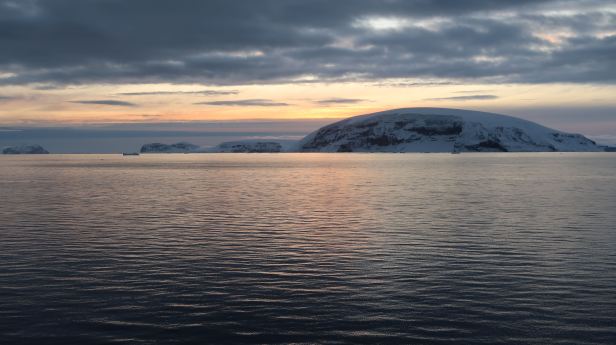

According to the charts, we were passing the Trinity Peninsula in the Antarctic Sound. Everywhere there were frozen islets, giant glaciers and icebergs of every size and description. The latter ranged from ones that would fit under your Bailey’s, to ones that were fifty times bigger than the Plancius. Once or twice, we heard the thunderous crash of icebergs “calving” that is breaking away from the main ice-floe. In the pervading silence, this created a real rumble, even when it was only a comparatively small fragment falling into the sea.
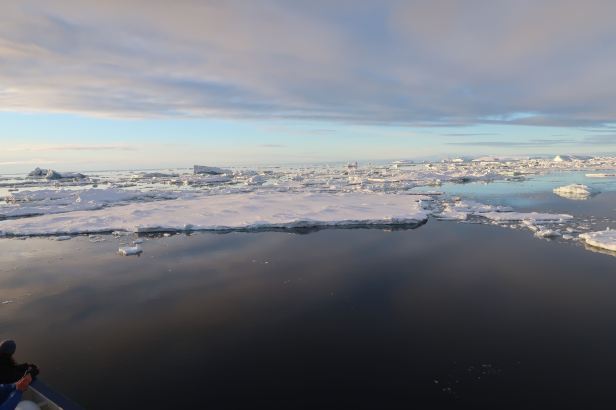
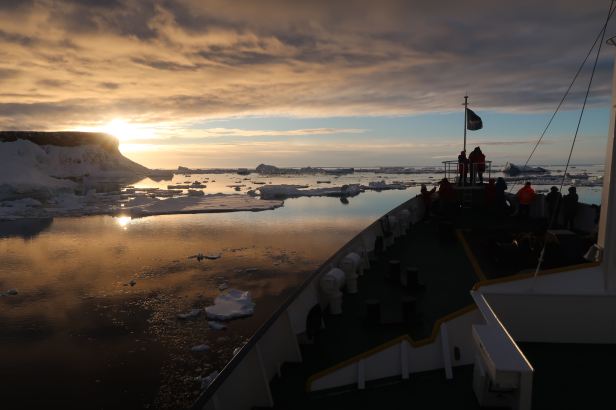
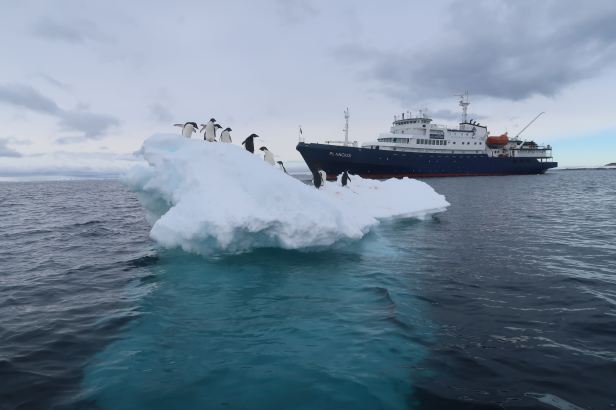
In the water and on floating pieces of ice were dozens, if not hundreds, of the elusive Adélie penguins, simply being penguins.
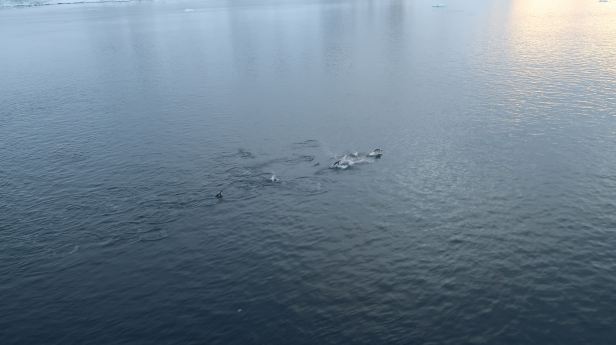
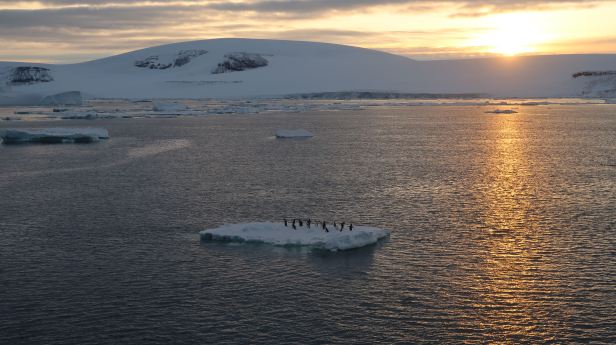
The sun had, by then, come up, but that event had passed almost unremarked.
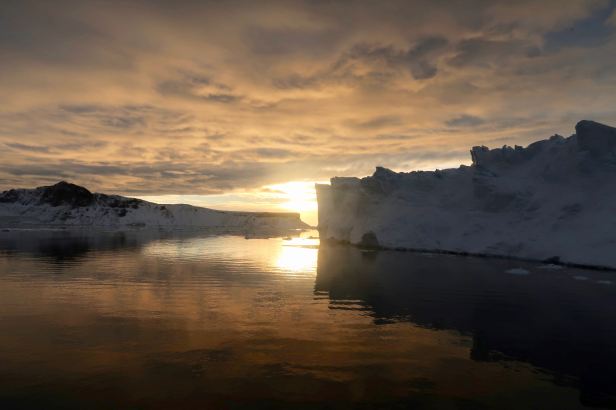
We took dozens of pictures, the vista was changing every second and it only ever got more picturesque. It was still bitingly cold but, despite the fact that we were on the ocean, which was as flat and calm as a mill pond, it was a very dry cold. It vanished the second we took refuge in the lounge for a hot cup of tea.
Wendy, from our gang, remarked that all the days on a stormy ocean has been well worth it. That summed it up. The primeval beauty of an untouched piece of the planet all around. I am not surprised that our ancestors were so fascinated by what we were seeing that they kept coming back for more. Despite conditions that were harsher than anything we can even imagine, they were willing to risk their lives to discover the secrets of this region. I cannot really go on, I would only start repeating myself or have to start searching a thesaurus for synonyms. As I said, you have seen it on television, there it was – at our frozen fingertips ….
Unpredictability is very much the name of the game on this expedition and safety is very much the watchword. It was, therefore sad, but not off of the spectrum of possibilities, when Ali announced over the tannoy that our proposed landing and hike on Devil Island would not be going ahead. That was because the density of sea ice on the approach was too great. Having once read the book ”Papillon”, my obvious disappointment was also tinged with relief !
Ali thought on her feet, indeed it seemed she was seldom off of them. As we were already in the astoundingly beautiful Antarctic Sound and just off of Andersen Island, a Zodiac cruise was organised.
We wrapped up really warm – even I included an extra layer and took my hat and gloves. The Plancius dropped anchor and out onto the sea we went. There were icebergs of all sizes and compositions everywhere. Old ones, new ones, made from freshwater, made from frozen seawater, huge beyond belief, tiny and on the verge of disappearing for ever. A glorious mish mash of frozen precipitation.

Unusually, all six of our gang made it into the same Zodiac. It was very cold out on the sea and I was really glad that I was well wrapped up. Our driver was again Martin and he navigated through the mass of floating ice with skill and aplomb.

Almost the first thing that we saw was a whale, in this case a Humpback, together with its calf which alone was bigger than my SUV. Of course, all the Zodiacs headed towards it, but it did not want to play and, with a swish of a mighty fluke and a much smaller one, the pair dived deep and were gone.
We were keen to see Adélie penguins up close and, despite the myriad we had seen fishing from the rail of the ship, there did not seem to be many about. The Zodiacs chugged amongst the ‘bergs in a quite spread out formation and sightings were relayed by walkie-talkie. Each Zodiac had another one as a close companion, just in case ….
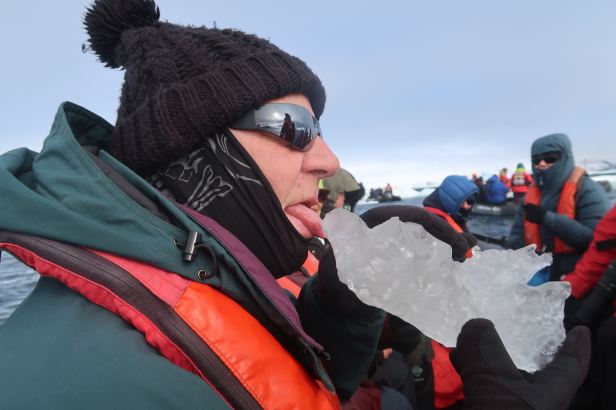
Even without wildlife, the sheer, harsh beauty of our surroundings was simply a sustained assault on the eyes. Whites, greens, blues everywhere. Martin reached over the side and picked up two small chunks of floating ice. One was as flat and as clear as a window, the other was greenish, opaque, still smooth, but not flat. The green piece was sea ice that had been long submerged, but which still contained quite a high percentage of air. The clear piece was very old, probably hundreds of years, with no air bubbles at all. We were invited to lick them. The smoothness of the surface in both cases was total and neither, oddly, tasted in the the least bit salty. Wendy dropped the clear piece and it shattered. It was lucky it was not a Ming vase of similar vintage !

A couple of Adélies were spotted on a floating piece of sea ice and, like Orcas, the Zodiacs converged. I still could not quite work out what it was about penguins that make them so totally irresistible, but those Adélies had it in spades.

We were not supposed to stand up in a Zodiac, let alone dance, but at that moment a skua alighted next to the penguins and, lo and behold, it was the South Polar variety. Our companion boat, piloted by Susie, rocked alarmingly as her passenger complement of “birders” deliriously tried to photograph it. In case you care, to my eye it was a lighter brown, albeit almost imperceptibly, than all the other skuas we had seen.

We chugged around and did find a few more small groups of Adélies, including some that were doing the “tobogganing on their tummies” thing, which was totally hilarious.
Then, suddenly, there was an air of concern in the walkie-talkie messages. In the wind, the ice can move with surprising swiftness to close the “leads”, which are the areas of clear water through which vessels navigate. We were, it seemed, totally cut off from the Plancius. We could see it, across the bay, but we could not get there. It was a reminder, if one was needed, of how easy must have been for those historic seafarers to get stuck in the ice. This was especially in winter, when everything moved and froze right in front of their eyes. Where were the Chilean helicopters, I thought, when we needed them ? The Zodiacs grouped together and we slowly circled.


Luckily, after only about ten or fifteen minutes, the still drifting ice opened up a large lead and we motored speedily through. In our boat, Martin had seemed totally unfazed throughout, which had communicated itself to us. In Susie’s Zodiac, the “birders”, with their really l-o-n-g lenses, were all trying to snap Snowy petrels and Antarctic terns and probably never even noticed.


As we waited, in a line of Zodiacs, to get back on board, a large iceberg in the middle distance simply rolled over. Tiphanie shouted, so we had time to look, but not to photograph it, as it toppled gently over onto a new axis. It was at least a mile away, but the wash from the event was still quite significant when it reached the Zodiac a few minutes later. Having been submerged, the “new” top of the iceberg was a translucent green.
On a flattish sea, embarkation from the Zodiacs was quick and easy. Everyone gathered in the lounge. We did not realise how cold we were until we got into the warm – a lot of teas and coffees were consumed as the Plancius raised its anchor and chugged slowly out of the bay.
The whole area was a nature lover’s paradise. I would have liked to have had a nap, but every few moments the tannoy would announce some new visual thrill. Fin whales, Humpback whales, pods of Orcas (seemingly not hungry ones), Adélie penguins, it was an unending array. Then, huge excitement and a “birder” stampede to the Port side. It was an Emperor penguin. A juvenile admittedly and lacking the more distinctive adult plumage, but the “birders” were delirious. Standing next to an Adélie, it dwarfed it. An Emperor was a rare sight indeed and that ticked the seventh and final box in the list of penguin species it was possible for us to see.
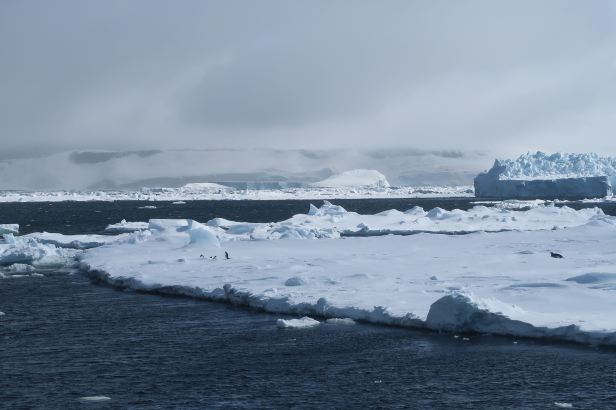

Now we had only the Weddell seal, the Leopard seal and the, never yet sighted, Blue whale, to go !
In the end I did have a short nap. Then it was lunch where, on two occasions, whales “blew” right outside the restaurant windows. Then it was time for the cruise to Paulet Island.
As we dropped anchor, Ali announced over the tannoy that there was such a proliferation of wildlife on the beach that half of us would land and half would cruise the bay – and then swap over.
Paulet Island
We were very near the end of the queue, the very last boat in fact and our driver was Tiphanie. We cruised the bay, viewing the immense Adélie colony from a distance.
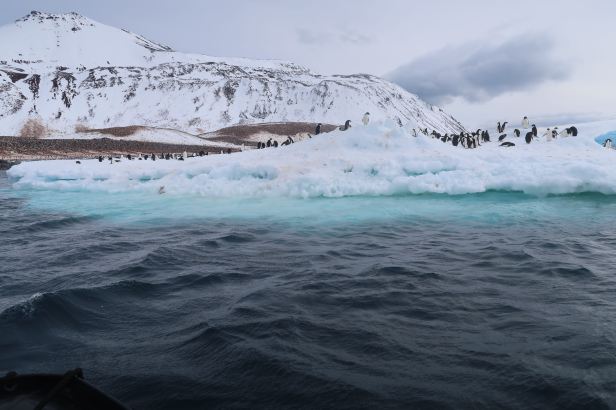
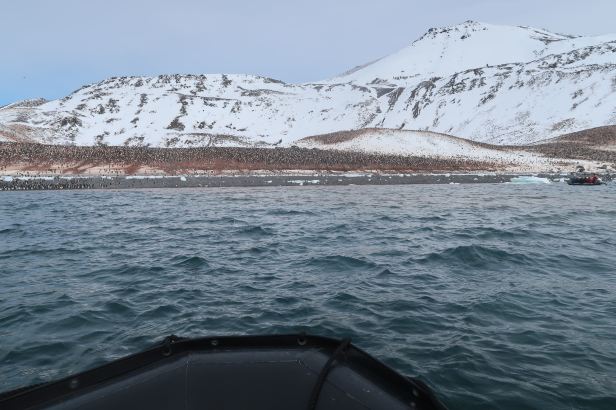
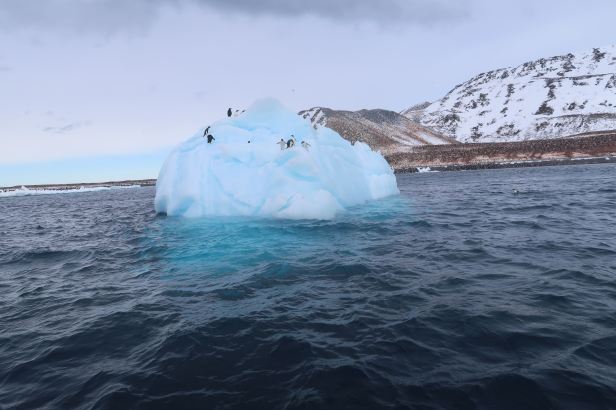
I keep saying it, but it really is almost impossible for any penguin to do any single thing that does not make you smile. There were a number of icebergs floating in the bay – and on almost every one Adélies were trying (comically) to climb them, failing (comically) to climb them or, having somehow ascended what appeared to be sheer walls of glassy ice, jumping (comically) back into the sea, or starting to jump and then (comically) deciding not to …. I am sure you get the picture !
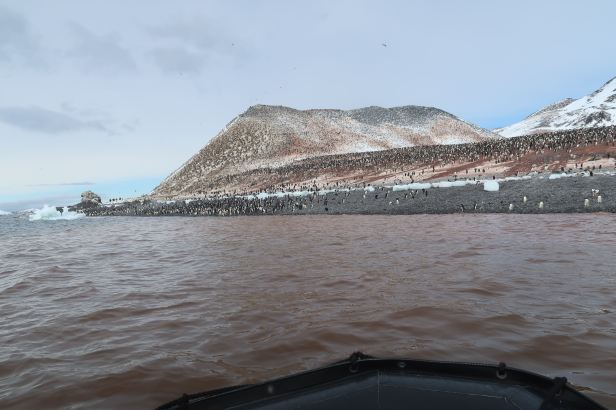
After an hour we landed on the beach. The water near to the tide line was a strange shade of brown. Let us not go there. The beach itself was large shingle, with small icebergs marking the high tide line. This provided a handy demarcation line for our walk. Fifty-five people below it, countless thousands of Adélie penguins above and I really do mean countless thousands.
When talking about penguin colonies, it is easy to use the word “thousand” lightly, but the area of the colony was vast -and they were packed in tight. Maintaining the recommended distance was simply unfeasible, but it did not seem to affect the penguins one iota. The island had a few flat sections and a couple of low ridges, all of which were packed fairly solid. There was also a reasonably high hill, if not a low mountain and the birds were stacked upon the slope almost vertically in places – and, it appeared, upon the summit too. From high above, the birds were peering over the escarpment and who knew how far back from there the colony continued ? The only comparison I can think of is the appearance of the first line of Zulu impis above Rorke’s Drift in the film “Zulu”.

At one end of the penguin colony, there was also a large colony of Blue-Eyed Shags whose far more substantial (and more widely spaced) nests also stretched high up the near vertical cliffs.


Near the Shag colony, a group of raucous Skuas were varciously tearing something to pieces. Penguin or Shag, it was impossible to tell.

Adélie penguins build nests out of stones and the male sometimes gives the female pebbles to attract her. It was too late to be building the nest and attracting a female, but we still saw a penguin carrying a pebble. After a while, he put it down and walked away. In the evening, when Ali asked who had seen an Adélie with the pebble, at least half our hands went up.
Some penguins are lazy and, instead of finding their own pebbles, they prefer to steal them from their more industrious neighbours.
There is a great video of this:
https://m.youtube.com/watch?v=M–8devfaaA.
Down where we were, the Adélies were being as amusing as they had been on the icebergs. The stench was worse than any to which we had, until then, been subjected – and not by a small margin. It was, quite simply, overpowering. As were the birds themselves, Whilst I would accept that their amusement factor is probably subjective, their ghastly stench was not. There were “Shit Chickens” everywhere. Considering the amount of “food” available we were surprised that they could walk, let alone fly !
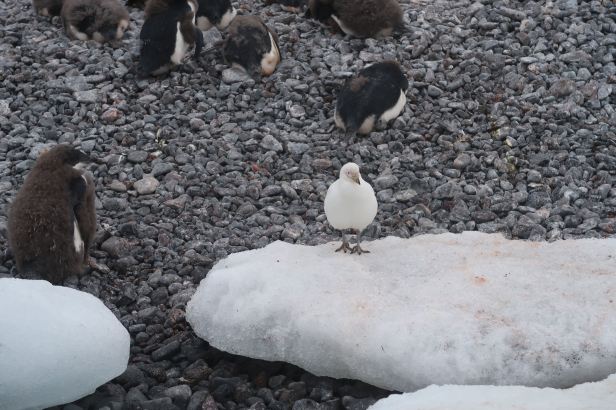
It was usually possible to tell, just by looking, whether a bird was going to, or from, the beach. The ones going towards the sea were more brown on their fronts than white. That was the reason, no doubt, for the odd colour of the water at the tide line. Returning birds, despite the odious shallows, were white breasted – at least until they set foot in the colony. Even the snow was brown.

It was also noticeable that the ice blocks on the high tide line provided a source of fresh water. We saw many adults helping themselves to a beakful of ice.

Because it lives so far south, the Adélie has a very short breeding season. The chicks were in a variety of stages in their development and were, universally, fatter than their parents. The demands of the chicks for food was unceasing.

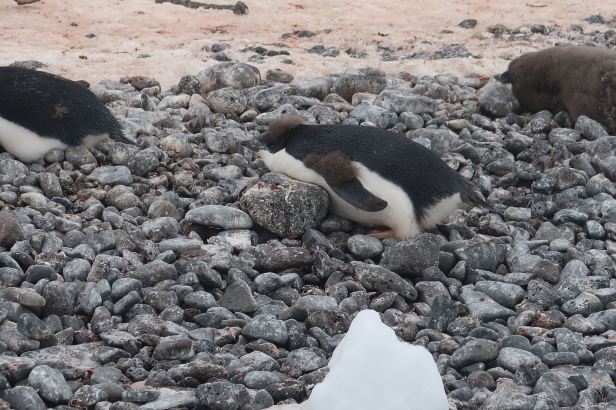
Some chicks were still totally covered in down, some were moulting — we saw several that were on the verge of fledging and had shed all of their down except for a kind of “mohican” hair style.
The incoming tide was making our part of the beach very narrow, so we decamped back to the Plancius. It was a relief to leave the smell of the guano behind – only we did not. It seemed to have insinuated itself into our very clothing. We bio-cleaned our boots and over-trousers, we both showered and took new clothes, we showered our over-trousers – and we could still smell it ! In fact, wherever we went on board we could smell it, so it was not just us. The colony might have been miles away by then, but it was still, very much, with us.
The daily recap was brief. We would try two further landings the following day in the South Shetlands, slightly to the north of the peninsula. Then, that would, effectively, be it. We would leave for the crossing of the Drake’s Passage and then transit back to Ushuaia. Our odyssey would be coming to an end.
Dinner was quiet, we had all been up since before 04:00 and it was clear our beds were calling us all.
 Travels with my Harley