Saturday, January 18th, 2025
As I had mentioned before, I was sending a daily bulletin to a group of friends. Sadly, it appeared their education was a bit lacking. As I am certain that you know, the phrase “a surfeit of lamphreys” referred to the death (unfortunate of otherwise) in 1135, of the English King, Henry I – from eating too many lamphreys ….. It is lucky poor Henry did not like bacon.
When I woke up, shortly before 06:00, something was different, there was no rocking movement. The previous evening, Lucie’s map App, “Mapy” had shown us approaching the twin islands that together comprise the Falklands. Now we were there.
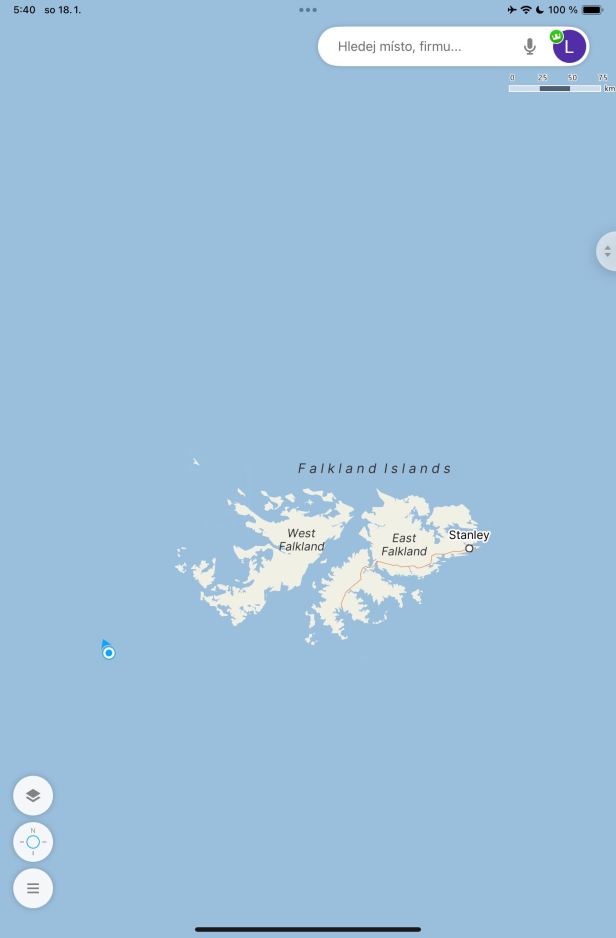
In the night we had reached New Island, in West Falkland and were now at anchor in the scarily named “Coffin Bay”. Coffin Bay, incidentally, got its name from Coffin & Sons, a Nantucket based whaling company that once was based there.
According to the ship’s log, our position was 51°43.7’S / 061°17.0’W

It was a bright sunny morning, the temperature outside was twelve degrees and I was not uncomfortable to be out on deck in just my tea shirt. We would need to dress up properly for the trip though, or we would not be allowed on the Zodiacs. A warm day beckoned.
We ate breakfast, mercifully, perhaps, it was bacon free (but I did have two fried eggs). Then we returned to our cabin to “suit up” for the Zodiac trip to the beach. This involved our big rubber boots (all landings were ”wet”), our motorcycling rain gear and, of course, a life-vest. We had two life-vests each. A large one, for a real “abandon ship” moment – and a smaller one for the Zodiac. The latter was comparatively heavy, because it had a gas bottle that would automatically inflate the vest if it came into contact with water. In the warm sunshine, I was soon a very warm boy.
Coffin Bay
The short trip by Zodiac, was exhilarating in the blue sea and under a very blue sky. During the trip, a pod of Peale’s dolphins played quite actively with us. We landed us on a sandy beach, a short distance away from a small settlement.
The first thing I saw, in the half distance, was a pair of adolescent Striated Caracaras, which is a carrion bird, tearing the remains of something to shreds. Nature was why we were there and it is, as they say, red in tooth and claw ! The Caracara is, incidentally, also known as the “Mexican Eagle” and appears on national the flag of that country .
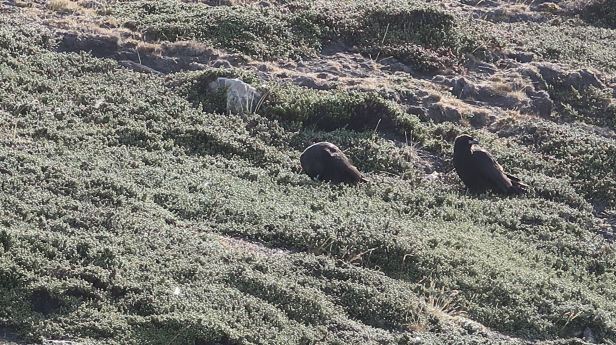
There was a wreck of a former sealing boat, the Protector (but, presumably, not of seals or whales) in the bay and the Caracaras had a nest in it.
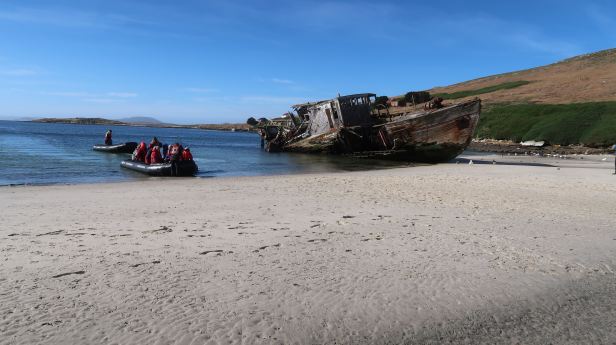
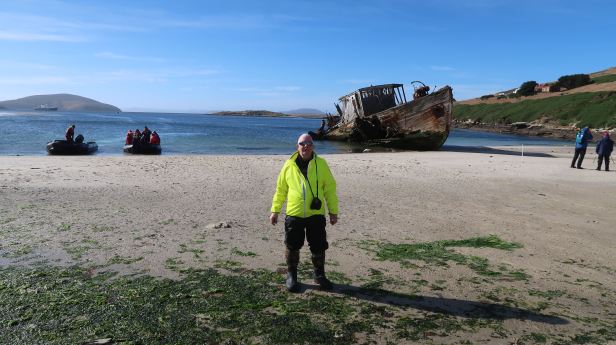
There was a small museum behind the boat. The museum mainly concerned the, now defunct, whaling industry, but the building itself had an historical origin. In 1813, despite the fact that Britain and America were at war, a British captain, Charles Barnard rescued the passengers and crew of a sinking American vessel. When Barnard went ashore for extra provisions to feed them, the rescued Americans stole his ship and abandoned him. He and his three crew were marooned for eighteen months before being rescued themselves. The museum is built on the site of their shelter and its foundations are said to be the oldest in the Falklands.
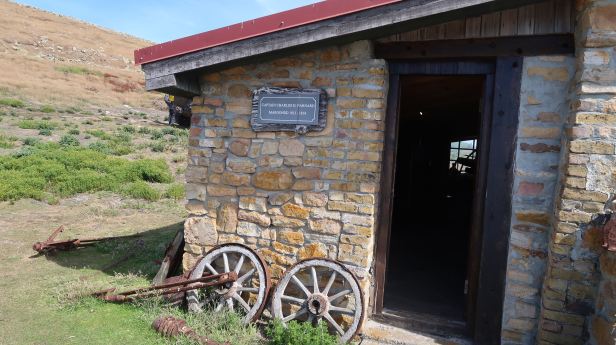
We were given quite strict instructions as to where we needed to go and how to get there. The tracks, which led gently uphill, were marked and we were told not to wander off of them.
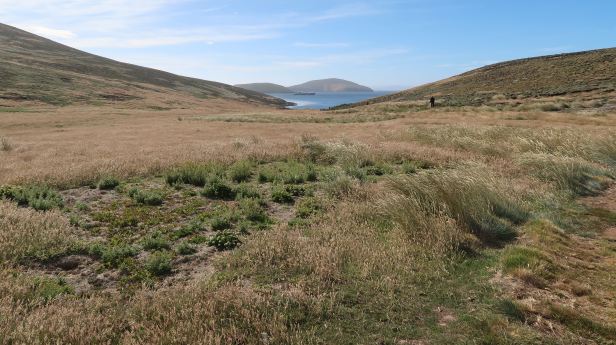
On the soft turf and in rubber boots, the going, whilst not murderously hard was tougher than it looked – particularly as it was very warm. I first abandoned my fleece and, soon after that, my jacket too. I was the only one walking about in a tea shirt, which excited a lot of comments, but I was still far too hot.
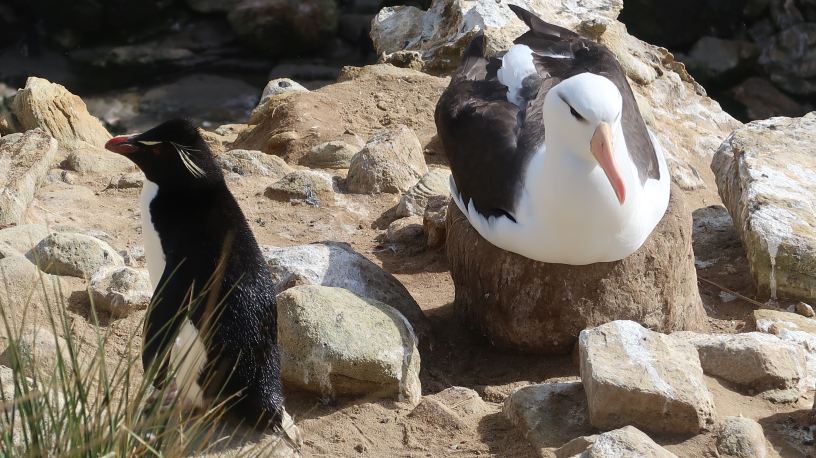
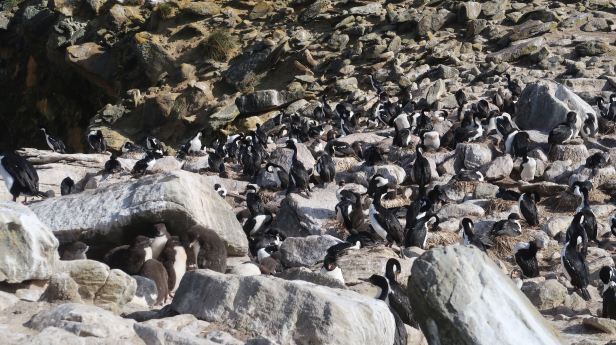
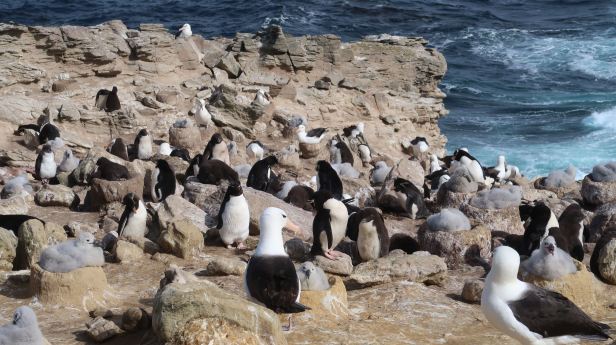
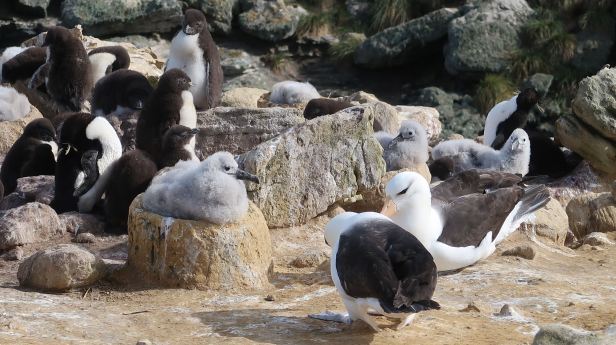
The wildlife on the island seemed to be exclusively avian although I know there must have been rats, There were birds, of varieties that you only usually see on wildlife documentaries, absolutely everywhere . In the main, they seemed totally unconcerned by our presence. There were geese of various types wherever we looked, the Tussock grass was teeming with them. Sinister skuas swooped overhead and, as we came to the cliffs, we encountered a huge mixed breeding colony of Imperial Shags, Rockhopper penguins and Black-browed Albatrosses. Apparently, the Rockhoppers think that the presence of the huge Albatrosses discourages, as far as is possible, predation by the circling skuas.

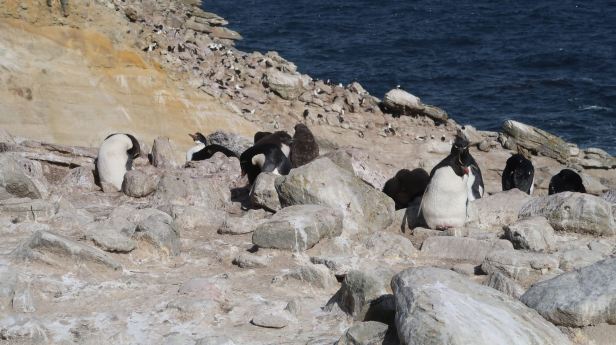
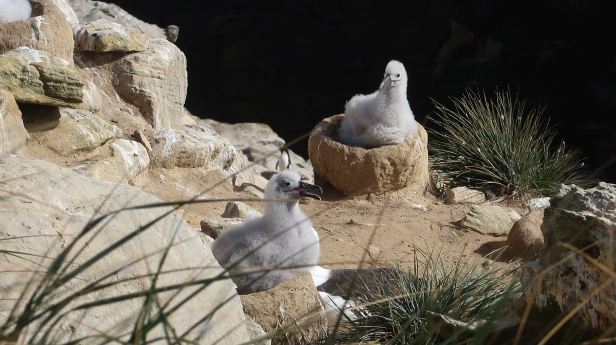
The Albatrosses, which were indeed huge, have a wing span of almost eight feet. They construct quiet elaborate nests of mud which resemble cups and bear that name. Fat chicks, still in their grey, fluffy down, sat in the cups. Periodically, an adult would appear and regurgitate some fishy goo for them to eat. The Rockhopper chicks, each guarded by a non-fishing parent, just lay in the sun. Like all penguins, they were impossibly cute and, as we were to discover, like all penguin colonies, the whole place had a fearful stench.
Then it was a hike back to the beach. On the way back down the slope, we saw a Long-Tailed Meadowlark. It had a strikingly red breast and was slightly at odds with the drabber plumage of all the geese in the surrounding moorland.
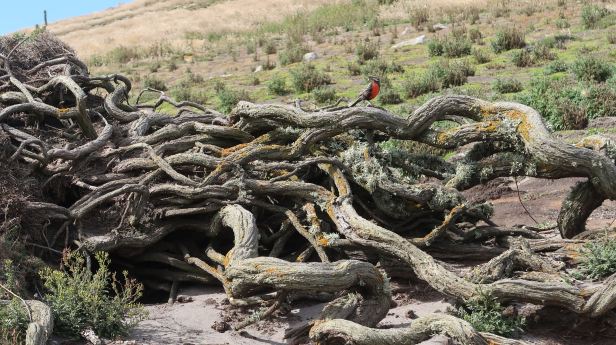

We took a quick turn around the small museum and a brief walk along the bay.
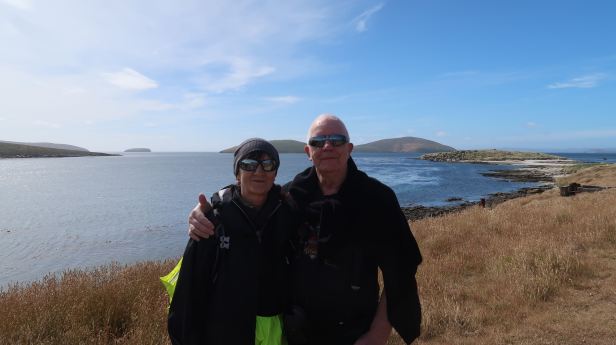
Then, it was safety gear on and another exhilarating Zodiac ride back to the Plancius.

We took off our wet stuff and enjoyed a pleasant lunch. I just knew I was going to gain weight on the trip ! While we were eating, the Plancius moved a few miles (British Protectorate, remember !) up the coast of New Island and dropped anchor in a new location.
That meant that, as soon as lunch was over, it was back to the cabin, back into boots and waterproofs, back to the Zodiacs – and back out onto the water.
North Beach
On the second beach, North Beach, an Elephant seal, albeit quite a small one, lay in the shallows. It really was becoming like actually being in a wildlife documentary.
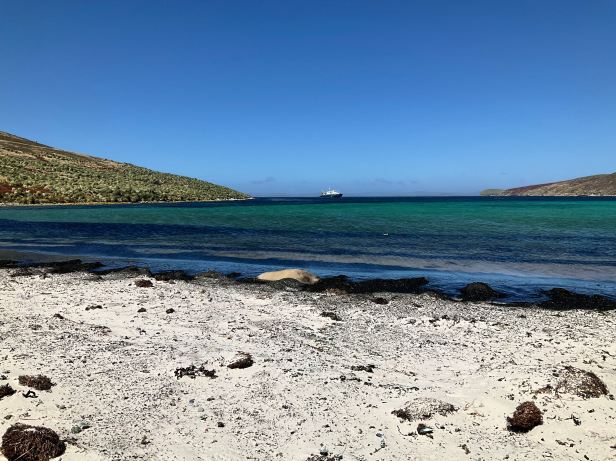
A rib bone, presumably from a whale, lay on the beach.
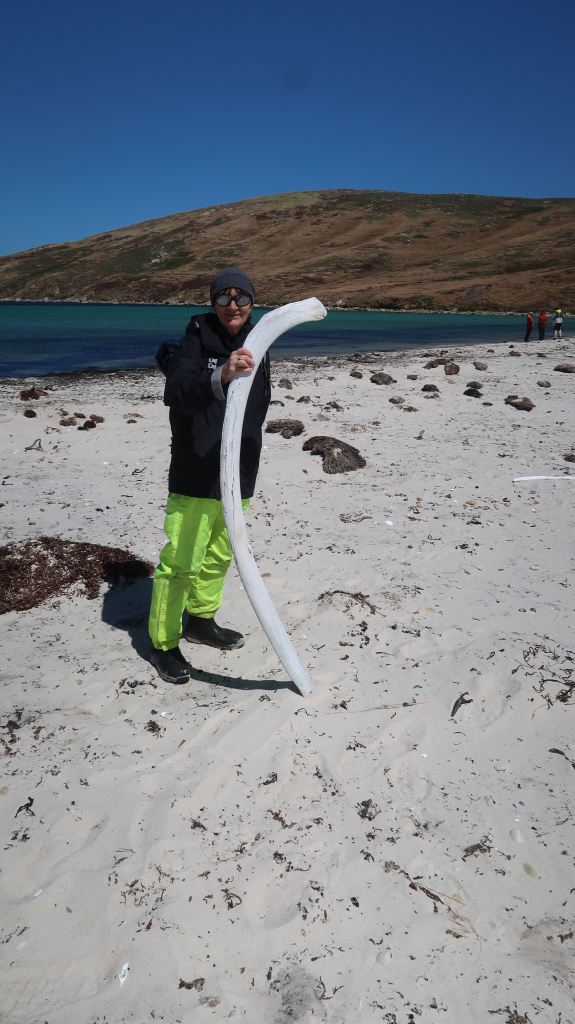
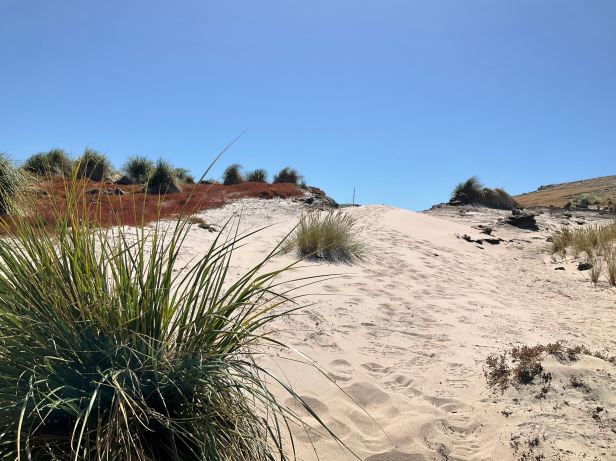
We made our way up a sandy slope, which was not easy in rubber boots and across a section of peaty moorland.
At the top of the hill, was one of two colonies of another species of penguin, the Magellanic. A group of maturing chicks (they had lost most of their down) were being guarded by some adults. Periodically, a skua or a Caracara would drop into the crowd of chicks – only for the adults to collectively drive it away.
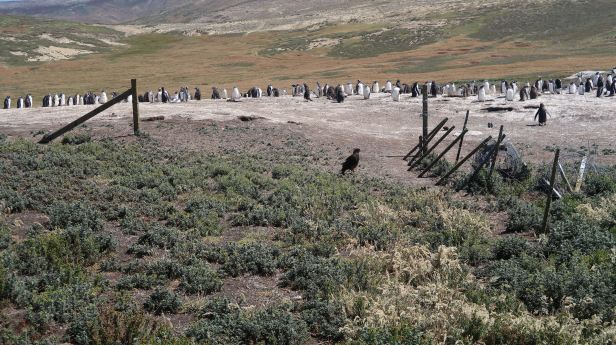
The sea was about half a mile distant. A steady stream of adults was walking up, or down, the slope, either bringing fish to the chicks or going to get some more. At the bottom of the slope was a third penguin colony, but these penguins were Gentoos. The Magellenics were walking right through the Gentoo colony – but the latter species seemed unfazed by this.

Adults of both species were fishing in the bay.

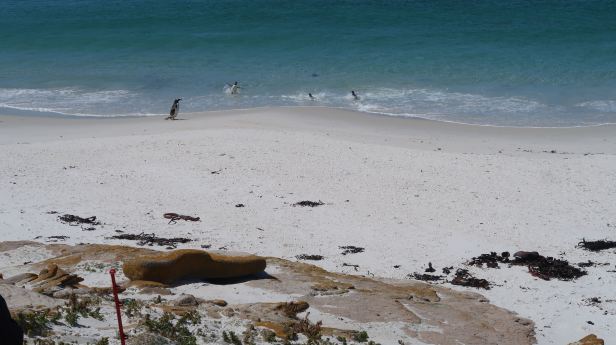
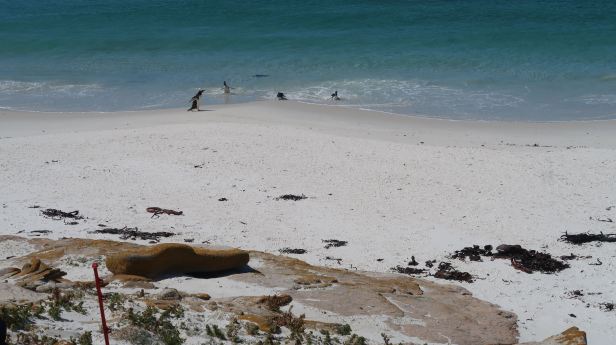
That moment when they smoothly swim through the breakers and emerge waddling clumsily onto the sand was something Lucie and I had never observed “live” before. It really was a funny sight !
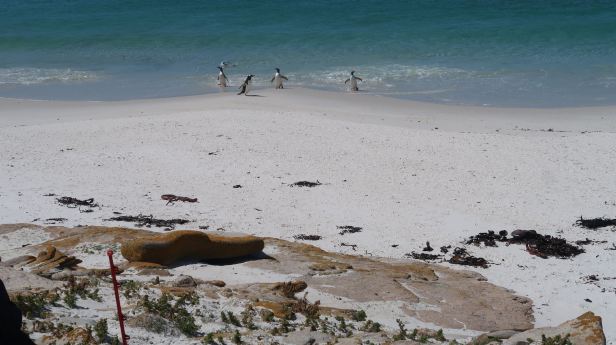
We walked, or should I say trudged (walking in those boots was not easy !) back up the hill. At the top we took a route to see yet more Albatrosses and found them again sharing their crags with some Rockhoppers. It must have been a huge climb for the small penguins, but they obviously feel the greater security makes it worthwhile. The scenery at this site was really spectacular – stark, sheer, cliffs, a picture-postcard azure sea that was far colder than it looked and a sky full of constantly wheeling Albatrosses.
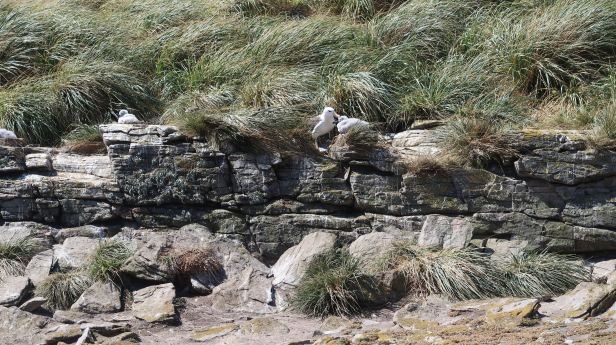
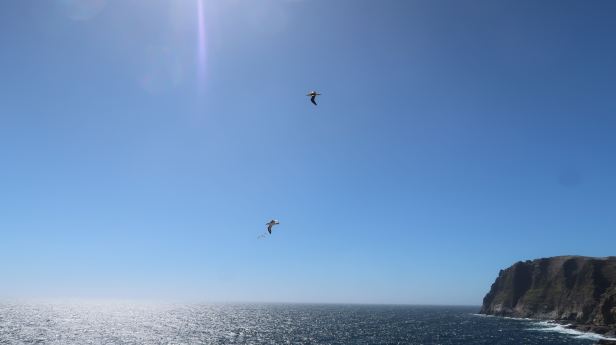
The wind was steadily rising as we walked back down the hill towards the bay.
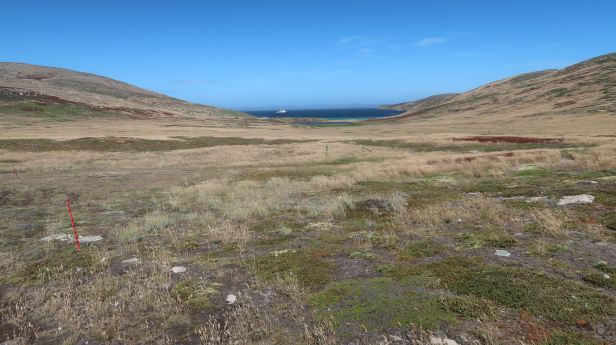
Strangely, because they seemed to be so sociable, we encountered two penguins, a mother and her chick, on their own and a long way from the colony.

The increased wind made the trip back to the Plancius was really rough and splashy. The waves had become very high and the Zodiac had difficulty docking. During the disembarkation process, we all got very wet. If that happened in South Georgia, we thought, it would not be much fun at all.
At the daily round up, the expedition leader, Ali, revealed that the winds had been at the top end of the safety limit – but nobody seemed to have been that bothered. We had an informal contest about who had got the wettest (Lucie and I were not even in the top ten) and agreed we would all have paid good money for the same experience at Disneyland.
The following day, we were told, we would spend the morning in Port Stanley, the capital of the Falkland Islands. We were given a run through of the delights that awaited us and we were told that, as there is a jetty there, we could do a “dry” landing in our normal boots. Hooray !
We had another good, set-menu, evening meal at which two more ladies, Wendy, from Newcastle and Amanda from Worcestershire (which she said sounded better than Birmingham) joined our “gang”. Like us, they were ticking off a bucket- list item. Normal people, living the dream, the Plancius seemed to be full of them.
The last item of interest was that, as part of our route around to Port Stanley, the Plancius would need to navigate a narrow channel, between two islands which rejoiced in the name of “the woolly gut”. Quite where the name came from was not divulged, there were certainly no sheep to be seen. The ferocious winds at the “in” end dropped to almost nothing as we passed through the sheltered channel – only to pick up again as soon as we emerged.
It looked as if it would be another rough night !
 Travels with my Harley