
Monday, January 20th, 2025
“A life on the ocean wave
A home on the rolling deep
Where the scatter’d waters rave
And the winds reveal their keep
Like an eagle caged I pine
On this dull, unchanging shore
Oh give me the flashing brine
The spray and the tempest’s roar”
Henry Russell, who wrote the well-known words above, must have been stark, raving, bonkers !
It was a rough night but, in truth, not as ghastly as a look out of the window might have presaged. I did get woken up a few times though. I just wish Lucie could have been a little bit quieter when she was replacing the things that had fallen down in our cabin.
Daybreak brought the view of an endless sea of, errr, sea, through our window. It looked looked grey and vaguely threatening. Of course, to anyone who knows me well and knows how I feel about the sea, would realise that I would use practically the self-same phrase about the sea for any that I saw. All I would do would be to adjust it to the hue of the actual water. Sadly, it is all we would see all that day – and the following one too.
According to the ship’s Log our position was 52°13.8’S / 052°13.5’W
Breakfast was quite merry. Previously, I would never have believed that I could even contemplate a glass of water in such conditions, but I tucked in with a will (Coco-Pops and pancakes with maple syrup for you “bingo” people).
I have mentioned many times that I do not really like talking to people that I do not know. However, for some reason, it appeared quite an easy thing to do on this expedition. Today, we were joined at breakfast by a Belgian guy who had heard Lucie mention that she was a scientist. He was reading the book “Every living thing” by Jason Roberts. After admitting (possibly with his tongue in his cheek) that he had been brought up believing that the world was created in a single day, two thousand years ago, he had bought the book to expand his understanding of evolution. He ended up discussing the pros and cons of Linnean classification with Lucie – and it was not yet even 08:30 ! He had also worked in banking IT at one point, but had, almost by accident, it seemed, become involved in conservation to the point where he now represents Belgium at a national level on conservation issues.
Our first talk of the day was given by Koen and was about penguins. I think everyone on board was in attendance. Let us face it guys, who DOES NOT love a penguin ?
I do love it when someone really likes and understands what they are talking about and Koen’s talk was informative, interesting and speckled with wry humour. He may have been preaching to the already converted, but we all loved it and he was roundly and rightfully applauded at the end.
In case you care, there are eighteen species of penguins in the world, although some say nineteen. There are eight species in Antarctica. So far we had seen some Magellanics, some Gentoos and the smallest ones, the Rock Hoppers, which have fluff on the sides of their heads and look a little angry because of it. We not yet seen the slightly bigger Macaroni species, which really was named from the Italian pasta. That story is, apparently, a bit long and complicated and Koen did not go into it. Some members of the expedition claimed to have seen a stray Macaroni in the Falklands, but Lucie and I had not.
Skipping two other species in size, the Adélie (according to Koen, the most psychotic penguin) and the Chinstrap, we got to the Magellanic penguin, which has plumage that seems to give it a white “scarf” around its neck and the Gentoo. The Gentoo is already pretty hefty by penguin standards and we had seen some in the sea hunting. The previous six species are all surpassed in size by the King penguin and, also, by the biggest of all, the Emperor penguin. Although we were told we we probably would not see an Emperor, we would encounter huge colonies of Kings in South Georgia. One thing was certain, none of us would have any difficulty differentiating between the little blighters after that talk, that much was for certain !
The next talk was about South Georgia and given by Tiphanie. They were officially claimed for Great Britain, with a ceremonial volley of musket fire, in 1775, by no less a personage than Captain James Cook.
Although famed for his navigational skills, Cook had thought he had located the “White continent”, as Antarctica was then known, when he first saw South Georgia.. Upon discovering his error, he petulantly named the site where the “claim” was made Disappointment Bay. The Georgia part of the name refers to the British monarch of the day, George III.
South Georgia is also close to the (South) Sandwich Islands, which Cook named after his patron, the Earl of Sandwich. Oddly, Cook met his end thousands of miles away, in the North Pacific, at another Sandwich Islands that we now call Hawaii …
The whole of South Georgia, which also includes the South Sandwich Islands, is a British Protectorate. Now that sealing and whaling are prohibited, the islands no longer have any permanent residents and its government is based in Port Stanley. South Georgia is now attempting to return itself to its pre-exploitation form. Stringent fishing rules are in place and whales of all species, together with Fur and Elephant seals are slowly regaining their pre-hunting era population levels. Programs are also in place to remove invasive species. Reindeer and, almost unbelievably, rats have both been eradicated. Dandelions are proving harder, but the work goes on.
The evening briefing was chiefly about the extremely strict and rigorously enforced bio-protection regulations for South Georgia. We will all have to carry out a supervised cleaning of all of our external clothing and sign a form to say we have done it. We would also be randomly checked before disembarkation by bio-protection officials from Grytviken. Lastly, there was a wildlife “promo” video for the island, personally narrated by Sir David Attenborough. We could hardly wait to get there.
The last lecture of the day was about seals. There are two main types and it is a bit confusing. In general, they are divided by whether they have visible ears and can propel themselves with their front flippers, or whether they move only on their bellies and do not have ears. The Fur seal is of the first type, the Elephant seal is of the second. We had seen one, juvenile Elephant seal in the Falkland Islands – but the rest were all Fur seals.
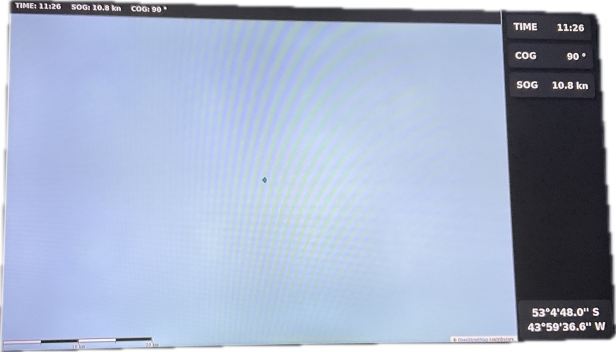
There was a “where we are” display on the television in our cabin, which showed a tiny black dot on an entirely blue screen. Slight variations in the blue indicated that the Plancius had now crossed the point where the South Atlantic Ocean meets the very cold currents that flow directly up from the Antarctic. This invisible line is called the Antarctic Convergence. The waves were, if anything, even worse and the outside temperatures had plunged in line with that of the surrounding seas. In a matter of minutes, it got significantly colder and it was decidedly chilly out on the deck.
In the ferociously churning seas, dinner was again a set menu and also, again, quite delicious. Quite how they managed it beats me.
We had also crossed another invisible line, this one for a time-zone, so the clocks moved forward one hour. Without a signal, our iPhones did not seem to know this – and neither did Elon’s satellites. We would have to hope we would not miss breakfast the following morning. I expected the voice of Big Brother (or Big Sister, because it was usually Ali) through the tannoy would keep us in line.
Then it was time for bed, not the least because it was easier not to lurch around like a drunk person if you were already laying down.
Tuesday, January 21st, 2025
The ship had a kind of Log Book, posted on Deck Five outside of the lounge. Today it said: “sea is rough, dolphins are staying away from the ship”
After a night with the curtains closed, lest a glimmer of light should distract a passing Albatross, we again awoke in the dark. When we opened the curtains again, guess what we saw ? Any answer containing the words endless, rolling, grey and/or waves, gets a point !
For what had promised, on the surface, to be a boring day, we soon found we had a lot to do. After breakfast, where, for the benefit of the “bingo” players, bacon was consumed, the action began.
According to the ship’s Log our position was 52°43.5’S / 45°16.8’W
First we were treated, if that is the correct word, to a lecture, which appeared to have a really big “L” about bio-security in South Georgia. This had two main thrusts. The big thing was to not, under any circumstance, import, intentionally or otherwise, anything at all that did not “belong” there (which, given the very remote location of the islands, was everything).
The second was to guard against either importing or helping spread, “Avian Influenza”. This is a viral disease, thought to have originated amongst poultry in China. Thanks to the natural movements and migrations of birds, this quickly went global. After uncountable avian casualties, the virus somehow made the “jump” to mammals. Both Elephant and Fur seal deaths were already off of any measurable scale. The disease had already reached South Georgia and the onus was on us not to help spread it any further.
The next phase was a microscopic and, hyperbole aside, I DO mean microscopic, cleansing of all of our outer clothing. This included the vacuuming of every pocket, the combing of all Velcro fastenings and even scraping around any inset logo, for example on our rubber boots, to remove every tiny, “alien” particle. It took a long time and we were supervised by Koen.
We might have worried Koen a bit with our philosophical hypothesis that, what if the “Great Plan” included a necessity for there to BE dandelions, for example, on South Georgia. His frown was worrying, so we cleaned with a will in order to convince him we were not bio-terrorists ! Lucie said it reminded her of Czechoslovak Civil Defence exercises of her youth, the only bonus being that we did not need to wear a gas-mask whilst doing it.
The Plancius has a 100% good record with the South Georgia authorities on bio-safety. However, that aside, one in every ten of us would be meticulously checked again, by a government official, before being permitted to go ashore.
Because of the high-level of crew involvement in the cleansing process, there was nothing else really going on. The high seas meant that most of the outside deck was also out of bounds.
So, after a nice lunch, we retired to our cabin to do useful stuff. In my case that meant sleeping. The seemingly endless cycle of eating and sleeping, although pleasant, was beginning to pall slightly. I confess that my sleeping was an escape valve for the “stir craziness” that being confined inside was engendering.
The only part of the deck that was usable was crowded with smokers and the “birders”. The former group would pop outside, light up, smoke their cigarette and come back in. The latter group would stand there for hours at a time, cameras in hand, just in case a Lesser Pink-beaked, Sooty Petrel should appear for a microsecond on the crest of a distant wave.
From time to time, I have been criticised, not entirely unreasonably, for my own obsessions. Those guys elevated the meaning of the word obsession to a whole new level.
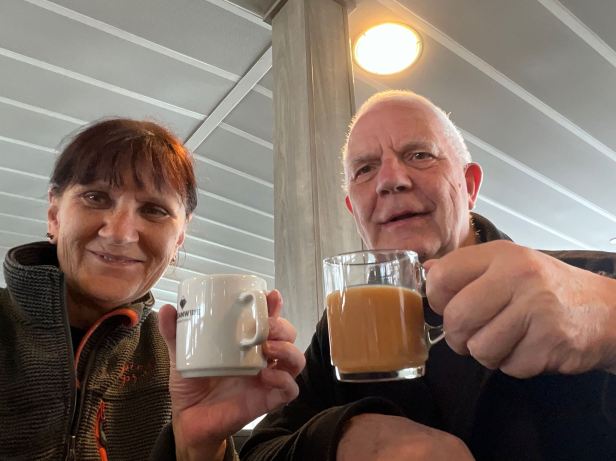
It was a Tuesday, so, to maintain our link with the outside world, we took our traditional photograph for our friends in Prague who would be enjoying Tuesday Night Drinks and partying without us ! We obviously used tea, not beer, to make the toast !
The daily briefing time rolled around and we were shown where it was hoped the ship would be the following morning. Despite the fact that, from a clock point of view, we had lost an hour, our southward course meant that the days grew longer and longer. Ali cheerfully informed us that we could reasonably expect to sight South Georgia about 04:30 – we would see about that.
Because of the Antarctic Convergence, where the waters of two distinct temperatures meet, the sea throws up a high level of nutrients. That meant lots of phytoplankton which, in turn, meant lots of whales.
I find this surprising, but apparently it is true. Whales that can talk to each other, via the medium of “whale song”, over huge distances, cannot detect an approaching ship. This meant the Plancius had to reduce its speed, so as to give the person at the wheel time to steer round any whales that appeared in its path.
I noted from the screen in our cabin that we were more than fifty-four degrees South. Despite all of our travels, Lucie and I were now some way further south than we had ever been before. If our time on shore went as expected, we would be in for an interesting time the following day.
Dinner, as always, followed the briefing. Sadly, lack of exercise and fresh air actually made eating it quite hard work for me – and Lucie could not finish hers either. I made myself a mental promise to skip a meal – sometime in the second week of February …..
Then, as usual, it was writing all this rubbish and then, in case I needed to get up at 04:30, off to bed ! Strangely, although we had not really done much, Dr Eva had told us that constantly (even if subconsciously) adjusting our stance in response to wave motion was actually quite a lot of effort. To show that I believed this, I fell asleep at once !
 Travels with my Harley