Thursday, September 10th, 2026
Distance hiked – 4.3 kilometres
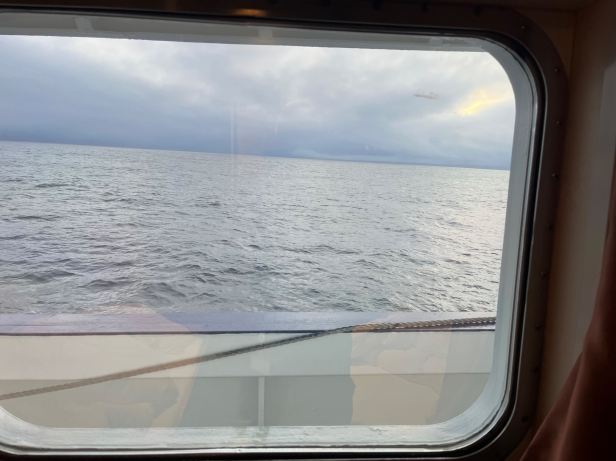
I slept like a dead person, but proved that I was not one by waking up. As usual, it was 05:30 and it proves what a sad individual that I am, when I reveal that pleased me because it was the “real” 05:30 and not that same time, but in another time-zone. I genuinely love to travel, but I also enjoy the feeling that I do have a home to go home to – and that moment was now starting to draw near. My, oh my, I sound melancholy ! The view out of the window was cold grey sea and what looked like thin fog in the half-darkness before dawn. The sea was not as rough as had been projected, but the Plancius was rolling slightly in the swell.
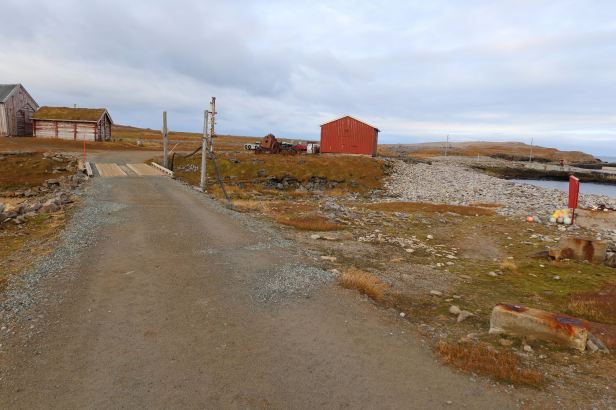
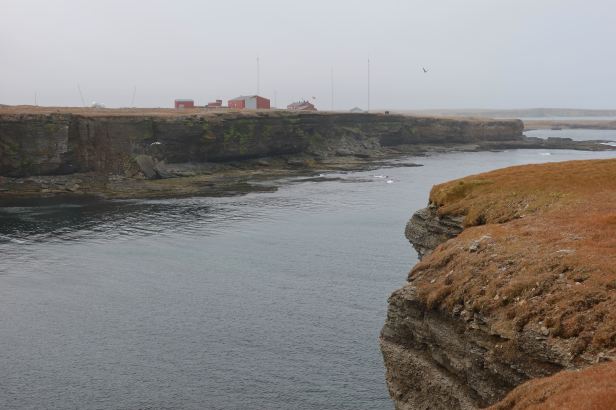
I went up to the lounge for my teas, but, unusually, my Austrian buddy, Jo, did not make an appearance. I sat at my preferred seat, by the window, hoping for the first sight of our destination, but it was not forthcoming. It was only during breakfast, when Marco sat with Lucie, Herman and me, that a brown line appeared in the distance and Bear Island (Bjornoya) rose slowly out of the sea in front of us. By the time that Captain Christophe gave orders for the anchor to be dropped, we were beneath the low cliffs on the island’s northern tip and opposite a small headland where reddish-brown buildings and radio masts indicated the position of the Bjornoya Radio/Weather Station. Pippa gave us the ten minute warning which, if you can tell your left foot from your right one and also know your own shoe size, is ample. We hurried to the gangway in record time. Fate, of course, usually finds a way to bite you so, whilst we were all ready, the shore party was delayed and we stood there in the chilly wind for quite a while.
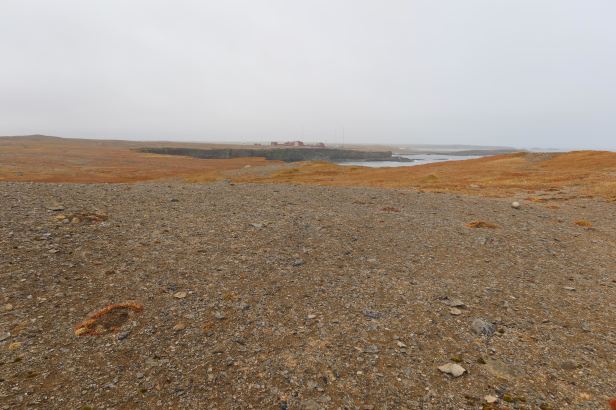
Bjornoya Radio/Weather Station
“Once more into the beach, dear friends, once more”. I think that comes from Shakespeare’s “Henry V” and, whether or not I am right about that, it is what we did. It was a very choppy journey, but experience had put us at the back of the boat, so we kept quite dry. We landed on a small rocky beach that was a bit treacherous underfoot, especially as the waves were quite high. We scrambled up the surf-polished rocks, that were more like big, smooth, pebbles, dumped our life-jackets in the bag and assembled on the road. Yes, the road.
There really were not that many of us, only about forty. The island is almost entirely a nature reserve and the only part of it that is not reserve are the radio/weather station and its immediate environs. Despite its name, no Polar Bear has been seen on the 18,000 square kilometre island since 2019. Nonetheless, the “authorities” demanded that we follow full bear protocol – and assured us that we would be watched. We split into two, equal, groups which had identical intentions but these were to done in a different order. Our group was led off by Charlotte, with Chloe bringing up the rear.
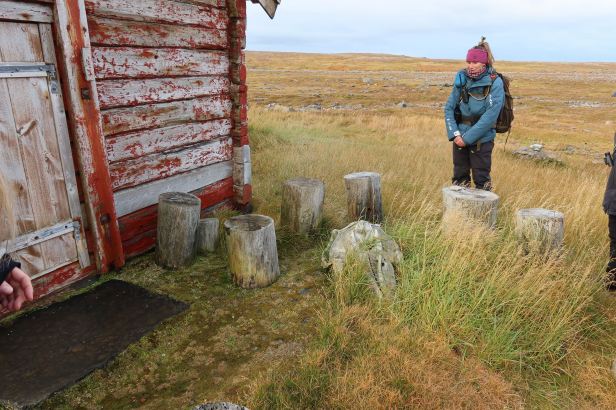
Our first stop was outside a rather shabby looking building. This was not only the station sauna, but also the oldest building, not only on Bear Island but, because the island is considered part of that peninsula to the North, also on Svalbard.
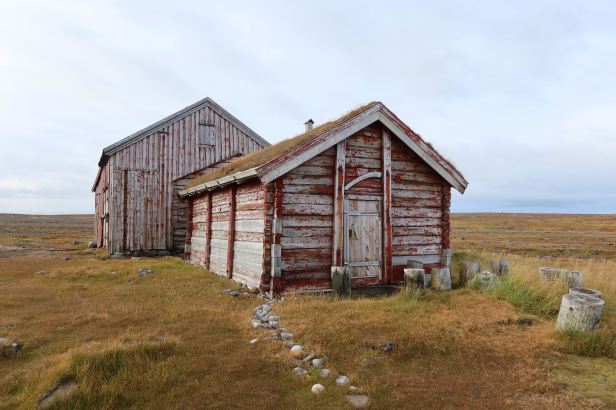
Outside the hut were some whale bones and a whale skull that was either from a small Minke whale or an Orca. Even Chloe could not be certain.
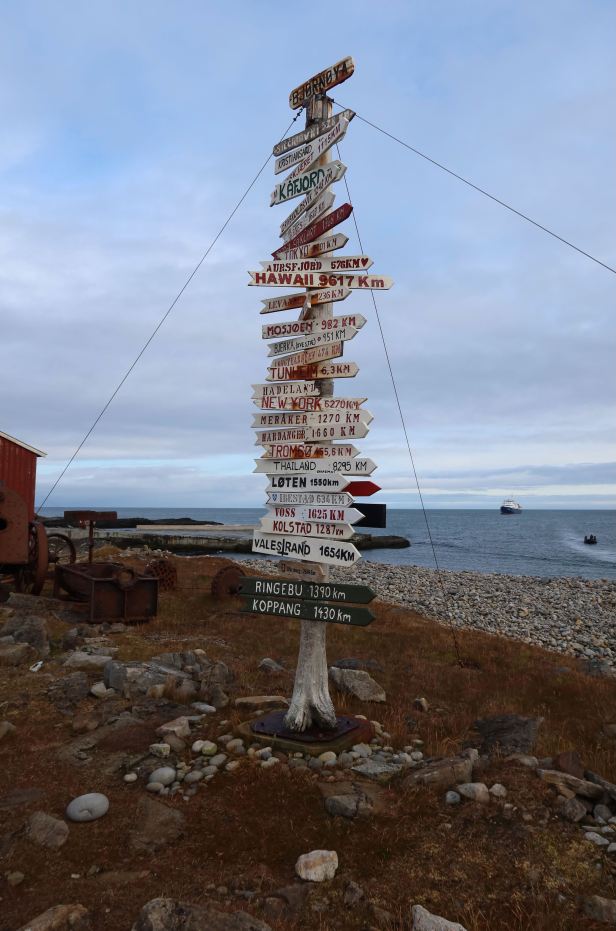
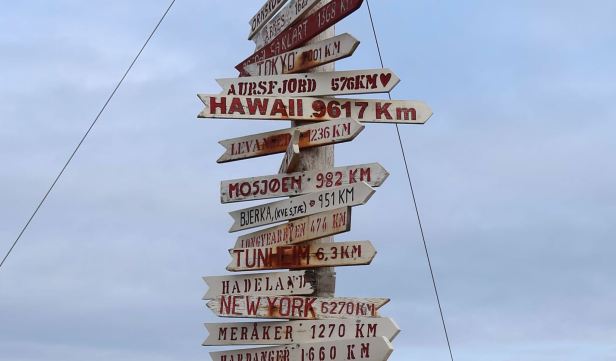
Nearby was one of those signposts that you find in remote places. The type that points to well known locations all over the world. As Charlotte led us off in an easterly direction with her rather purposeful stride, I hoped I was not taking the first steps on a 9,617 kilometre hike that would, apparently, take me to Hawaii.
The wind was cold and blustery as we made our way across a small bridge, which had an ancient sign warning of motor vehicles and then up along a road that led through the station.
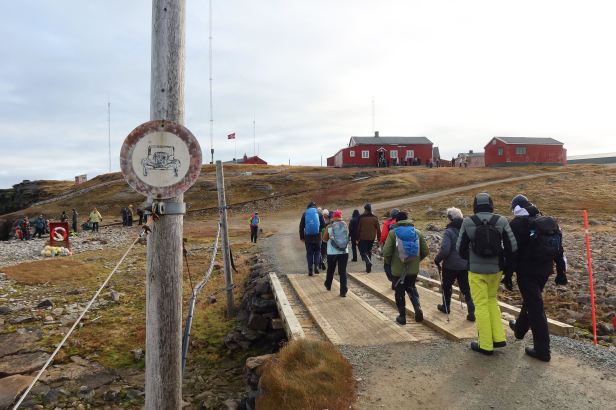
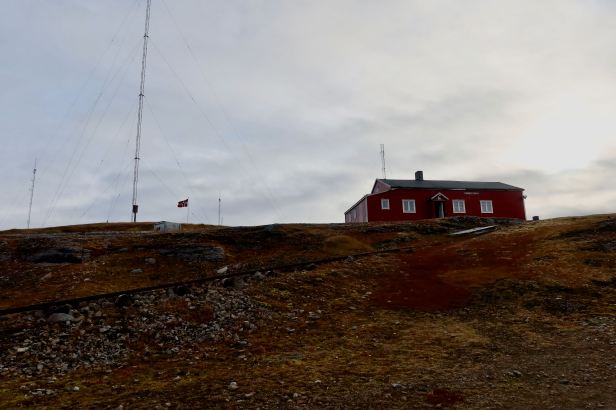
There were all kinds of those little mini-sheds, like boxes on legs, everywhere. These, presumably contained weather monitoring equipment, but we were forbidden to touch anything, so who knew ? There is a permanent team of nine people who work there for nine months at a time. The ostensible task of the installation is to measure and record weather conditions and there was no visible security, but there was a lot of cctv. We were being watched.
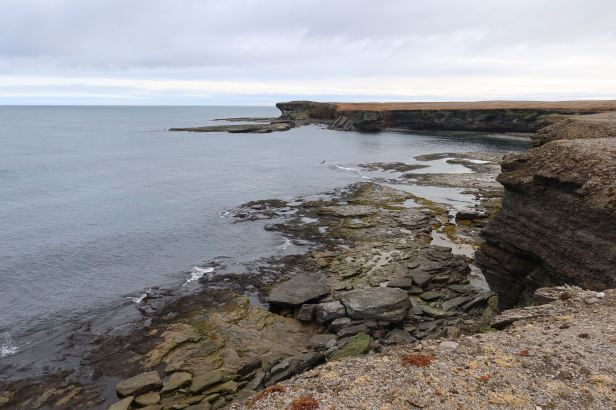
We soon left the station, which was not hard because it is quite small and headed out along the cliffs. At the North end of the island, the sea cliffs were not especially tall, but they had a rugged beauty and were obviously prone to collapse from being undermined by the ocean.
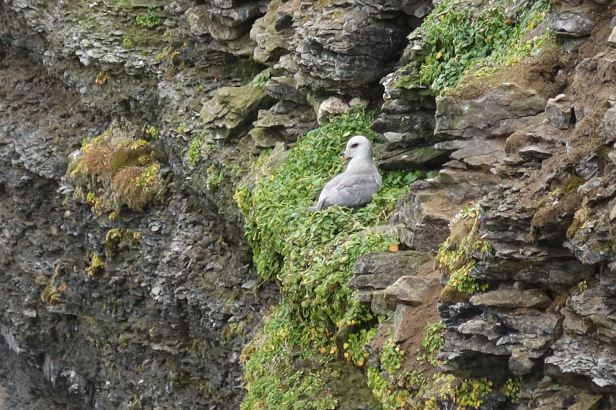
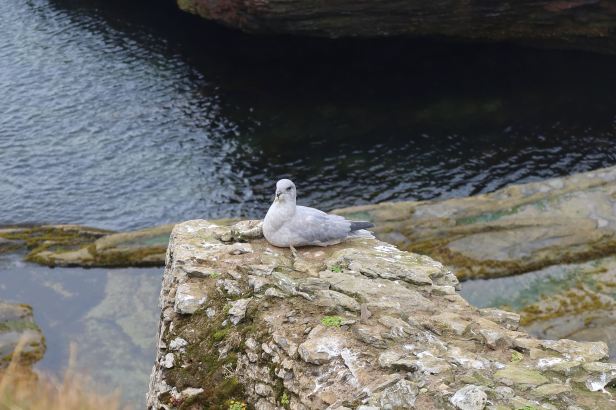
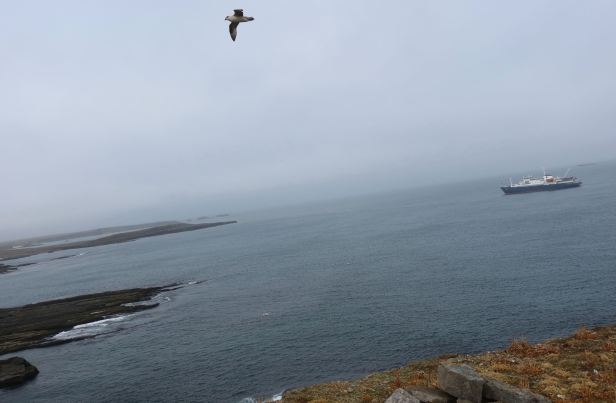
Everywhere, there were seabirds, principally this late in the season, adolescent Fulmars, but also gulls of many types including the large, grey, Glaucous variety. On the ledges on the cliffs sat young the Fulmars. These seemed to be practising flying as they would take off and rapidly return to the same spot.
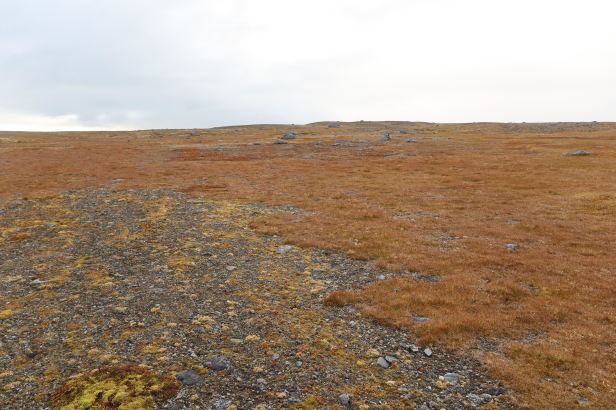
There were some spectacular long views over and along the cliffs and, behind us, long views across desolate, featureless island terrain towards higher mountains in the middle distance. Our time on shore was quite limited, so we only walked a couple of kilometres before we had to turn around.
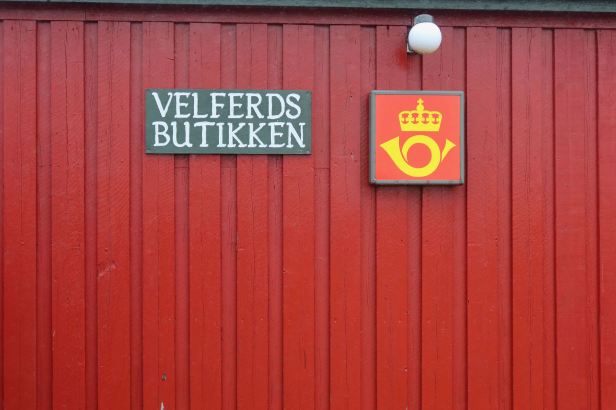
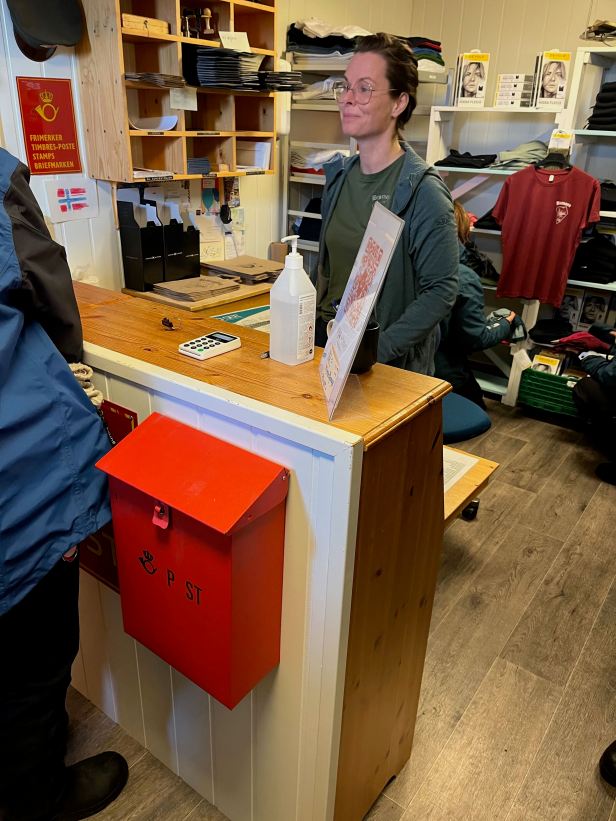
There is a base Post Office and store. We had written another postcard to our friend in Prague, so Lucie went in to post it. The office working hours were limited so, with a lot of people wanting to send cards, these had needed to be written in advance. Other stuff was available too, including tee shirts and a set of crystal glasses, but Lucie managed to resist temptation.
There was a small museum, but there was not much to see inside. It almost seemed to be a case of “There is a new version of this device, let us put the old one in an empty room, stick a label on it and call the rooma museum”. I spent longer getting my muck boots off and then putting them on again, than I did scrutinising the exhibits.
Then it was back to the ship and, of course, lunch.
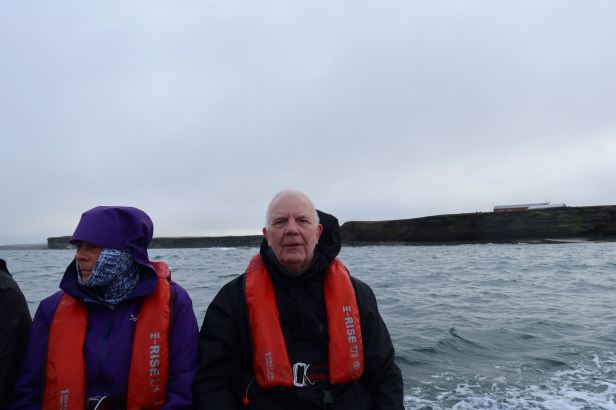
Whilst we were eating, the Plancius cruised slowly down the West coast of the island in slightly lively seas and eventually dropped anchor in Sorhamna bay. This was a quieter bay a short distance up the eastern side of the island and, because of that, slightly sheltered from the swell, which was coming from the southwest.
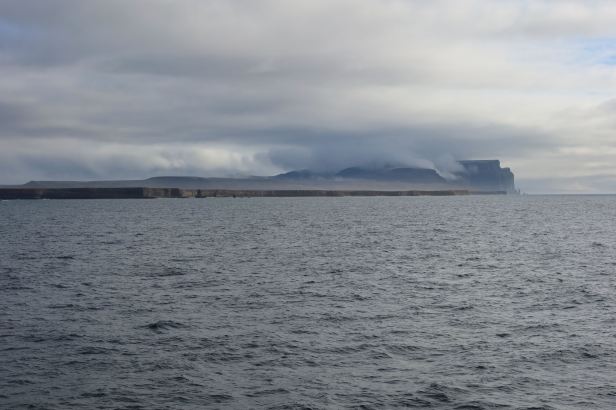
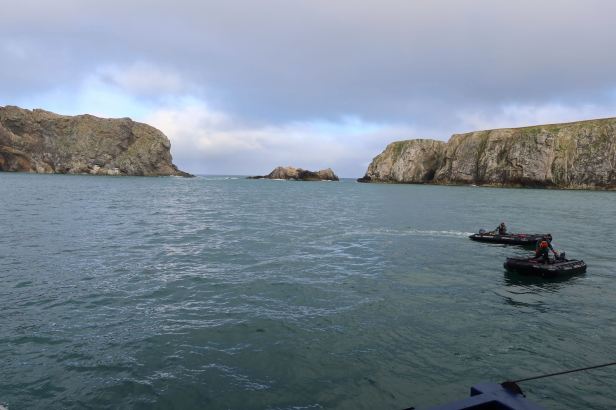
While we waited for the expedition team to ready the Zodiacs, I went to the lounge for a cup of tea. There is an ancient paperback, somewhere in the hundreds of books in our apartment, written by Alastair McLean and called “Bear Island”.
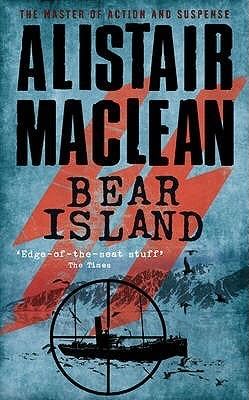
As in most of McLean’s works, a seemingly disparate group of people get gathered together for a “reason”, only for multiple mysterious deaths to occur. It eventually emerges that none of the people are who they claim to be and for their “accidental” coming together to be far from accidental from a number of aspects. As I looked around the lounge, I wondered which among the, now familiar, array of faces was actually a fleeing Nazi war-criminal, an agent of MI6, a woman with a dark past, a scientist with a secret motive for being there, or a glamorous KGB assassin. Were the “Germans” actually German ? Was my “Austrian” friend Jo, in reality, a psychotic killer dispatched by the Kremlin and not a vegan nature lover ? Pippa’s Zodiac announcement (or was it a secret sign) came over the tannoy. Careful not to turn my back on any of them, I went down to the cabin to suit up, with an extremely enigmatic woman who is allegedly from eastern Europe and who has always claimed to be a humble botanist.
Sorhamna Bay
Pippa had announced that there was quite a swell, but that the Zodiac cruise would be going ahead. With a slight tinge of sadness, we pulled on our boots and waterproofs. This would be the final activity of the expedition and, when we took them off again, that would be it. The Zodiacs were already circling.
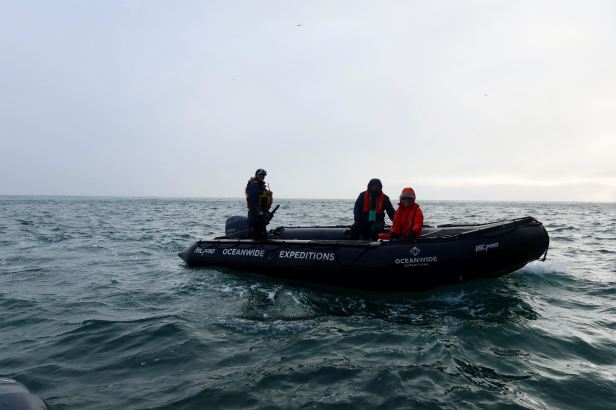
We went to the gangway and, shepherded by Doctor Anna, took a Zodiac driven by Sven. There were only six passengers. Having seen the sea, discretion had won out over valour for a lot of our travelling companions.
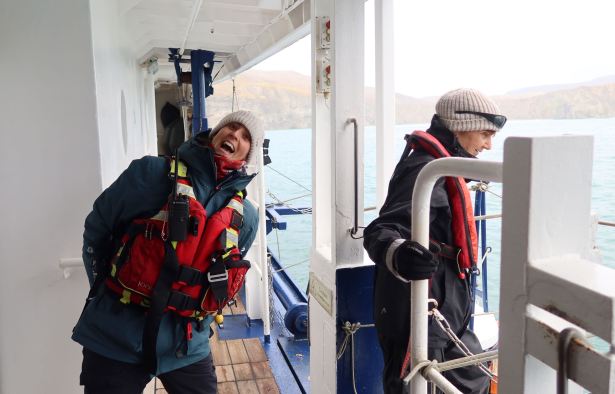
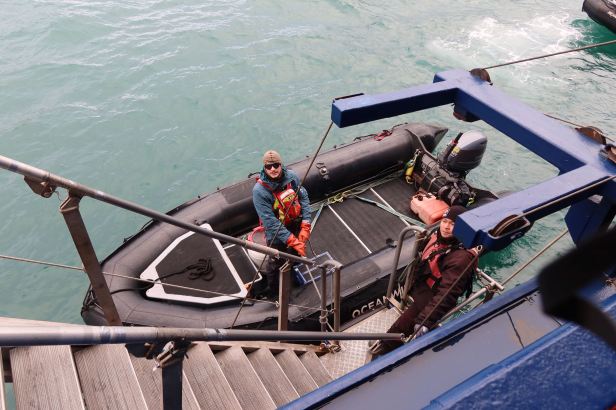
In truth, down at sea-level, the heaving, greenish waves did look very high and threatening. Large breakers, seemingly higher than the Zodiac, somehow rolled beneath us before crashing into the bases of the towering cliffs in showers of foamy spray. Still, life means sometimes having to step out of your comfort zone, or possibly, in this case, swim out of it if things went wrong. The swell were even more dramatic once we rounded the first headland and out of the bay into the sea proper.
Sven explained the “plan”, but it had no letter as there was only one. This was to run, against the swell, to the very southernmost tip of the island and then to come back, at a more relaxed pace, with the tide. He set off at a speed sufficient to overcome the wind and waves coming towards us. At first our progress felt alarmingly bumpy as we literally bounced from the crest of one oncoming wave to the crest of the next. Luckily, Sven was obviously very competent at the helm and it quickly became quite fun, in a high adrenaline sort of way.
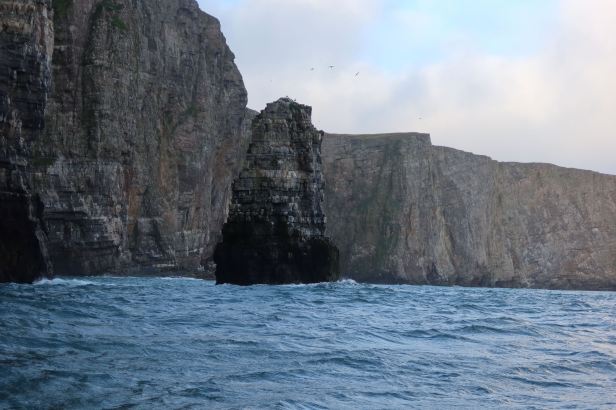
More than a little bit damp from the spray, we reached the end of the island. With nothing, at that second, between us and the top of Norway, we turned around and headed back the way we had come. Whilst running with the waves made for a slightly calmer ride, there were still some big rises and falls and circular whirlpools and eddies that deflected our course. I hoped these were being created by nature and not some Nordic version of Charybdis, in an attempt to drive us into the clutches (and sharp teeth) of the local equivalent of Scylla, lurking in a cave beneath the cliffs. The scenery was simply spectacular, huge cliffs, made even taller by our low vantage point, wave sculpted columns, islets, the aforementioned caves and several tunnels right through the bases of the rock stacks. Sven is a geologist. As I said earlier, he tended to play the Stan Laurel to Marco’s Oliver Hardy, but that in no way diminished his knowledge. He happily chatted about the rocks as we moved along, explaining why the formations looked the way that they did, about the very obvious layering and stratification and very excitedly pointing out what appeared to be the actual Fault Line where the Tectonic Plates had collided all those aeons ago.
It was not only our last Zodiac cruise, but it was also the last one of the season for the guides. Dare I suggest that, as we began to get nearer to the ship, a slightly “end of term” attitude entered the fray ? As I have said there were a few, wave worn, tunnels beneath some enormous rock stacks. A bit of toing and froing on the shortwave occurred and we began to convoy, at intervals, through a tunnel. It was high and wide but the sea through it was not exactly placid. Wow !! It was a bit like a water-borne bunge-jump !
One of the many qualities that all the Oceanwide expedition staff have, is a genuine sense of fun. Sven asked if we wanted to go around again and we unanimously agreed that we did. So we made another trip which, with the benefit of experience, Sven managed even more adroitly. I pondered upon the fact that the foaming seas, that had seemed so threatening only an hour before, were now giving us all a good time. I asked Sven whether he was working – or enjoying himself. He just gave me a big smile.
We moved on up the coast. The small islets, isolated by the wave action and the countless rock ledges high above, were still crowded with seabirds. Most of these, so late in the season, were young Fulmars, still accustomising themselves to taking off and landing. On one, larger islet, there was even a small colony of Gannets. This is believed to be the most northerly one in Europe and sadly, reflects the warming of the sea that has enabled that graceful (at least when it is in the air) bird to extend its range. The Gannets like to decorate their nests. We could see evidence of plastic fishing nets, collected and placed there by the birds – another sad reflection, perhaps, upon the things we humans are doing to the seas. There were gulls of other types too, including many young Glaucous gulls, already a large bird, but even these were dwarfed by a pair of the mighty Great Black-Backed variety, perched imperiously at the very apex of a small rock stack.
Another sea-worn tunnel appeared. This one was a bit wider, but not so high and the swirl of the sea within was very evident. At its far end, there was a sharp right before a small, stony beach. Sven went down it, like a rabbit into its hole. As we made the right turn, a large wave coming the other way hit the front of the Zodiac.
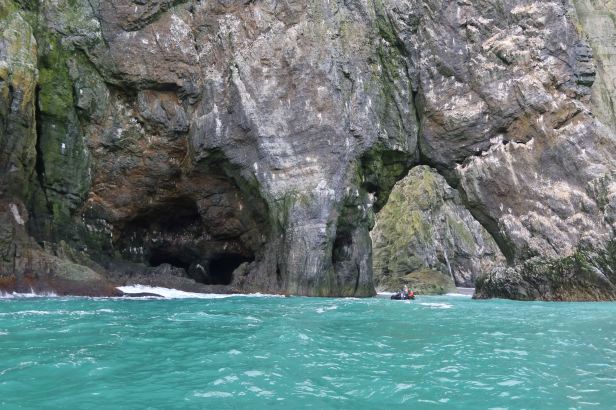
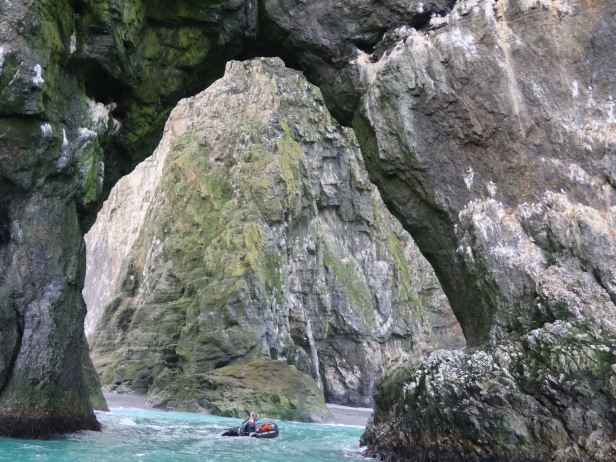
Like the Teletubbies, we all shouted “Oh no !” as we all got sprayed with icy water ! No danger, just a big thrill ! Then, again like the Teletubbies, we all shouted “Again ! Again ! Again!” and Sven duly obliged although, the second time, there was no oncoming wave.
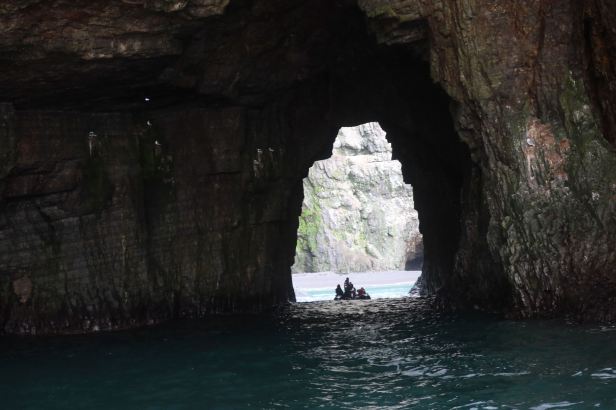
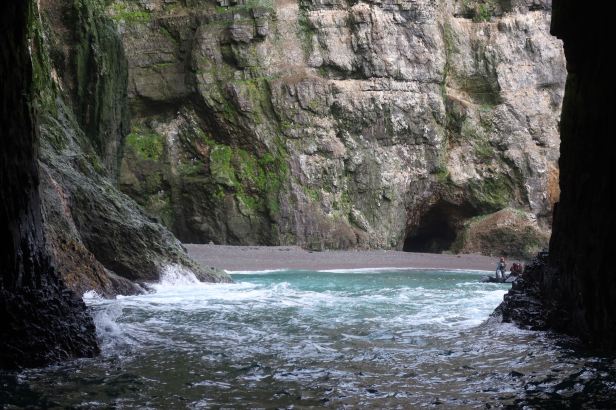
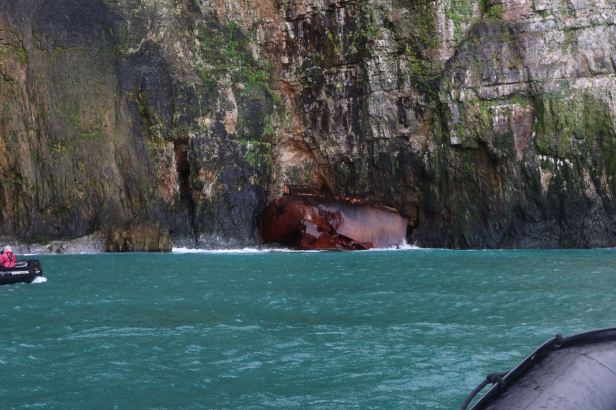
At one point we came upon the battered remains of a shipwreck wedged under the cliff. This was the last vestiges of the Russian refrigerated cargo and freezer ship, the MS Petrozavodsk. On May 11, 2009, when the first mate was sleeping on duty and the captain was drunk, the vessel to steamed directly into the cliffs. Both officers received prison sentences. All 12 crew members were safely rescued by helicopter.
All good things come to an end. We rounded the final point and there was the ship, luckily still anchored where we had left it. This was the last Zodiac cruise for us and, as it was the end of the season, it was the last one for Sven as well. Before we re-embarked, Sven gave us all one final, high-velocity, blast. In the marginally smoother waters of the bay, we did hit quite a speed, while the trusty Zodiac bounced over the wave crests like a skilfully “skipped” stone.
Whether it was the waves or just slight sadness on all of our parts, I do not know, but my trusty muck boots felt as heavy as lead when, for the last time, I climbed up the gangway. As I registered my return on the reader, I realised that the trip was effectively over We watched as the Zodiacs were winched on board and I knew that all we now had to look forward to was the run down to Tromso.
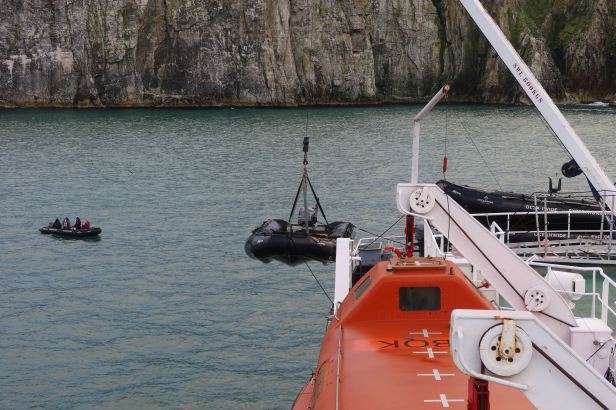
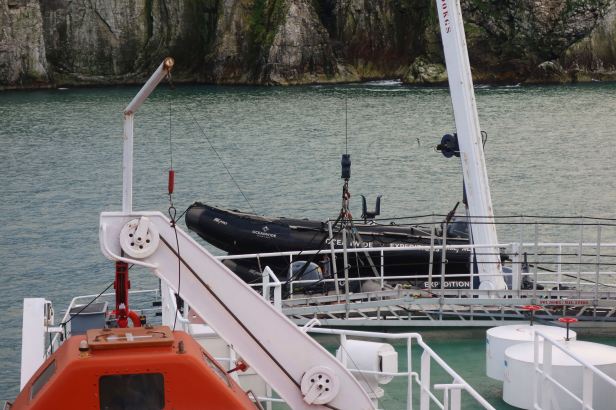
We had our penultimate recap.
Pippa was bubbling. She has a tough job and she had done it very well but, aided by good weather, relatively calm seas, good winds and, most importantly of all, good luck, the whole thing had been a fantastic experience. She thanked us for playing our part and the warm round of applause she received was, I think, symbolic of our recognition of what it was that she had helped us all to do.
Next up was Marleen, the hotel manager with instructions on when and how to settle our bills (and tips).
Then came Koen, with a talk on Gannets. They are more interesting than I had thought. TTHey have bodily adaptations like fused vertebrae and air cushioning to help them withstand the shock of a high speed impact with the water after a long and spectacular dive. When they first fledge, young Gannets are too fat and, thus too buoyant, to do the dives and have to wait until lack of food has made them sleeker before they can hunt for themselves. Having been in that sea, I can understand that you would need to be pretty desperate to dive into it from fifty metres up ! Because they swallow a lot of fish in one session (to regurgitate later for their single chick) “Gannet” has become a slang term for a glutton who overeats. I hoped Koen was not looking at me.
Then Marleen was back. This time she gave us a run through on how the on-ship hotel worked. To us, it had seemed to run like the proverbial Swiss watch, but her interesting talk revealed her job has many aspects that we would never even think of. It is, perhaps a testament to her expertise, that most of those same aspects had never even occurred to any of us.
Then, it was dinner. The bulk of the catering and housekeeping staff are Filipino and the sous-chef had a special surprise for us. This was Cebu Lechon, a traditional Filipino celebratory dish, which consisted of a whole, roasted piglet, with a special glaze and special sauce. It was more than delicious. Sadly, one vegan passenger (not Jo) apparently got quite upset about it – but there you are.
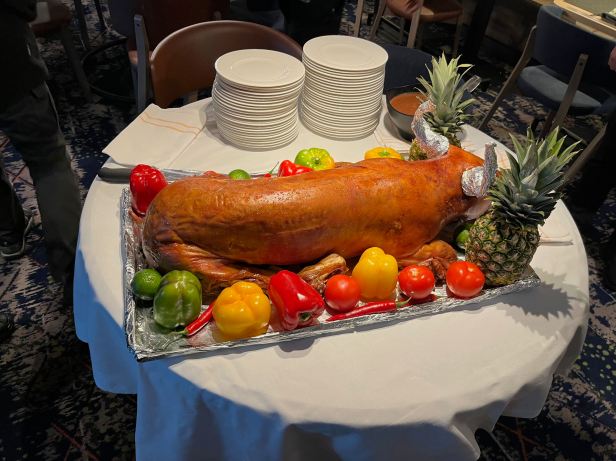
Too full almost to move (there was the standard food selection as well and I hate stuff to go to waste) we retired to our cabin. I could scarcely keep my eyes open after a very full and exciting day and, in a very short time, I was deeply asleep.
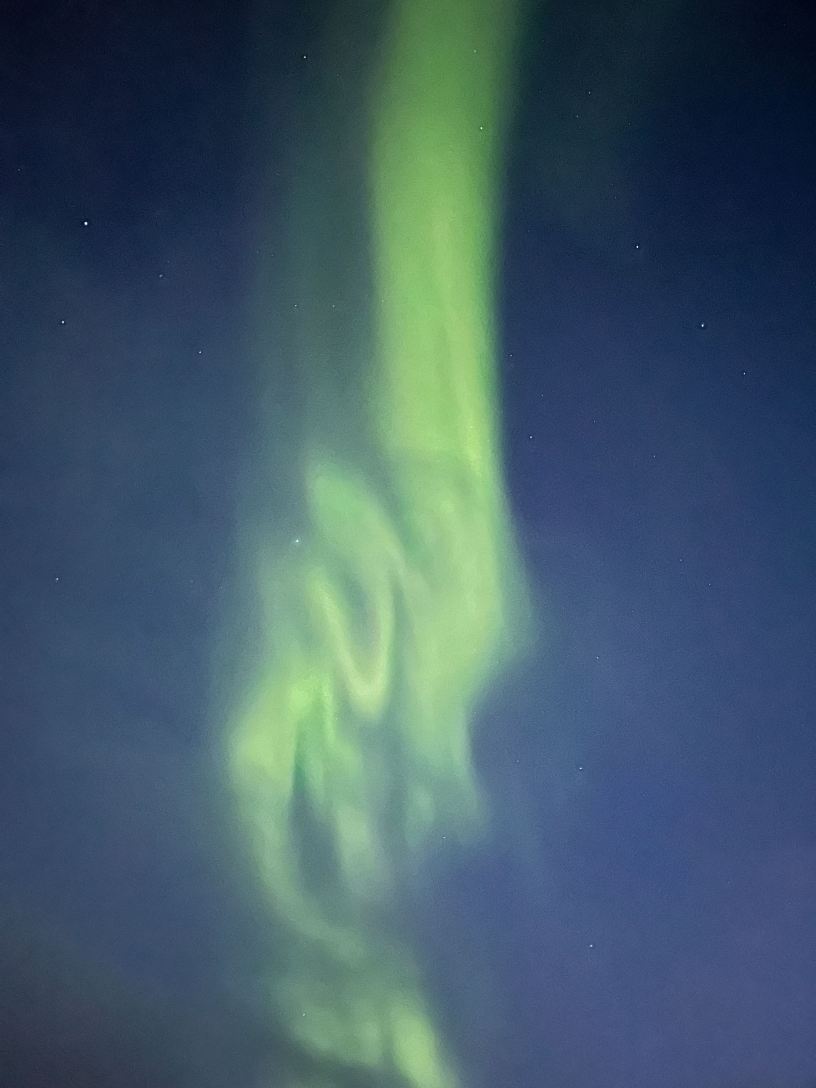
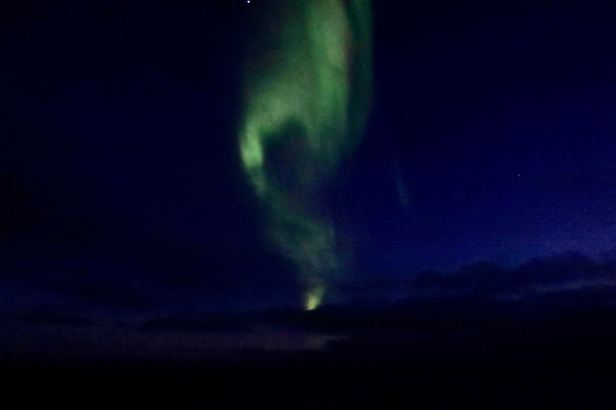
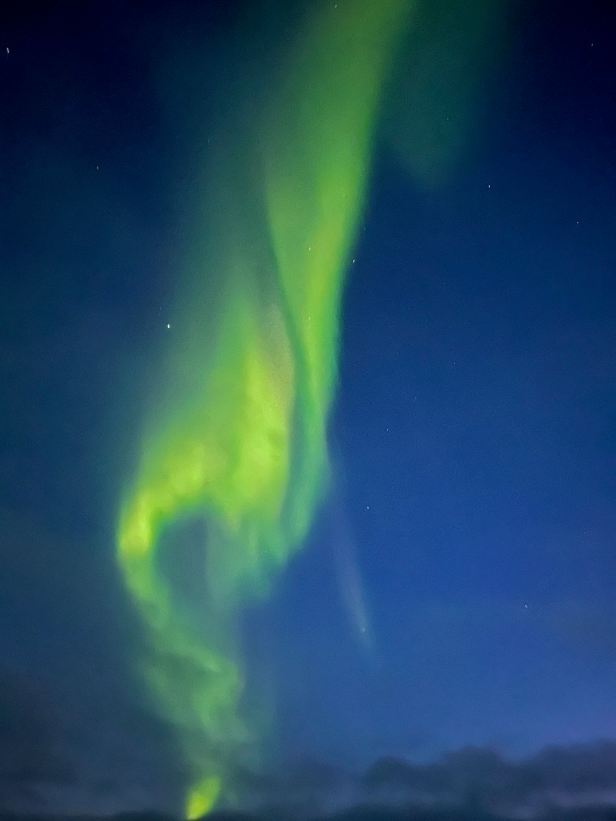
Perhaps, I was too deeply asleep because, when Lucie began shaking me in the middle of the night, I was very disoriented and may not have been very nice. Pippa was on the tannoy because the fabled Northern Lights (Aurora Borealis) were visible off of the starboard side. Even in my confusion, my brain kicked in when it wondered if, as they were to starboard and therefore to the West, whether they might actually be the Aurora Occidentalis. I decided it might be a mistake to pose this question to Lucie.
Somehow, I stumbled into my clothes. Luckily, I often get dressed in the dark so as not to wake up the Sleeping Beauty, so that bit was quite easy even in my zombie-like state. I grabbed my fleece and we trotted to the bridge. I do not really feel the cold, but my life it was chilly up there. The strong wind was icy and cut through my fleece as if it was paper. But that paled into insignificance when we saw the sky to the northwest. The greenish glow was unmistakeable. Although it was a little fainter than I thought it would be (it shows up better, ironically, on photographs), there was no mistaking it. I held Lucie’s hand and we gazed in wonder. The cherry of fable had just been plonked firmly onto the top of our, already iced, cake.
On the way back down, I met Pippa and asked her jokingly, where, at this late stage, she was was going to find the Walrus. She gave me the kind of look that would have frozen the blood of lesser (or thinner) men – I hoped that was in jest too !

