Saturday, August 22nd, 2026
Distance driven – 288 kilometres (899 total)
When I first stirred it was again at 03:00 but, as I did not need to move to find that out, I was quickly able to go back to sleep, accompanied by the soft drumming of rain on the roof. When I awoke the second time, at 06:40, it was lighter outside, but the insistent patter of rain drops a few feet above my head was still there.
I sometimes think that I would make a good slave. It is part of my nature to actively want to be doing something. No whip or goad required for me ! For this reason, I am no fan of wet weather and was saddened by Lucie’s announcement, when I took her a coffee (our room had a kettle), that her weather Apps showed it was going to rain all day.
Breakfast was provided. It was simple but plentiful and at least I could accompany it with a cup of my own tea. There was a toaster which, following my severe burn in New Zealand, Lucie eyed somewhat nervously, but, rather like Daenerys Targaryen, I escaped unburnt. The owner was overseeing proceedings and knitting a mitten with an incredibly intricate pattern. Her only comment on the dire weather outside was to remark that “at least it is not too windy”.
When we finally left the guesthouse, only a few minutes before eleven, it was still sheeting with rain. In the ten seconds that it took us to run to the car, we got soaked – and in the few moments that it took us to stow our rucksacks, so did the inside of our little jeep. It was steamy inside for most of the day. It was also incredibly windy, enough, almost, to blow the bloody doors off. To avoid a reprise of “The Italian Job”, we hurriedly closed them and left. The gusts were literally rocking the jeep. As we pulled out onto Road 62 and headed South along the coast, I said to Lucie “at least it is not too windy”. She did not laugh.
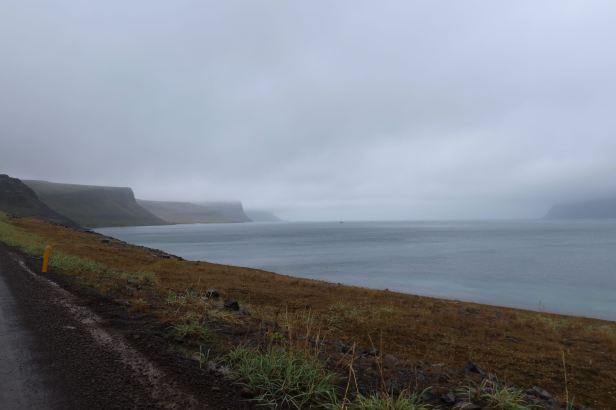
The rain was simply terrible. If it had just been windy, even at the strength we were experiencing, it would have been a wonderfully photogenic drive every second of the way. The wind-whipped breakers were crashing in, foaming over rocks and other stony obstacles that were obviously once hot lava, in a prize-winning photo fashion. But, with the reduced visibility brought by the deluge, I hardly dare avert my eyes from the road for a second. Drenched sheep were also lurking in the roadside grass, waiting to sprint across the road or, more likely, amble out and stop. It was more than a little bit nerve-wracking !
Finally, we came to a headland and swung West. This did not seem to affect the rain one iota, but it put the wind behind us. Instead of rocking the jeep from side to side, it began to propel us along to the point that I had to use the brake to slow our progress.
All you can do, in these circumstances is to keep going and, bit by bit, we proceeded along the coast. We climbed over the promontory on some quite hairy roads and then descended once again to sea-level on the other side. The rain continued unabated, but it was slightly less windy.
Instead of crossing the next vik, we branched left onto Road 612 which stated it was a dead-end. Luckily, we knew that when the end actually became dead, we would be at Cape Bjargtangar, which is both the most westerly point in Iceland and, also, the most westerly point in all of Europe.
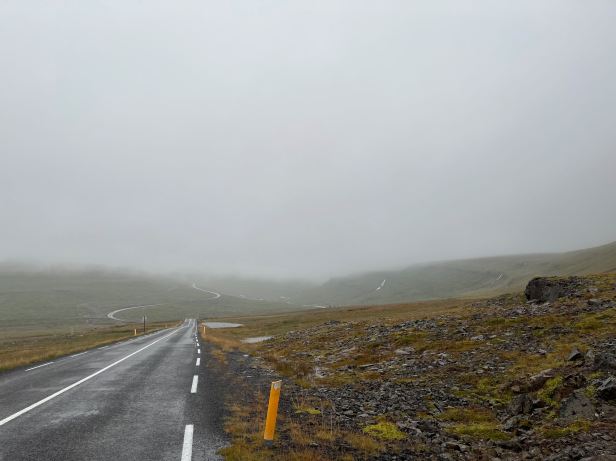
The road was one of contrasts. In some places it was like a motorway, in others places dreadful beyond measure. Once again, constant vigilance was required because of the rain and the surface changes. At least the high cliffs reduced the wind a bit.
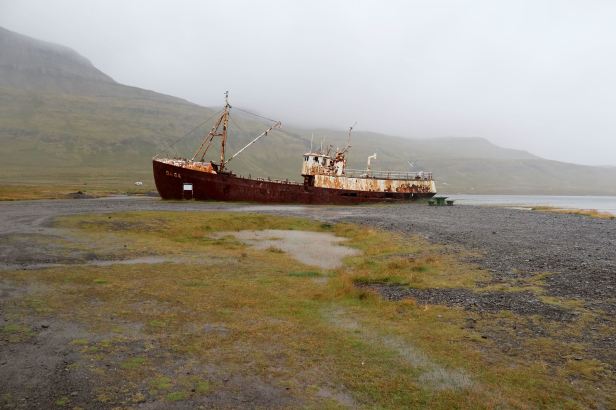
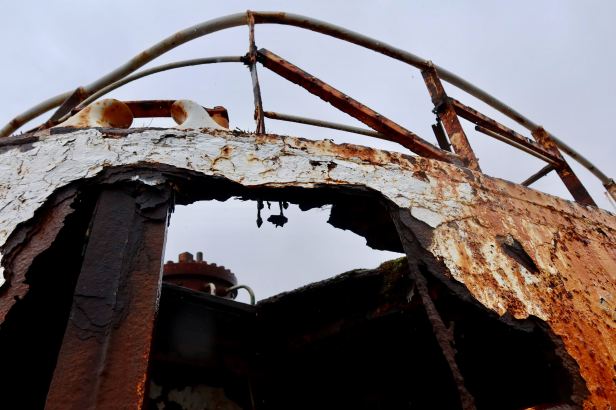
A short way along, in Skapadulur Bay, we came to a beached ship. This was the “Gardar BA 64” which, although built in Norway in 1912, is recognised as the oldest “surviving” steel ship in Iceland. It beached in 1981 and it is in a very sorry state. How much longer it will “survive” must be open to question.
We pressed on, progress seemed terribly slow. The long stretches of narrow, poorly surfaced and serpentine roads required both constant vigilance and low speeds. There was, oddly, a small airfield. What commerce there was, seemed to rely on aggregating and breaking up old farm and civil engineering machinery, or boats. In one place, there was even the remains of an aircraft ….
Another seeming “anomaly” was that, all along the coast there were stretches of golden sand. There were even dunes of it on one side of the road and a few wide beaches more reminiscent of a tropical island than a wet and windswept peninsular in the North Atlantic. In a volcanic island, where everything by the sea is usually black, it seemed somewhat incongruous.
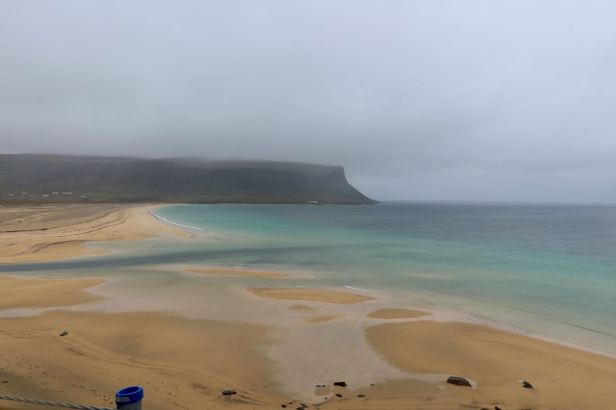
As we finally began to get close to the cape, we happened on yet another incongruity. A brand new road, wide, well-surfaced and sweeping, had been built to circumnavigate Latravik, the final hamlet on the road before the end. It seemed totally out of place. Maybe the people of Latravik had got fed up with traffic coming and going to the point.
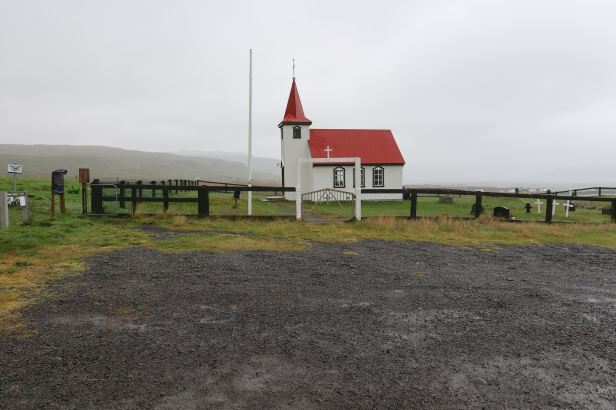
One last climb up an again dreadfully surfaced track and, with a big surge through a huge puddle (it was a jeep and I am a boy), we came to the end. The site also forms part of a bird sanctuary. There was a single white building, which appeared to be closed, but not much else.
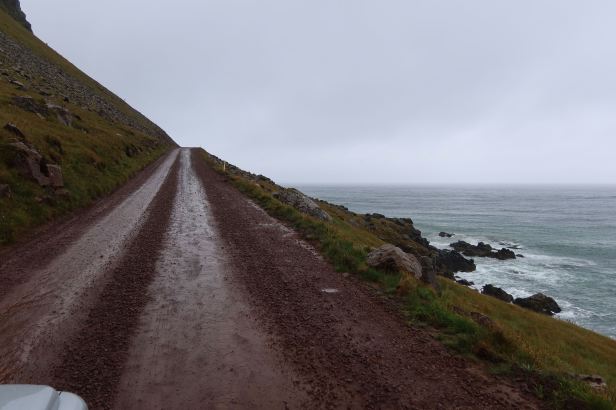
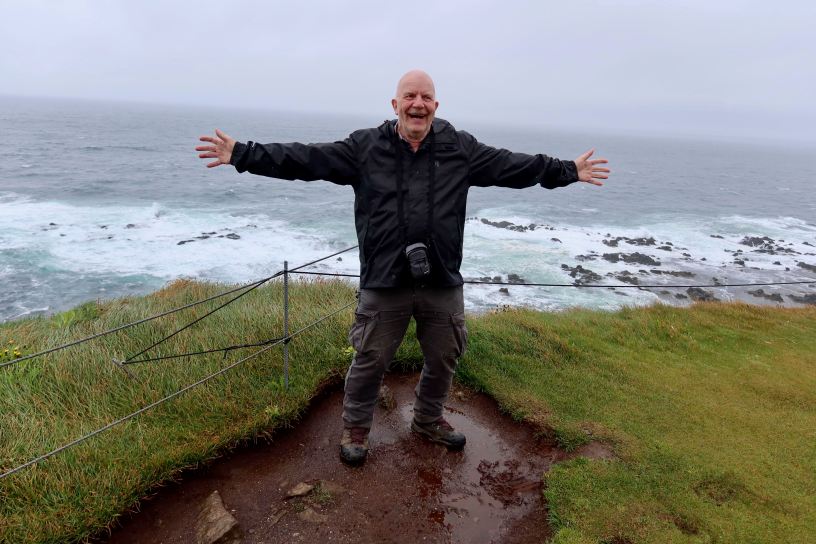
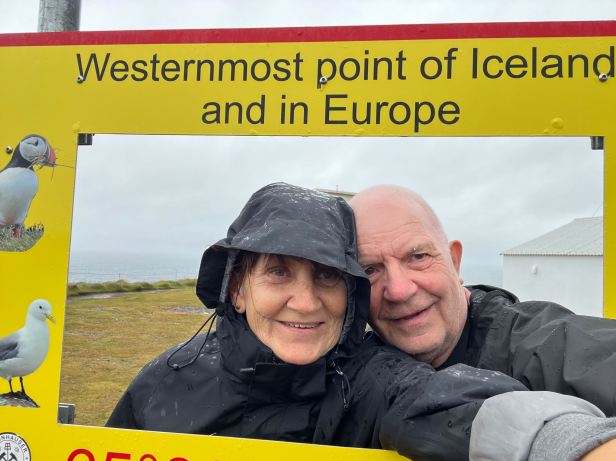
It was still pouring with rain and windier than ever on the exposed cliff top. We took a few “selfies” at a board intended for just that purpose, a couple more on the cliff edge fence – and scurried back to the Suzuki. Over an hour on dodgy roads to get there, another hour on the same roads to get back to Road 62 – and less than ten minutes on site. Still, box ticked – such is life.
It is one of those things that going back always seems quicker than coming. It was not, at least dramatically, in this case – but the wind, once again from behind us, might have helped slightly. Back through the climbs and descents, back through the serpentines, back past the shipwreck and back onto Road 62, where we turned left.
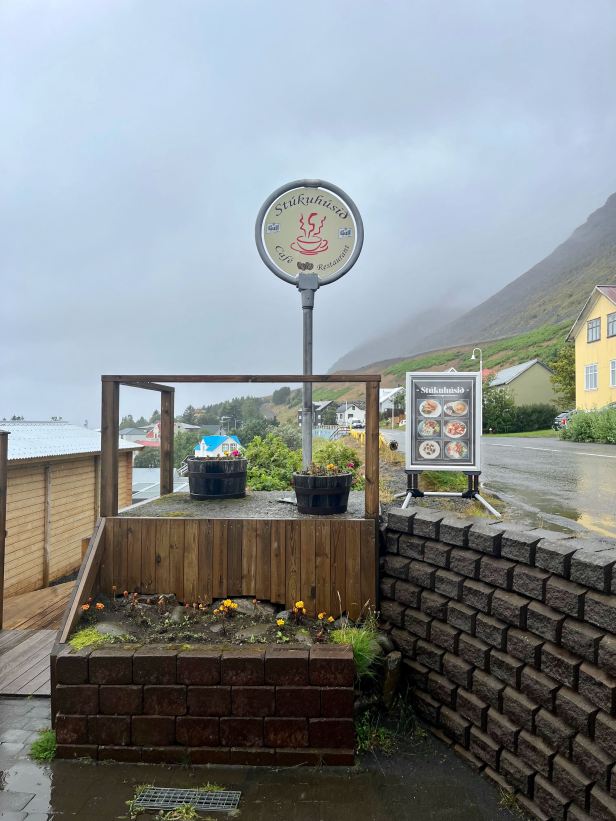
We were both hungry so, at the first small town, Patreksfjordur, we left Road 62 in search of petrol and food. Once refuelled, Lucie guided me to a small restaurant she had located, called Stukuhusid. With startling predictability, both the waitresses were Czech girls ! Even more strangely, two of the other four clients had recently visited Prague. That meant that, in a small room, in a restaurant in a backwater Icelandic town, three-quarters of the people had been in Prague in the past four months. Weird.
After an abortive attempt to replenish our supplies of candies – which left us wondering where on earth Icelandic people buy their food, we headed out of town, now on Road 63.
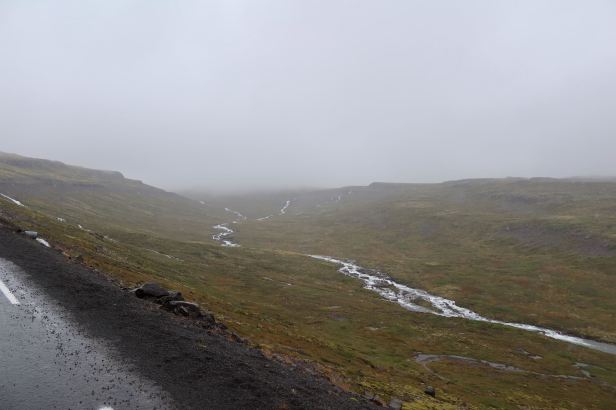
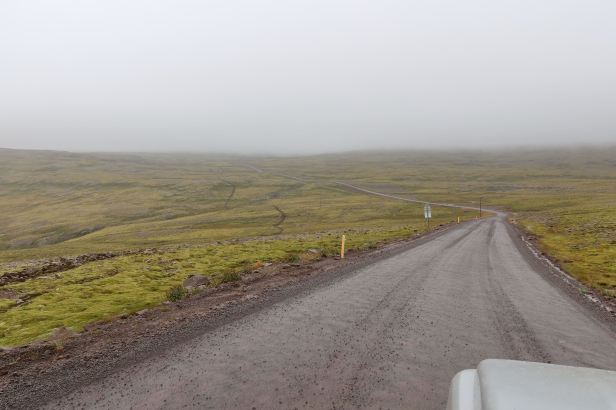
The road led up and up and up. We seemed to be climbing into the clouds. The rain now switched to intermittent, with occasional downpours, but at no time did it stop completely. We were in Iceland, so obviously it was hard to look in any direction without seeing a waterfall anyway. The huge volume of water falling from the sky had swollen these considerably and there were cascades at every point of the compass. Some of these were truly spectacular. The valley floors and gullies, where the flows were aggregating has become lakes and the innumerable streams had become raging torrents. What we would not have given for a few hours of rain like that in Prague over the preceding Summer.
We were still out of sweets and, at the nadir of the hill, we spotted a small, well kept little town which Google indicated had a supermarket. In all honesty, even thus aided, it was hard to spot. It looked closed, but luckily it was not and Lucie was able to renew our supplies. Almost inevitably, the girl in the shop was a Slovak.
Candied up (“candied out” does not exist as a term in our collective lexicon), off we went again. We were moving steadily North and, at altitude, there were still the occasional patches of snow to be seen here and there. The landscape continued to be harshly beautiful, but was by no means uniform in appearance. We debated this and there are obviously geological and botanical reasons underlying the differences, but that would take a lot of complicated explanation.
The road surface continued to vary sharply in quality. Sometimes we would spend a few kilometres, in the middle of nowhere, on something with billiard-table smoothness, only for it to degenerate back into cart track status, usually without any warning. There was no progression, which might have indicated some kind of plan. We could not work out any logic in this, perhaps the stretches to be upgraded are chosen by a lottery.
We were finally getting there, but the fun was not quite over. There seems to be a large program of road improvement – and for so small a population, there is an awful LOT of road. The apparent propensity amongst Icelanders to live in a single dwelling or small farm in the middle of nowhere means they have to be able to get around. We now came to a point where Road 63 was not being repaired, or even upgraded. It was being replaced. A massive civil engineering project was in progress. Huge, specialised, machines were, quite literally, cutting a route for a new road out of the mountainside. This was probably with the ultimate aim of smoothing out the undulations and serpentines and it is difficult to estimate, or in any way quantify, the vast amounts of rock that had already been moved – or, for that matter, how much more there still was to do.
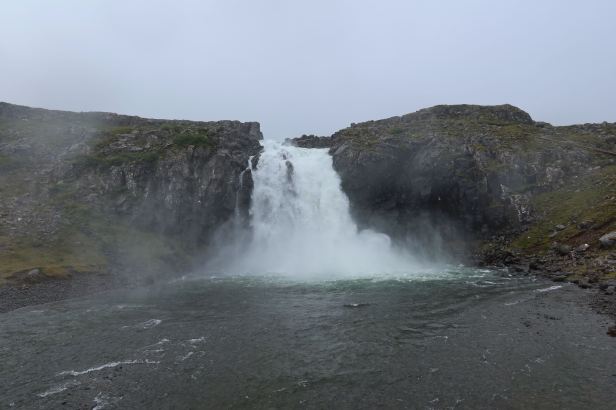
The overall scope was beginning to be discernible, however and it was ambitious. I guess in a few years time, it will be a lot easier to drive down that particular pass. But, we still had to do it on the “old” road, which had been considerably degraded by the activities of the giant earthmovers. Once again, I was very glad we were in a jeep. There was a very picturesque waterfall on the fringes of the works. We stopped so that I could photograph it and Lucie could have a smoke. We wondered if the scheme included a viewing platform for those fortunate enough to use the road in the years to come.
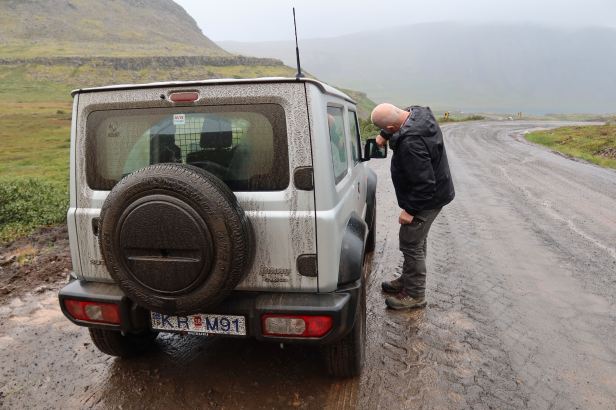
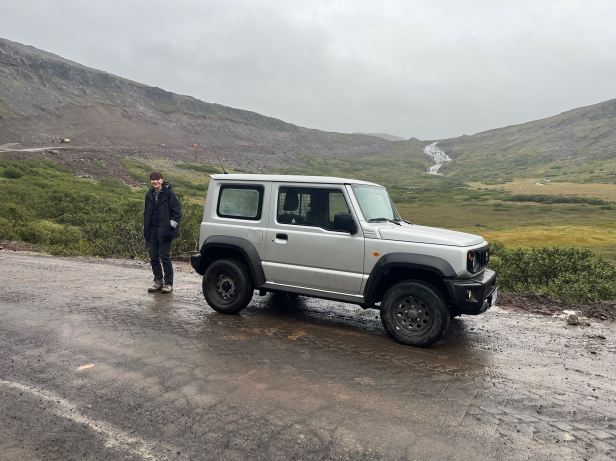
When you ascend, you will descend – and we did. Another long valley and another vik to cross on the inevitable stone causeway. This time, however, instead of another long climb and trek across the top of the promontory we found – a tunnel ! Had we, we wondered, driven all the way to Norway ? We supposed that there must come a point where it becomes more efficient to go through the mountain than to continuously maintain the roads over it – and we had found it. A neat, circular hole in the massif beckoned us in. This was the way to do it and we travelled a smooth and straightish course of over five kilometres straight into the next valley. A bright red sign had prohibited entry to those on horseback so, had we been of an equestrian persuasion, instead of in our little jeep, we would still have needed to take the old road over the summit.
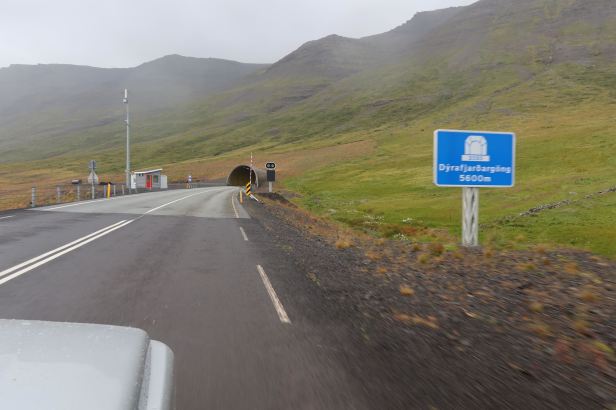
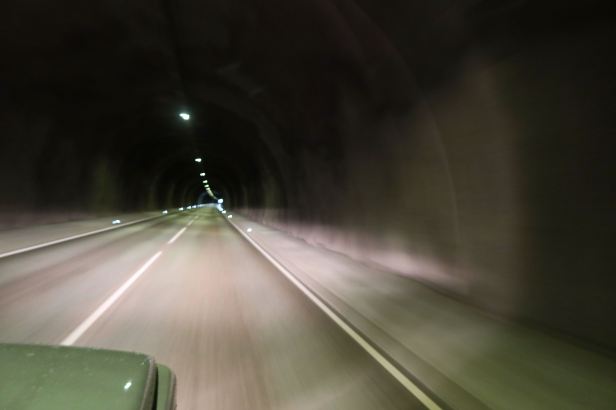
From there it was a comparatively easy run down to our destination. The new road was already complete further North and we made a smooth transition down to the vik and made the left turn onto Road 64 which took us towards our destination, Flateyri.
We were staying at the Fisherman Guest House.
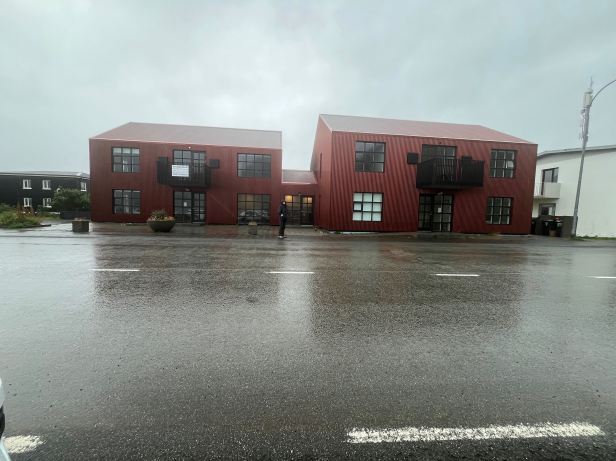
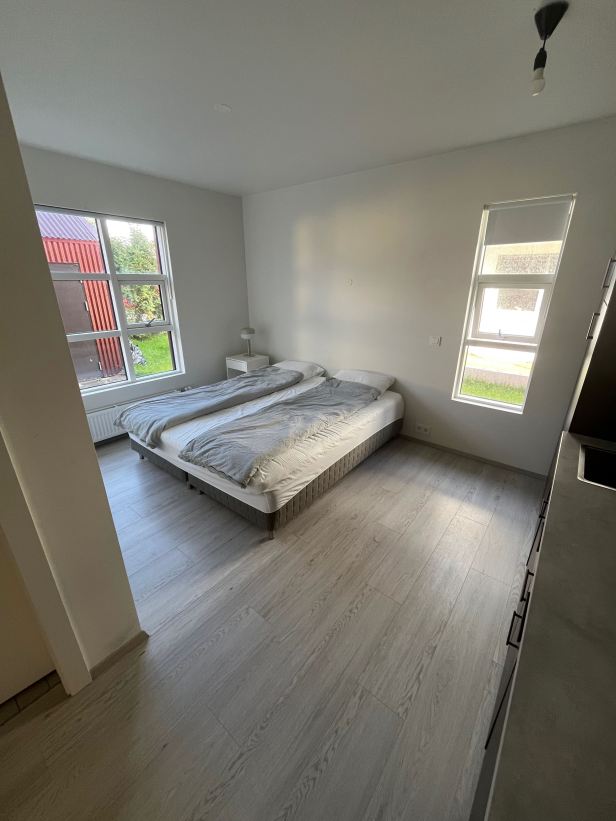
There is more than one of these in the area as we nearly found out by, initially, heading to the one in the next bay. Luckily, Lucie noticed before we did ! It was modern, clean, bright and welcoming. Our room was large, airy and warm (which it certainly was not outside where the rain continued to fall).
There was also a 24 hour coffee machine, in the spacious dining/common room which got a lot of points from Lucie when I took her an espresso.
For dinner, we walked about two hundred metres along the road to the Vagninn. I had a lamb dish which was, shall we say, inventive (but tasty) and Lucie had a cod dish. The beer was good but, in Czech terms, eye wateringly expensive.
We retired to our room. The bed was big and very soft. I thought, for almost ten seconds, that it would be too soft for me to ever sleep in. Wrong again !

