Monday, August 31st, 2026
Distance hiked – 6.2 kilometres
We suddenly woke up to a very dull morning. Yet again, I had managed to set the alarm for an hour too late and, as a consequence, it was Pippa’s voice and not my iPhone that dragged me, reluctantly, from the arms of Morpheus. I wondered if I would manage to get the times right before we left the Greenland time-zone, which was where my iPhone seemed to be living.
We ate a quick-ish breakfast and returned to our cabin to dress for the landing. A smoker of my acquaintance, who had been out on deck, informed me that it was drizzling very lightly. It was also noticeably chillier than on previous days. Not cold, at least on my scale, but the breeze had a definite edge. I did put on my long sleeved tee shirt and my hat, as a precaution. Down the ladder, into the Zodiac and a short, but choppy, trip to the shore.
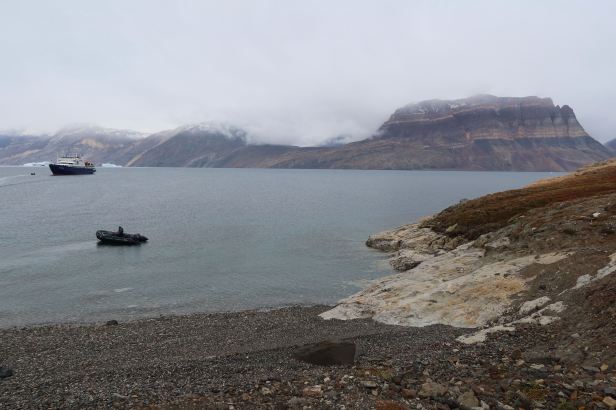
Blomsterbugt
We landed in Blomsterbugt, which is Danish for the “Bay of Flowers”. Sadly, so late in the season, there were not many flowers to be seen, only the few “usual” ones, clinging defiantly to life in the poor soil. Once again, we joined the faster section of the medium hike group and were led off by Marco, with the trusty Sven bringing up (and guarding) our rear. The terrain was quite uneven and it had been impossible for the guides to exhaustively check for Polar Bears, so we were given a reminder of what to do should a fluffy white head suddenly appear from behind a boulder.
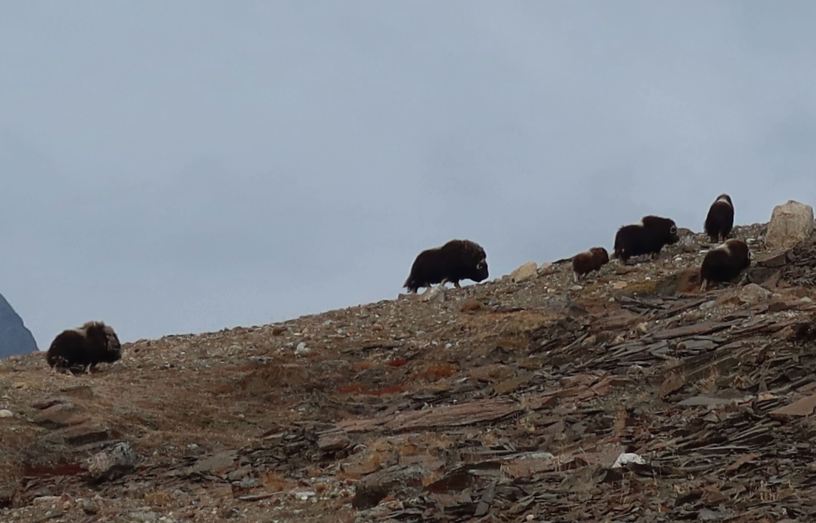
From the deck, as we waited to land, we had spotted what looked like a few Musk Oxen grazing on the higher slopes of the mountains around the bay. Although they were invisible from the shore, we hoped that they would still be up there. We climbed steadily away from the sea, ascending a fairly smooth and fairly long slope. At the top, the Musk Oxen came back into view, still munching on the thin grass of an, even more, elevated slope.
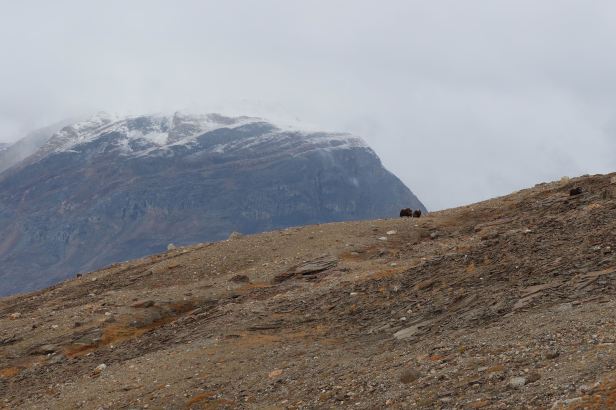
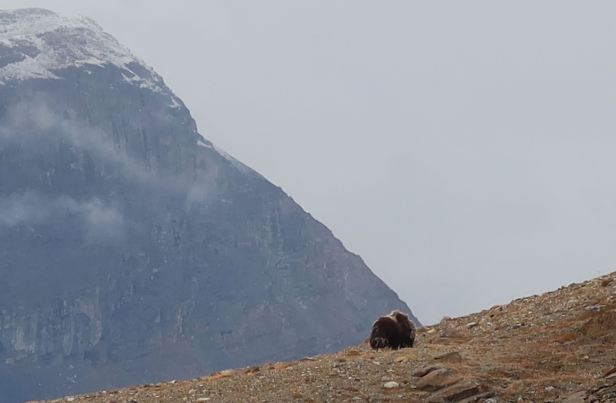
By climbing quite steeply and in silence (rasping breath did not count !) to a higher position, we were able to approach them to about a kilometre. We could see them and they could see us. They did not seem overly concerned though and kept chewing away. At that range, we could capture them on camera, but how good the pictures would be, I did not yet know. The passengers with long lenses however, could probably see right up their noses. The group included a calf, which we were told had probably been born at the start of this Spring. The adults carefully shielded it from the chilly breeze.
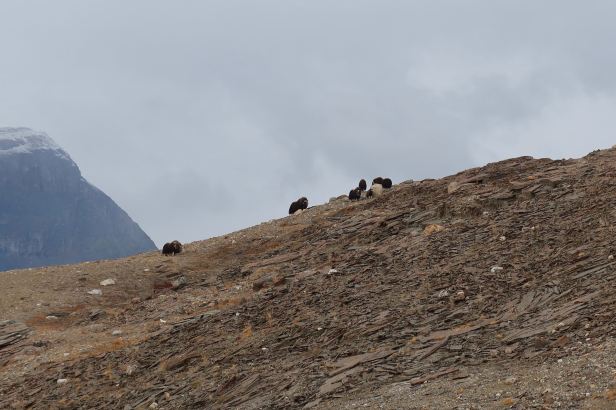
In truth, the word “calf” is probably incorrect. Despite their size and aspect, Musk Oxen are not related to cows. Their closest relatives in the animal kingdom are sheep and goats, so the youngster was probably, more accurately, a lamb or a kid.
As we finally turned around to leave, something white flitted across a distant hill. Luckily, it was SMALL and white and, in the monocular, proved to be an Arctic Hare. A speedy one, too, as it disappeared again in only a few seconds.
We tramped onwards. The terrain was very up and down but it was not really hard going. We soon spotted another Arctic Hare. They only have one colour and that is white. Helpful in the snow, no doubt, but it makes them highly visible in all other landscapes. We stopped and quietly snapped away at it from a long distance. When we moved forward, it basically ignored us and we got to less than a hundred metres, then about fifty and it still did not move. It watched us with something approaching leporine disdain. I suppose it thought it could easily outdistance a bunch of camera wielding geriatrics in muck boots without needing to even run.
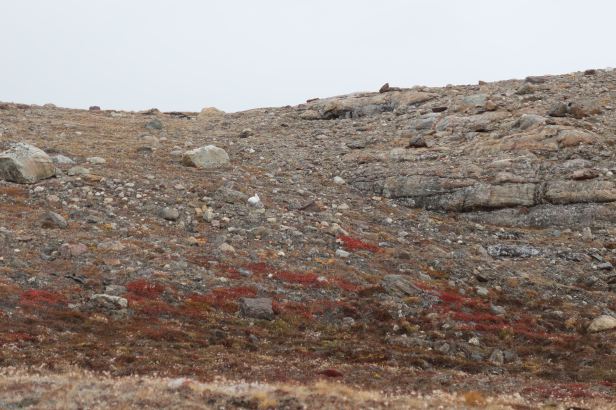
In the end, it was us that moved and the hare watched us walk away. The hiking groups now seemed to have shaken themselves out and there was nobody sprinting ahead and nobody, apart from the rifle toting Sven, lagging behind.
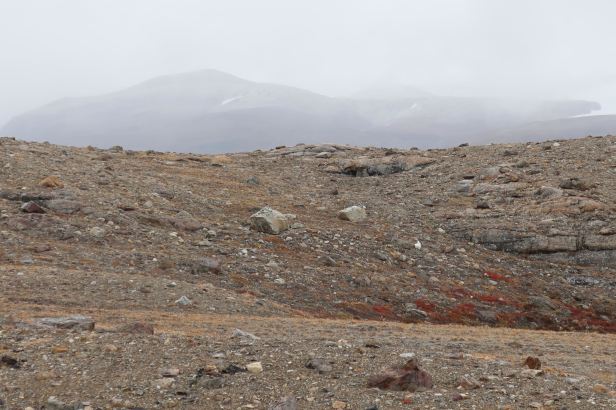
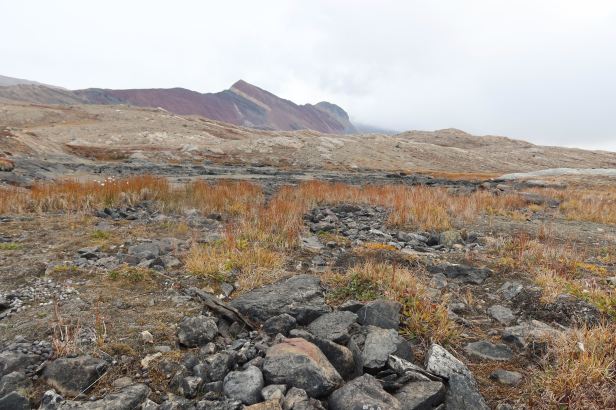
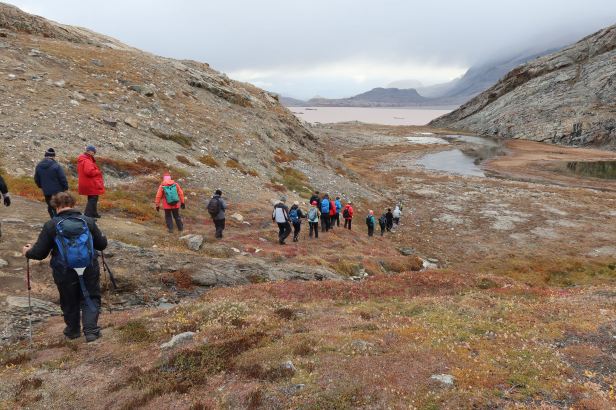
We walked through some fairly featureless terrain, keeping to a track that was obviously “the way to go” whether you were a hiker or a Musk Ox. We came to a rise above a lake which was gleaming dully in the weak sun. There was a lot of bones on the hill that were obviously from a Musk Ox, because its skull was there too. Marco said that this skeleton was first seen there in the mid 1980s. It was the skull of a female, in males the bases of the horns grow together and fuse to form a solid “plate” that competing bulls use to butt other bulls in the mating season
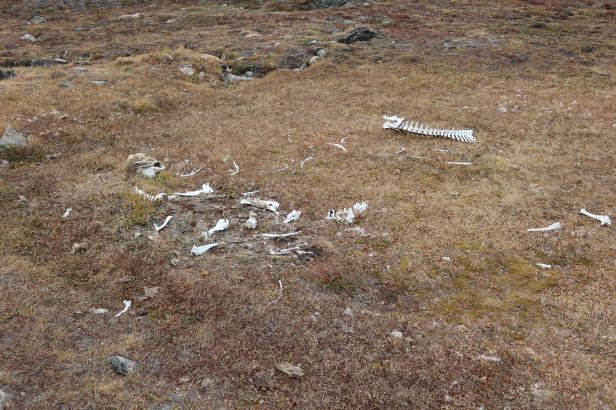
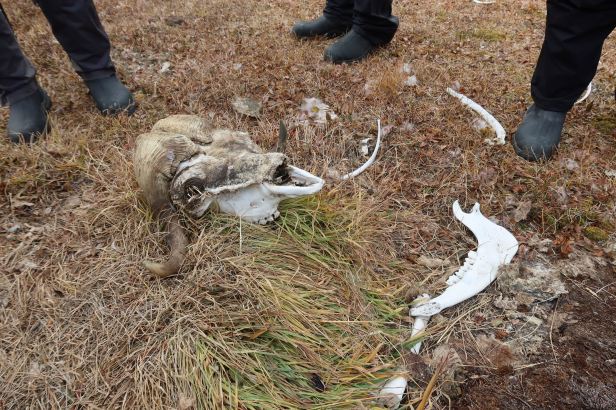
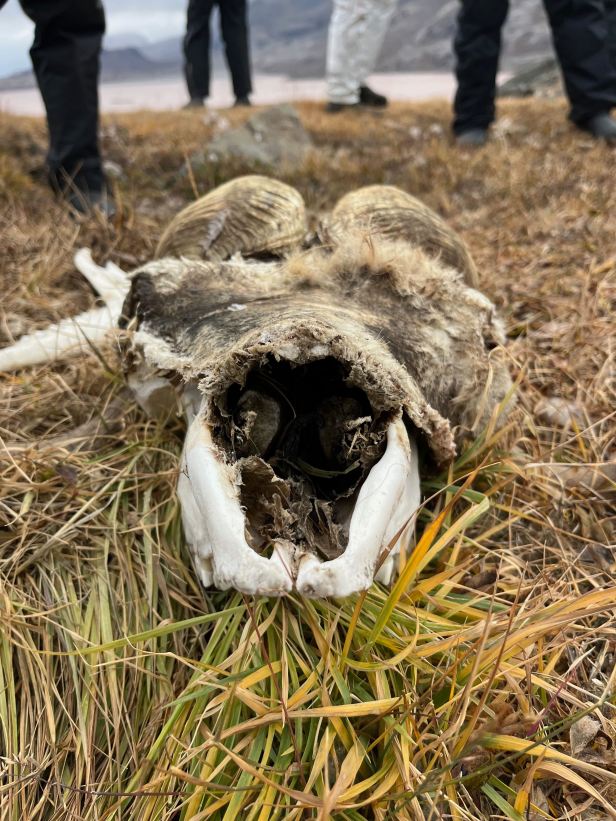
According to Chloe, there actually are bacteria and insects around, but they are not plentiful. This accounted for the remarkable state of preservation of the bones after half a century outside.
Below us was a lake. While some of our group rested at the top of the slope, the rest of us descended to the lake shore for yet more arty photos. It was quite a climb down, but worth it, as it was almost frighteningly photogenic down there.
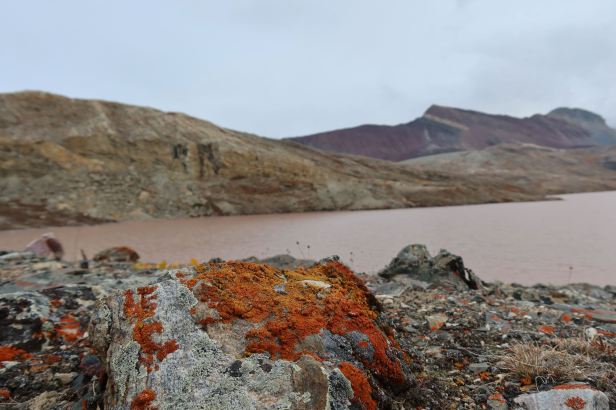
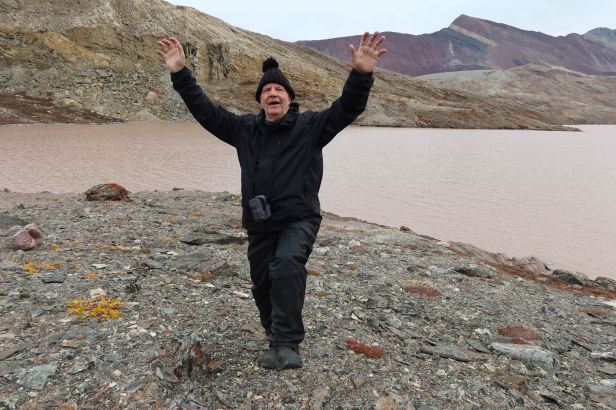
Of course, we then had to climb back up again, but it was not really a problem as even I did not miss my footing. Then it was a slowish amble all the way back down to the beach.
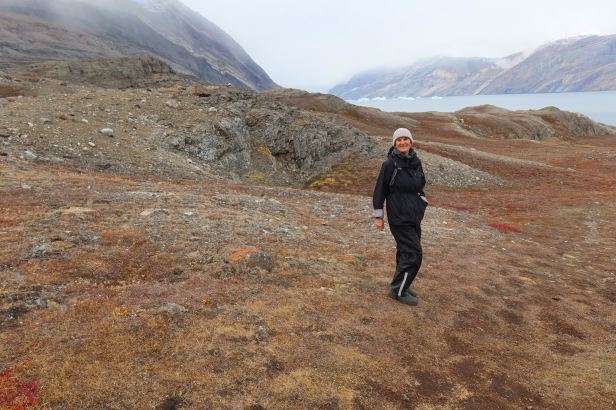
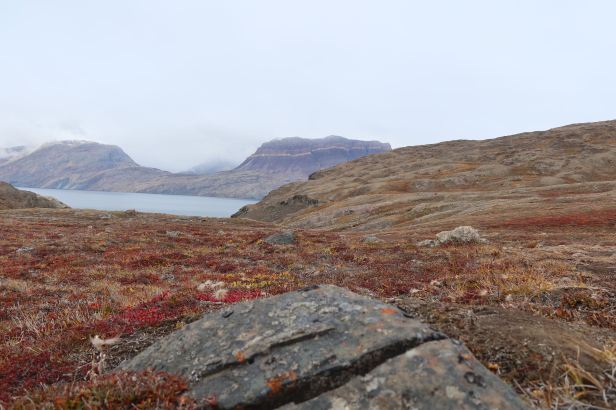
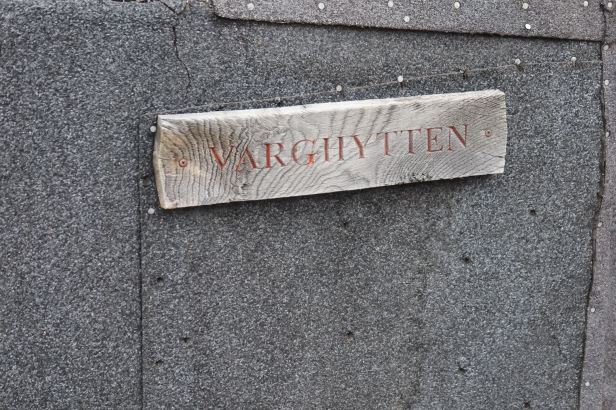
On the shore itself was a small black hut. This was constructed by Norwegian trappers in the early 1930s, not so much as a shelter, but as protection against wolves. A large pack was roaming the area at that time. It is actually called the Varghytten (wolf hut).
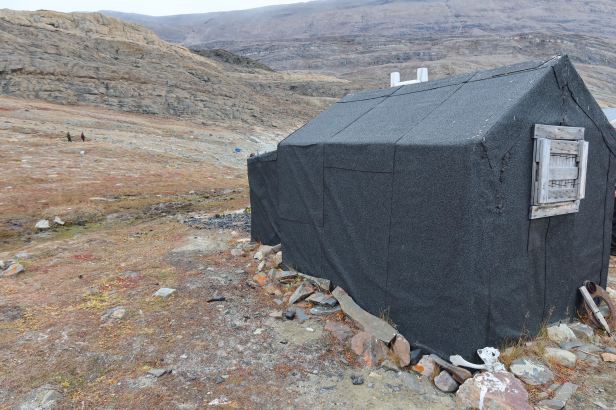
The door was protected by outward facing nails to discourage animal attacks. Apparently, one trapper later poisoned the whole pack – and then sold their skins.
Then it was time to go. Lucie managed to wriggle on board the Zodiac before mine – and waved a smiling goodbye ….
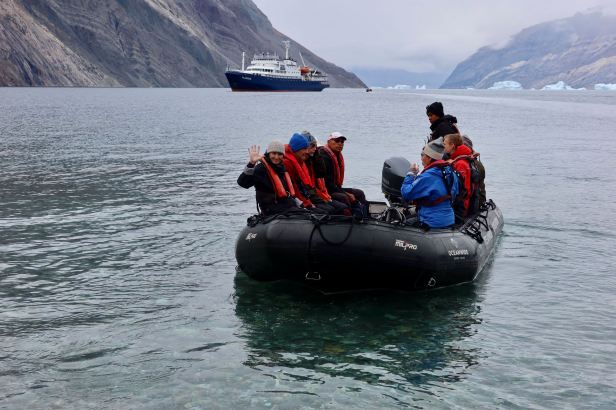
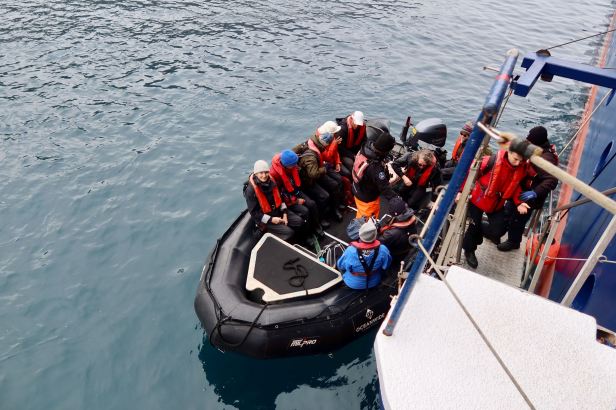
But Marco was the pilot of MY Zodiac and drove in a typically “Italian” way ….. (i.e. flamboyantly and very speedily). I was able to embark, wash my boots and take a snap of Lucie’s Zodiac arriving ……
Back on board and, as ever, it lunch. Captain Christophe regularly eats in the dining room with the passengers and, today, he sat with Lucie, me and a Dutch guy called Herman who is also a big traveller. The Captain was, for many years a Pilot. Not in an aeroplane, but the guy who guides big ships down small channels. He is from Avignon in France and is theoretically retired. The job with Oceanwide was, essentially, a paid holiday for him.
Kaiser Franz-Joseph Fjord
The plan for the afternoon was to cruise the Kaiser Franz-Joseph Fjord, so called because the Kaiser helped fund the first German expedition to survey it in 1869. We cruised slowly along and, you will not be surprised to learn that the scenery was stark and beautiful. The ship then turned into the Nord Fjord which ends in the spectacular Walterhausen Glacier.
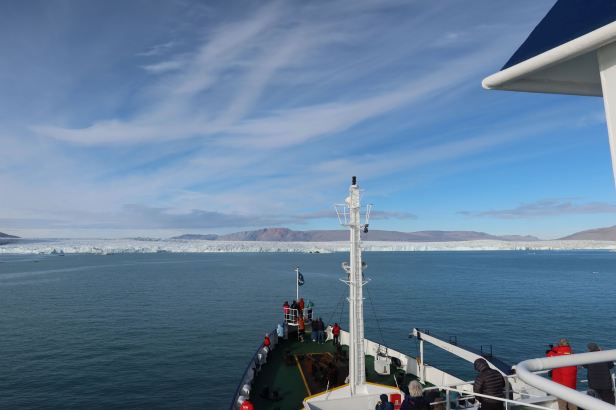
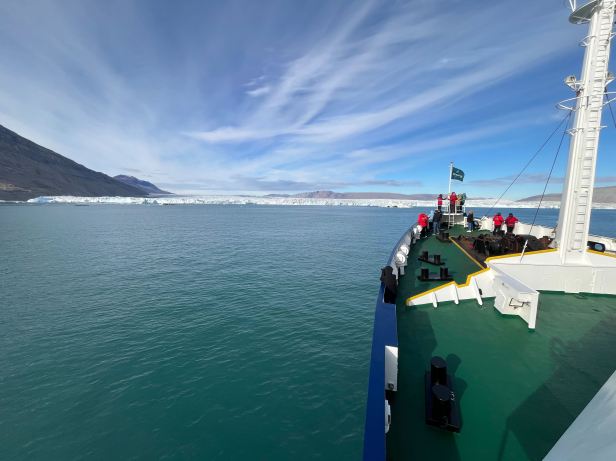
This wall of ice towers over sixty metres high above the sea, is ten kilometres wide and is the end of a glacier over one hundred kilometres in length.
The sheer amount of ice was simply breathtaking.
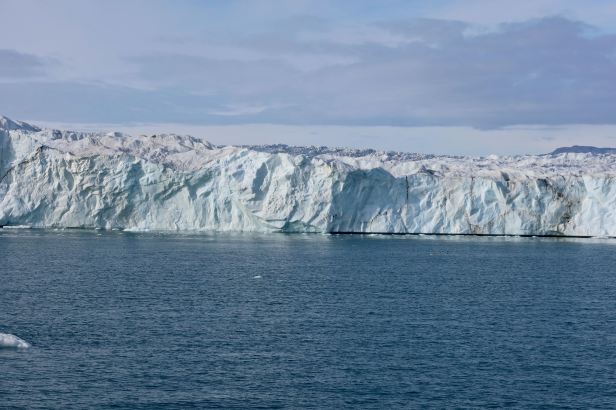
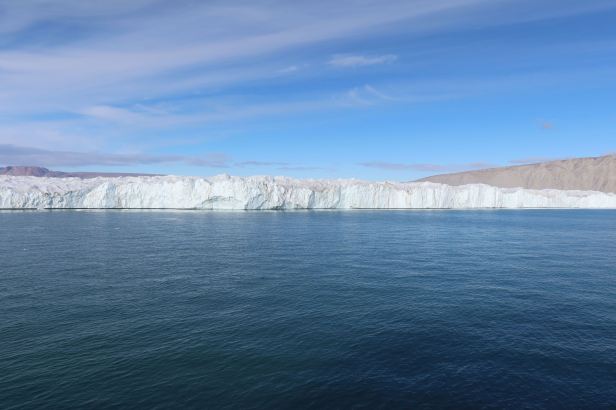
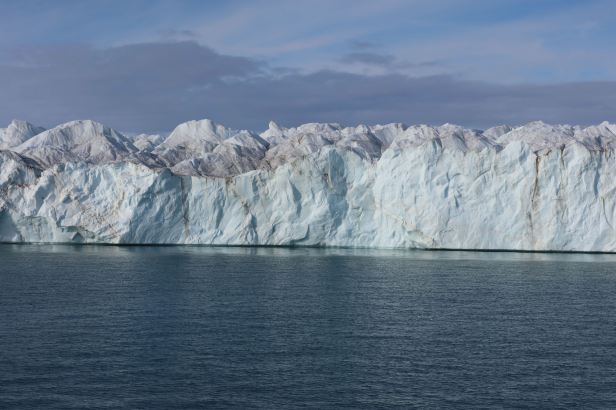
The Plancius approached, slowly, cruised across the brash ice strewn waters, about three hundred metres from the ice wall and slowly turned away. It was mesmerising.
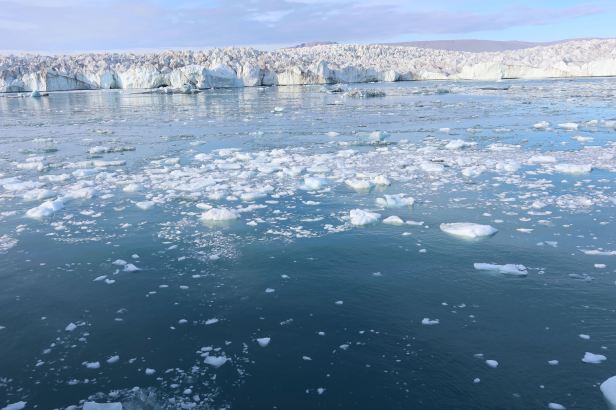
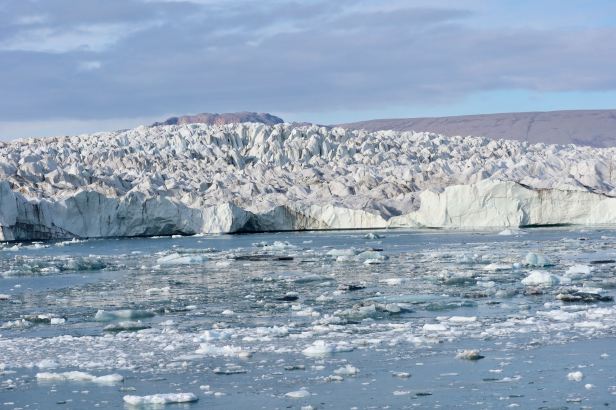
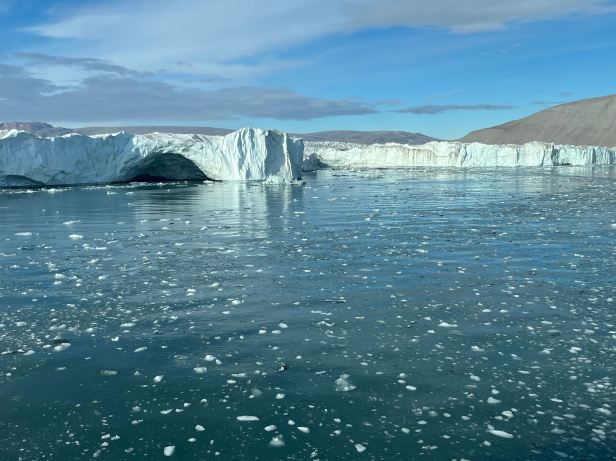
We rounded the turn and began to head back down the Franz Joseph Fjord towards the sea.
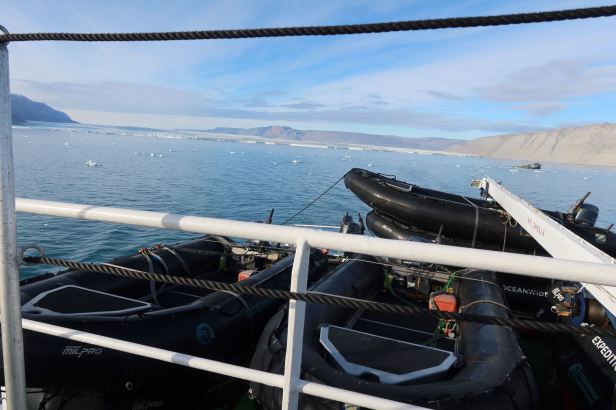
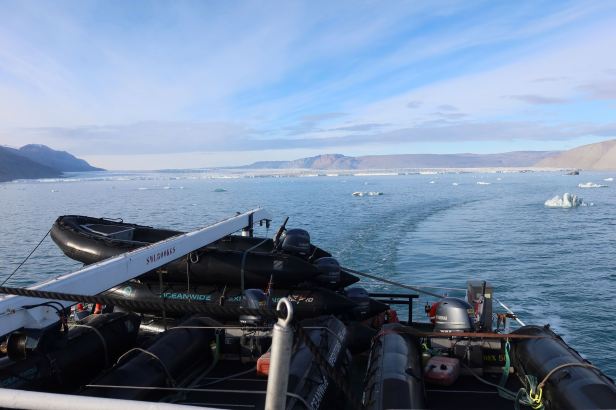
Then, it was time for the recap. Pippa outlined the plans for the following day which included two landings if the weather held. We would, by then, be a long way North, the second landing would be at over 75 degrees. That was further North than anyone on board has ever been, so it would be a real adventure for the guides too. If all went well, we would then head even further North, before looping South around the finger of the sea-ice and then turning North again towards Svalbard.
Then there were the talks. The first up was not a guide, but a passenger. This was a Swiss Geologist called Uehli who worked in East Greenland for two months in 1975. He was part of a Danish geological survey that landed two-man teams, by helicopter, in remote valleys to search for ore deposits. They had radios, but not, initially, rifles and they were completely on their own. It was quite a compelling tale. At one point, Uehli and his companion had found an abandoned baby Musk Ox. It more or less adopted them and was eventually airlifted by helicopter and transferred to a zoo in Denmark. Different times.
Then Michelle told us about a female Arctic explorer, Louise Amer Boyd. She was a Californian heiress and socialite. Louise became obsessed with the Arctic and had the means to fund eight separate expeditionvoyages. She took scientists with her, but received no credit for helping their research. In the end, her hobby completely bankrupted her and she died poor. She was still, however, invited to be on the first ever commercial flight over the North Pole. So at least she got to see it.

Then it was Chloe’s turn. She was almost beside herself with joy as she had found, in a lake, some Daphnia. This minute crustacean, it might be up to 6mm in size, is an amazing thing. With the aid of a special microscope, she was able to project one onto the screen where it flitted about for our enlightenment and amusement. In “good” conditions, Daphnia are exclusively female and asexually reproduce by endlessly cloning themselves. If times get tough, males are produced and sexual reproduction gives rise to eggs which sink to the bottom to await the return of good times in the future. When these good times arrive, and it can be decades later, the eggs hatch and it all starts again. The tiny Daphnia has a heart that beats 200 times a minute and can alter the size of its eggs to thwart different types of predators that would eat them.
Then it was another “set” dinner. The food was good, but these tended to drag a bit.
Outside, the Plancius was now heading East down the placid and darkening fjord. Later that night we could expect to meet the open sea where we would again start heading North.
We had been told to expect a bit more swell. I retired to my little bed, I wanted to be well into dreamland before that happened.

