Tuesday, September 1st, 2026
Length of hike 1 – 4.2 kilometres
Length of hike 2 – 4.6 kilometres
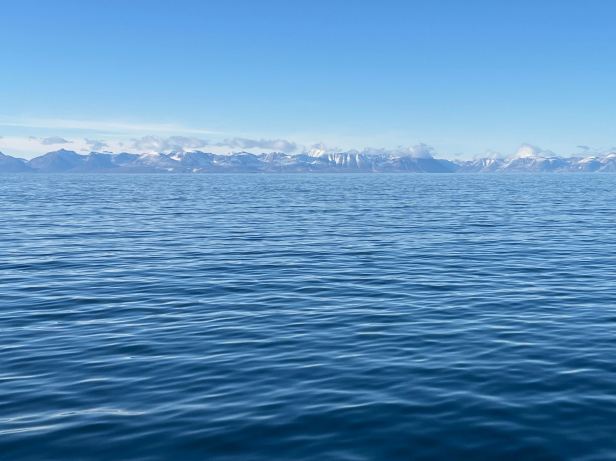
Lucie set the alarm, so we actually woke up in our (ship’s) time. Outside the window, the sea was grey and slightly choppy looking. The coast of Greenland, in the middle distance looked dull and foreboding. Pippa’s wake up announcement, which came after I had already two cups of tea, informed us that we were over 74 degrees North and approaching Sabine O. In life, the O is a Nordic one and means island.
There was a passenger on board, Suzanne, who is Danish. In conversation, it has already come up that she once worked in a fishing trawler in the very waters we were then traversing and that, together with her husband, she once spent over seven years circumnavigating the globe in a small, two masted, yacht. Yesterday, we saw the “wolf hut” in Blomenbucht and I remarked upon the inverted nails which, I presumed were to deter wolves. That morning, Suzanne showed me a photo of her husband sitting outside of that very hut – in 1974. He had actually been a member of the Sirius Patrol. She also mentioned that the nails were to deter Polar Bears, with the added rider that, of course, should it have felt like it, a powerful bear could have come straight in through the walls.
During breakfast, the Plancius anchored offshore of Sabine O and we watched as the first Zodiacs began to prowl the shoreline looking for a suitable landing site – and, of course, to scout for Polar Bears. Up closer, there was still a lot of laying snow in sheltered places – what a shame that my vest was still in Prague.
Germania Havn, Sabine O
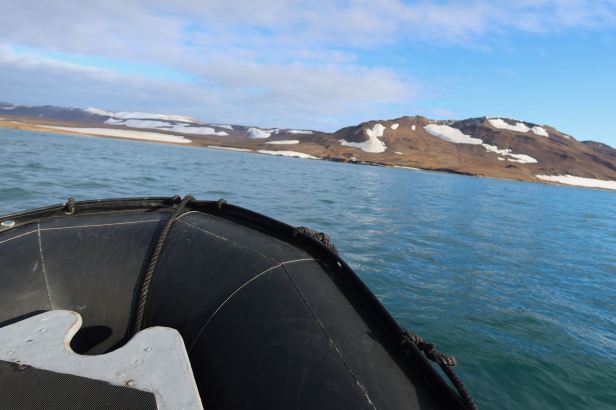
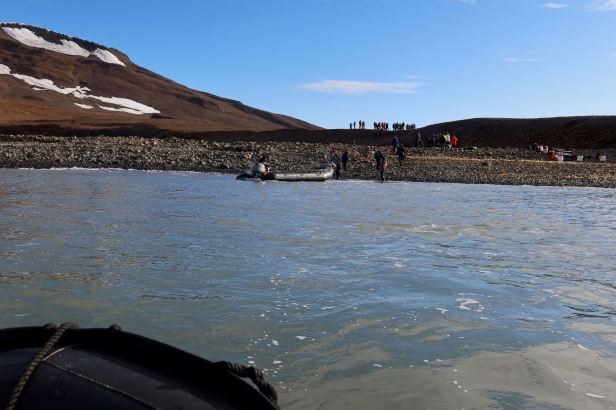
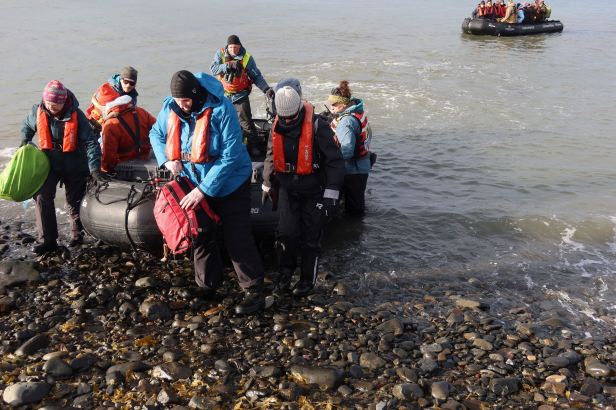
The call came and we struggled into our waterproofs and muck boots. Familiarity did not seem to make it any easier. Then, it was once more into the breach, or, at least once more into the Zodiac and we found ourselves on a quite inhospitable looking shore.
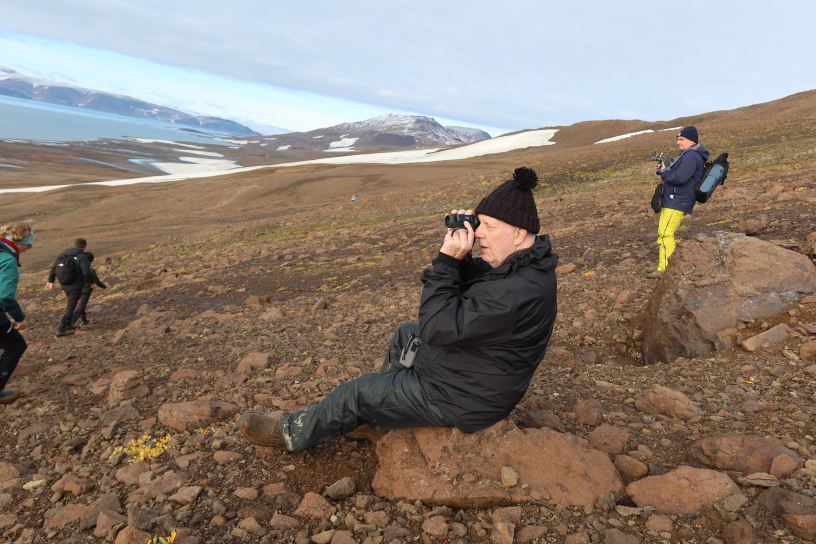
There was a sharp, initial ascent up a mound of loose rocks and pebbles to a small plateau where, once again the medium hikers split into a faster and a slower group.
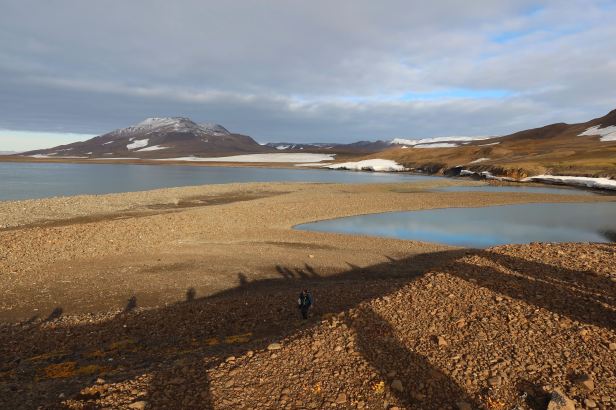
We were once again led by Chloe who warned us to be extra vigilant.
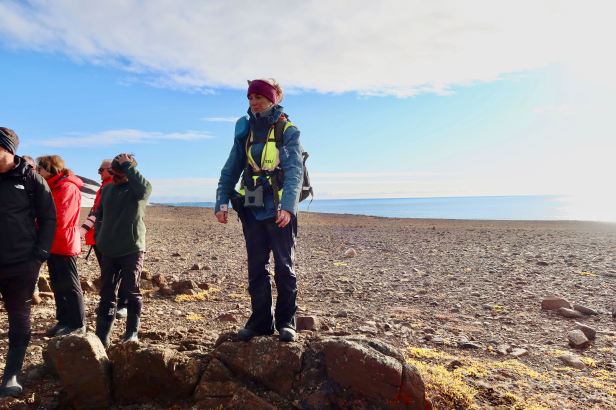
This landing was on territory that none of the guides had been on before and, in such a rugged landscape, it was always possible that there was an undetected Polar Bear. How reassuring ! In the event, the only white, fluffy things we saw were a couple of Arctic Hares in the far distance.
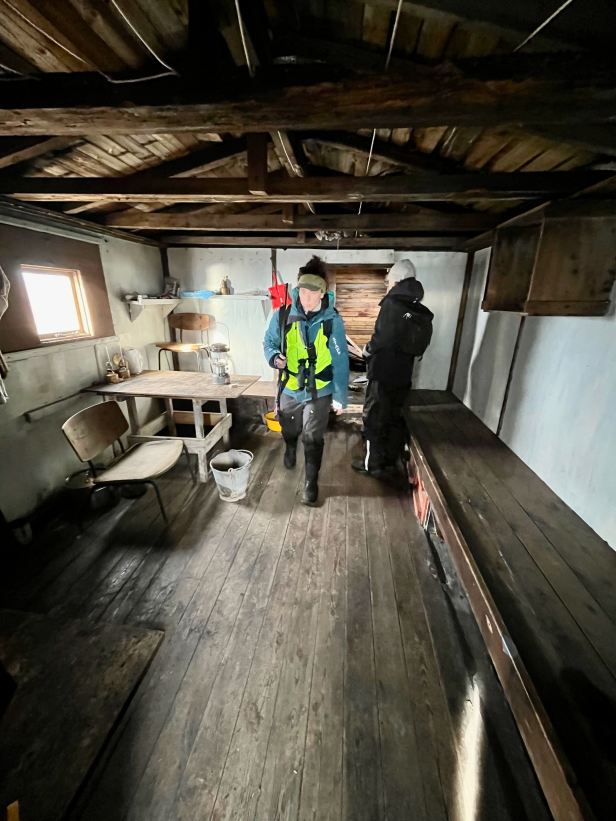
We stopped first at yet another hut. This was more substantial than the one of the previous day. It was open, so we could go inside. It was serviceable and a bit spartan, but would be a good refuge. There is a tradition that two matches are left sticking out of the box so that a frozen-fingered traveller, coming upon the shelter, could more easily start a fire.
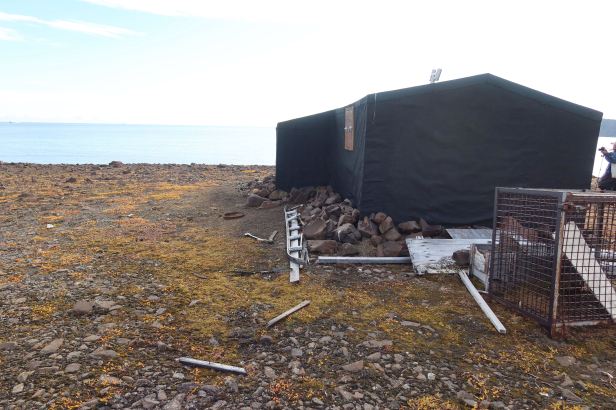
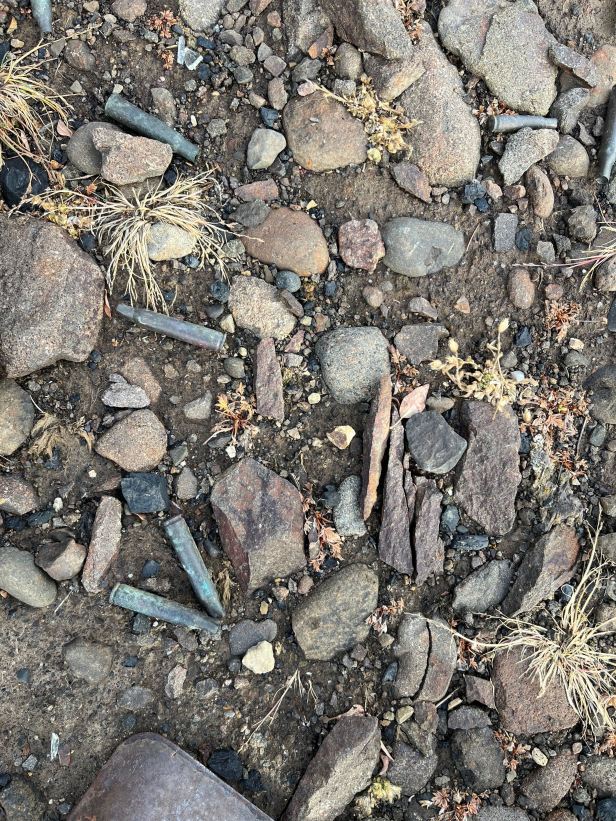
Outside, there were quite a number of spent cartridge cases from large calibre rifles. Some of these were German and clearly dated 1914.
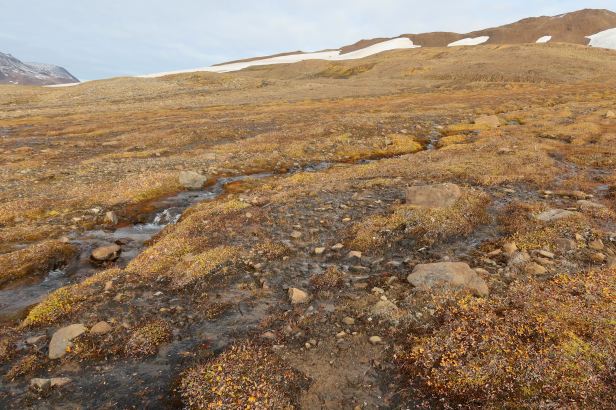
We were now at a latitude where there was permafrost a few feet beneath the ground and, because of that, a lot of the surface was a sticky and muddy bog. The muck boots certainly got a good work out ! It made for hard going, the extra effort required to walk only sunk our heels in deeper and, whilst nobody actually got stuck, a few did come close. At least the experience of my youth in a muddy pig farm finally finally came in handy. The youthful Chloe did set rather a killing pace, but we eventually all made it to a plateau which gave us a fine view over the island. There were a few birds fluttering around, the flashes of white, as they darted here and there, revealed them to be Wheatears.
Right in front of and below us was Germania Havn. This was where the German North Polar Expedition of 1868, in the ship “Germania” was forced to spend the Winter of 1868-69 in the bay, when the ship became frozen in. The Germans industriously spent the Winter surveying the local area. They certainly did not have a lovely hot lunch waiting for them, I thought as I watched the Plancius at anchor in the same bay.
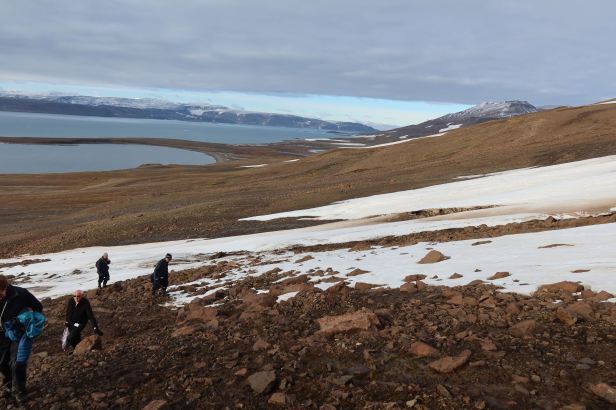
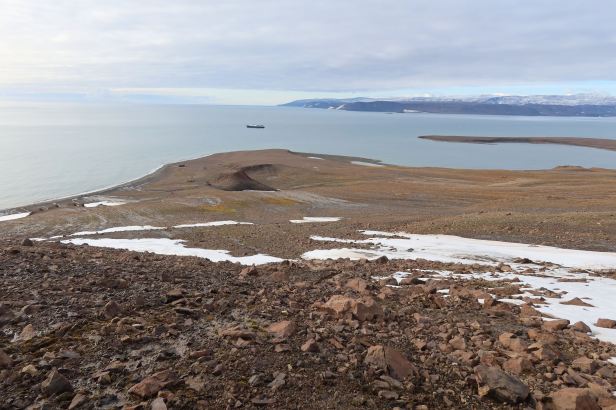
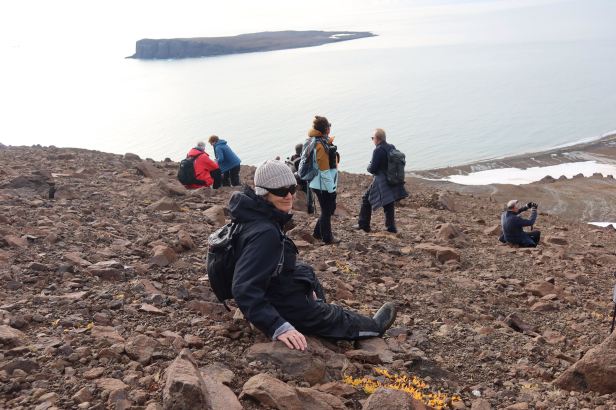
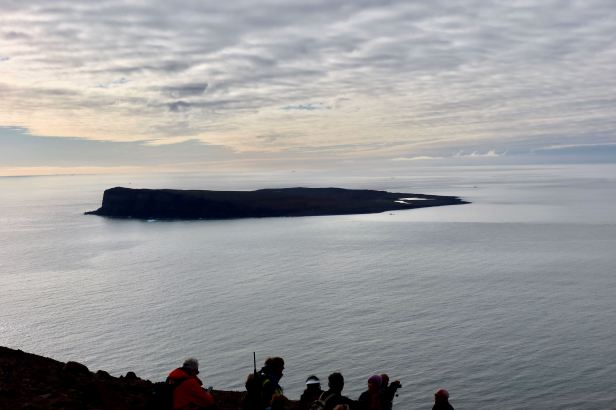
It had been hard work, getting up there, so we all took a rest for an “Arctic Silence“. Some of us sat on handy rocks, some stood. The only sounds were the birds and, of course, our laboured breathing. The dark shape of Sabine O was clearly visible in the bay below …..
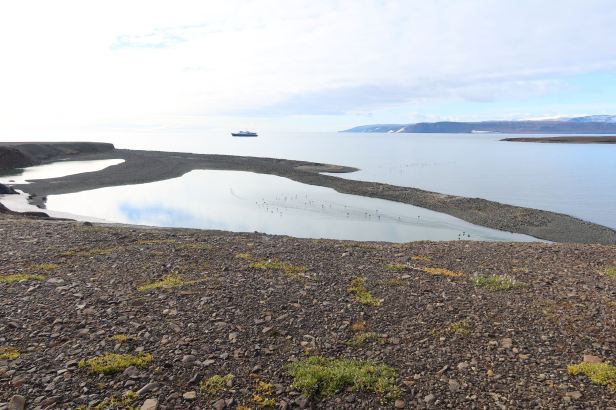
There was a large inland pool not far from the shore and the surface was dotted with dozens of ducks. When we appeared over the skyline, they all took off and flew away. They all had very long tails that revealed them to be, errrrr, Long-Tailed Ducks.
We all know the maxim “What goes up …..”. We were, of course, now up. Only one way to go then. The first part was a difficult descent across loose shale and deep mud, but we all managed it physically unscathed, although one man did fall in the mud. Happily, it was not me. Then, after negotiating tongues of ice and a couple of streams, we came gratefully to a lower plateau. Our group had now caught up to Pippa’s slower hiking group. We jointly made the trek down the final tricky descent and then across the small plain and finally back to the beach. By checking out the lie of the land from an elevation, Pippa had been able to plot a less boggy course, although a lot of the ground was still very soft.
We cleaned our boots, as best as we were able to, in the shallows before boarding the Zodiac back to the ship. Once on board, there was some vigorous brushing in the troughs provided in attempt to remove the final vestiges of boggy goo.
Then of course it was lunch. There was an excited announcement by Chloe over the tannoy that she had “captured” a Sea Butterfly and that she would be exhibiting it in the lounge after we had eaten. She has a wonderful, infectious, enthusiasm for all the tiniest inhabitants of aquatic environments and, according to her posted biography, is one of Europe’s most pre-eminent marine biologists in her chosen field. When we had eaten, we went to have a look and the Sea Butterfly was a tiny creature which does appear to have two “wings”. There were two, swimming about in a half-litre glass full of sea water. She also showed us a Daphnia, the subject of her talk the previous day, under a microscope. Both tiny creatures were simply amazing and you would probably never even notice either if you were walking by, or swimming in, the lakes where they live.
The Plancius was now steaming towards Shannon Island and it appeared in the distance. Our destination and where we hoped to make a second landing, was Kap David Gray. This was a distinctive promontory named, by the Second German North Polar Expedition, after a Scottish whaler who had assisted the expedition by providing information about likely ice conditions. Sometimes referred to as “The Prince Of Whales”, Gray reportedly caught 197 whales and 168,956 seals during his career.
Shannon Island and Kap David Gray
The Plancius dropped anchor quite a long way from the shore and we watched, from our cabin, as a base camp was set up on the beach.
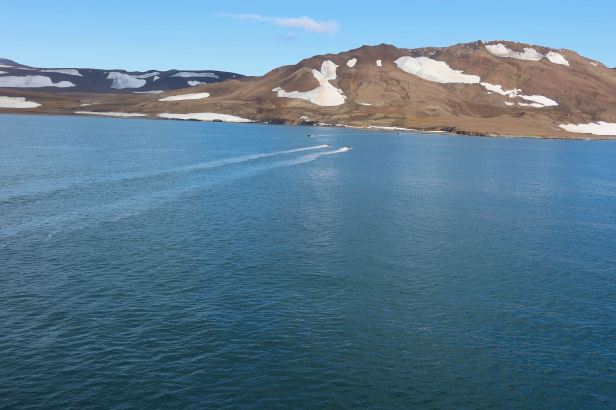
Finally, the tannoy announcement came and we togged up and went ashore. It was a little chilly, with a bit more wind than we were used to. Normally, this would not have mattered as the hike keeps us warm, if not over warm, but sadly, on terrain previously unvisited by the Oceanwide team, even the quicker of the two medium hikes was too slow. I was not exactly warm and Lucie eventually got so chilled that she also wore my fleece !
Immediately above the beach was a wet, marshy, area and running about there, we saw a Ringed Plover. Closer inspection revealed there were actually several, but they blended in so well that they were very hard to spot. Their range includes the UK, but I had never previously seen one there.
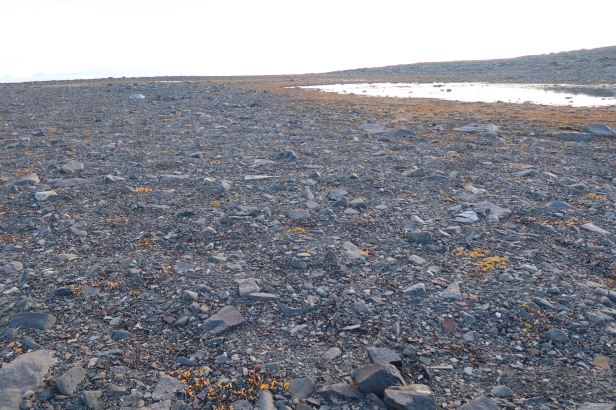
The hike was led by Michelle who, once again, repeated the Polar Bear warning. Marco, with his rifle, was the back-stop. We did not encounter any bears, but the people on the long hike did find some reasonably fresh footprints, including those of a cub. We started in very soft, black, volcanic sand which, as we moved away from the beach morphed into a long slope covered in small rocks.
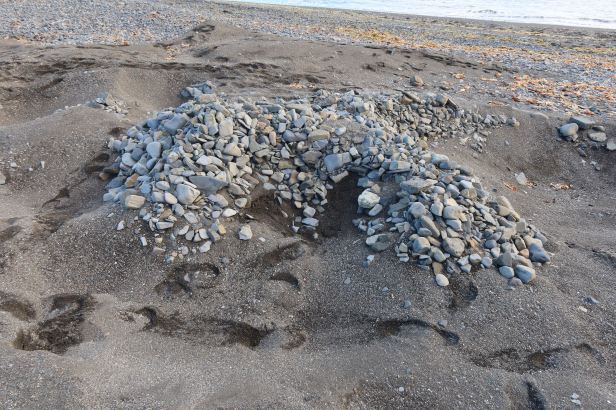
These made the going quite difficult and watching where you were going was important. I naturally found this out the hard way. A hiker in font of me suddenly stumbled and stopped, I looked at her, not the ground – and immediately fell over. Ouch ! I did bang my right knee and my right hand – but the chief casualty was my dignity.
Shannon Island was actually a whole lot of nothing. It was almost exclusively of a reddish-brown hue and as desolate as the surface of the moon. The sizes of the rocks did vary, from small stones right up to huge boulders, but apart from a couple of distant Arctic Hares, there was not much to see, apart from the scenery.
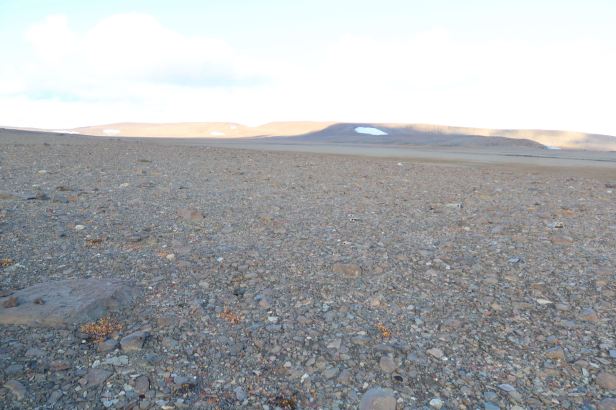
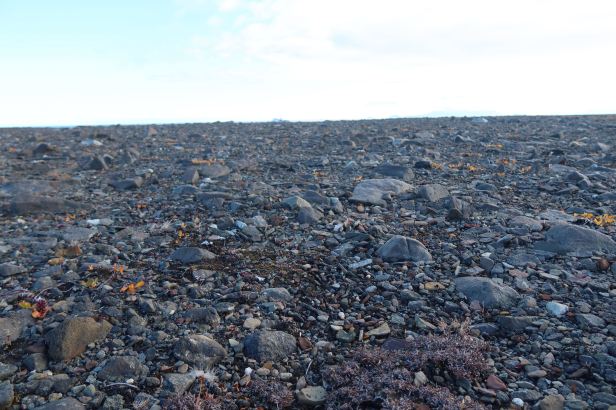
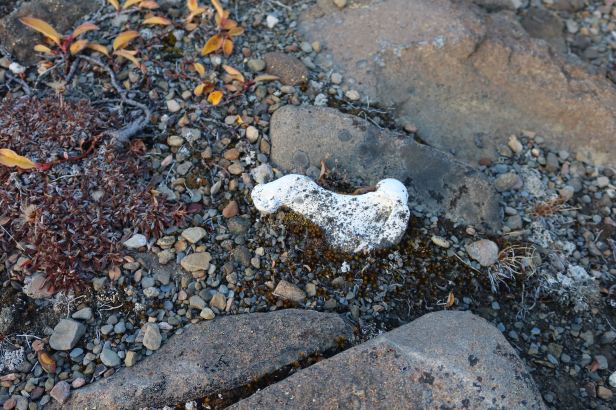
There were endless tiny plants, struggling gamely in a harsh environment and Michelle pointed out a comparatively successful moss which was growing beneath an old bone. The nutrients slowly leaching out of the bone had given that tiny piece of soil a boost and the lucky moss was bigger than all the others surrounding it.
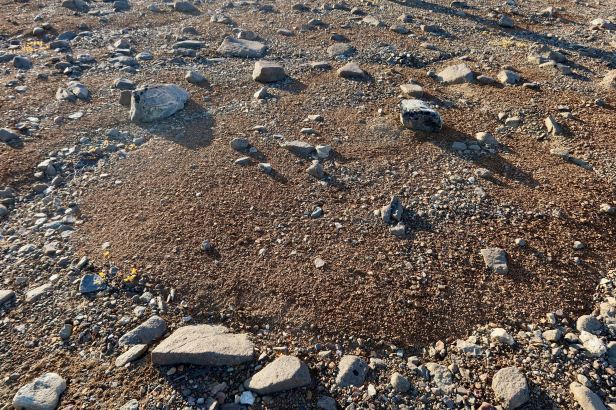
A few of us noticed some seemingly symmetrical patterns in the soil and rocks and were momentarily pleased to have discovered something archeological. Sadly, we were all wrong ! According to Marco, the water freezing in the soil during Winter, swells and moves the ground slightly. This ice thaws in Summer, but the small fissure remains. Each Winter, more water enters the crack and freezes and, over time, the fissures can get quite wide. The cracks then fill with soil particles, but the little plants do not like to grow there because the annual widening affects their roots. The fissures often form a geometric pattern which, as it is devoid of plants, stands out well in its surroundings. This is called “pattern ground”. You learn something every day.
The desolate and reddish scenery that surrounded us was how I imagined it would be on Mars.
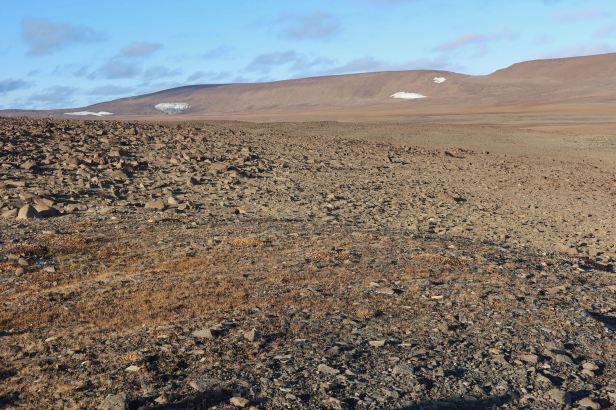
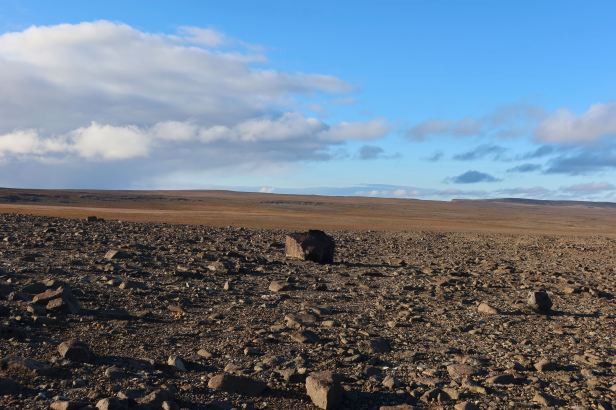
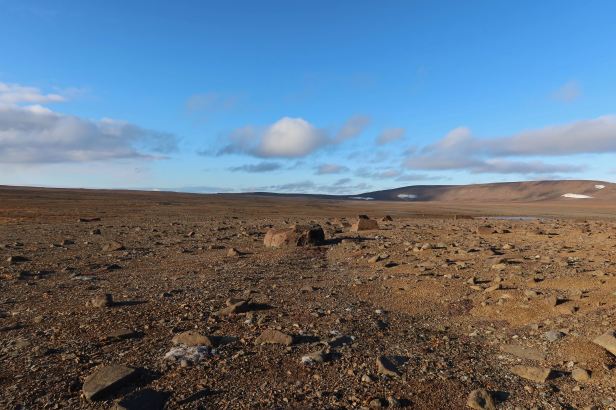
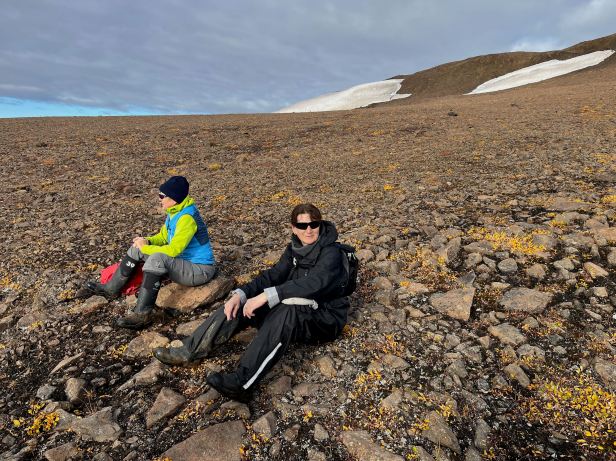
Eventually, on a quiet hilltop, Michelle called for an “Arctic Silence”. We all sat on rocks or stood in silence in the weak sunshine. It was another magic moment but, with the lack of any movement, soon became a very chilly one too.
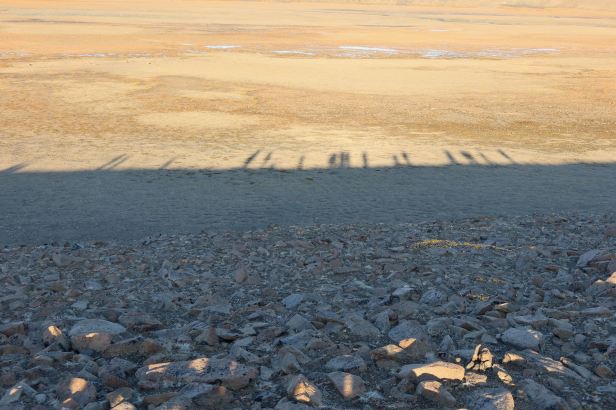
We walked down the hill in a big loop and then towards the beach, casting long shadows in the low-angled sunlight.
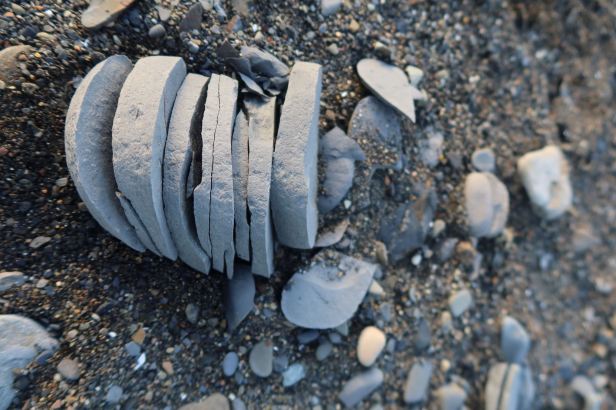
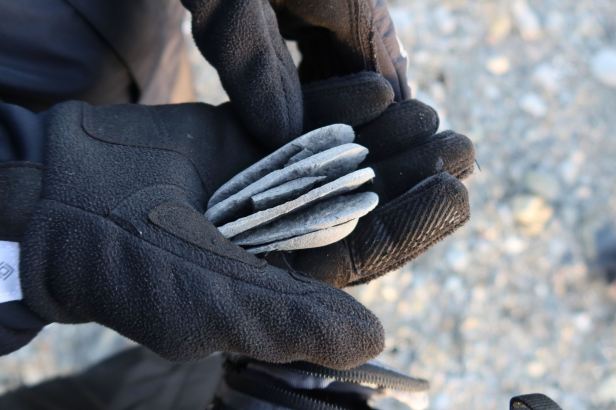
Near the shore, we came upon a whole area where rocks had simply split, multiple times, like loaves of sliced bread, by the frost. So symmetrical were some of the fractures that they almost looked as if they had been done with a bandsaw.
On the beach itself, mild drama. The waves had washed one Zodiac so far up the beach that it could not be refloated. It took Pippa, Lucie, seven strong men and me to get it back into the water.
The hikes, on uncharted territory, had overrun their schedule so, once we were on board again it was immediately time for dinner. This was followed by an abbreviated recap. The next day, if all went well, we should reach the apex of our Greenland trek. Then we would depart for Svalbard, hopefully taking in some sea-ice on the way. That was it, most people were already nodding off.
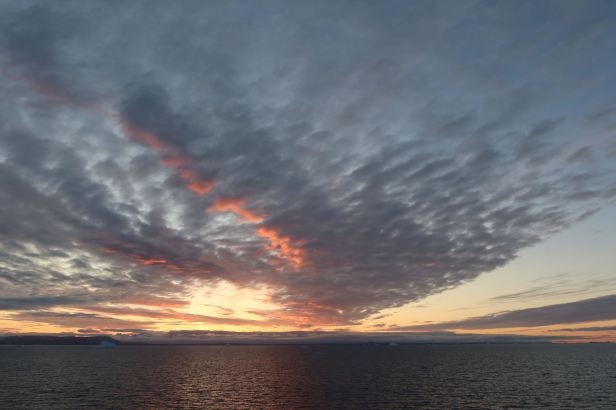
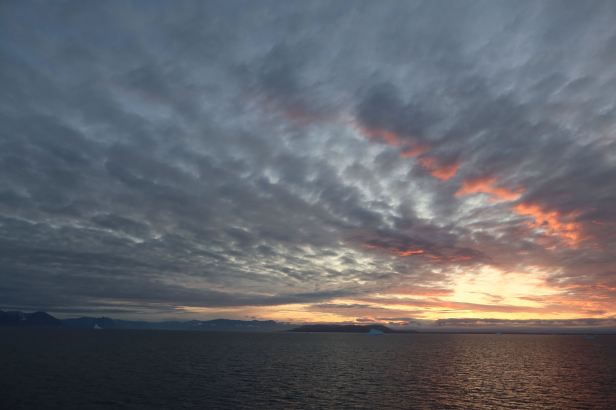
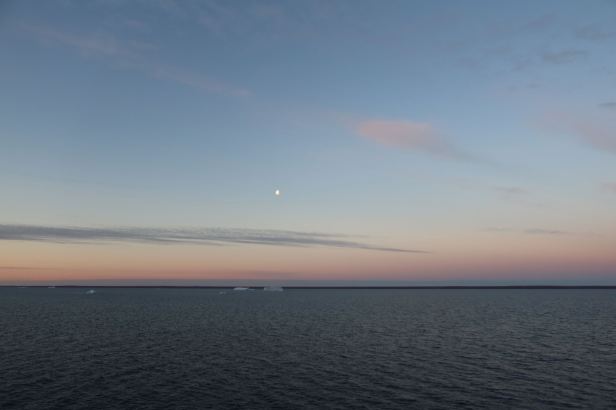
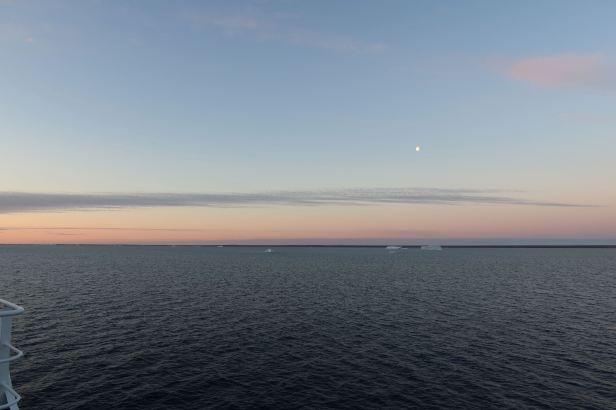
So, despite another practically surreal sunset, with the Plancius again proceeding North, it was off to bed.
Another long day was beckoning.

