Wednesday, September 2nd, 2026
Distance hiked – 5.6 kilometres
When we woke up at 06:30 (I think I finally had the ship’s time/iPhone thing figured out) the Plancius was cruising slowly up the coast of the long and thin, Store Koldewey Island. The view from our window was finally the Greenland of my imagination. Bleak rounded bluffs, covered in either ice or a dusting of early snow at altitude, rolled inland towards an equally bleak and frosty horizon. These bluffs stretched away as far as the eye could see behind the ship.
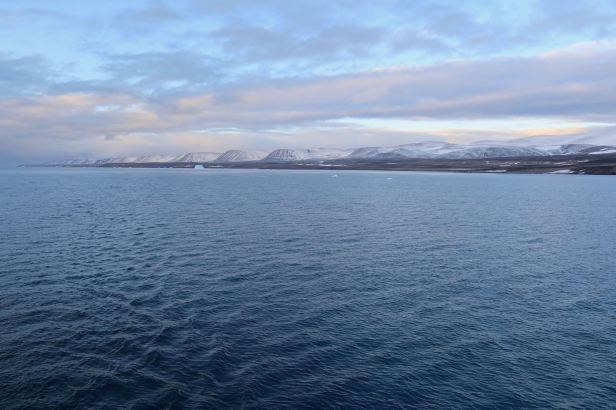
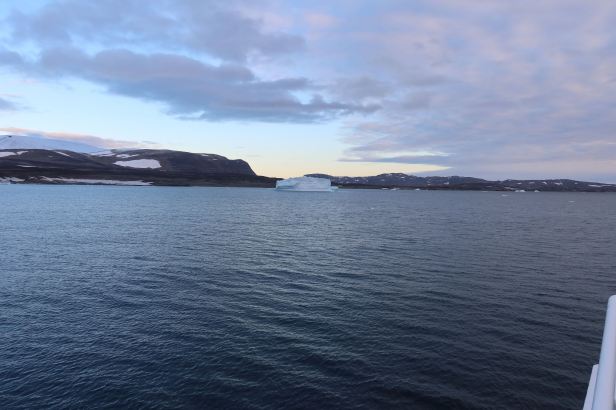
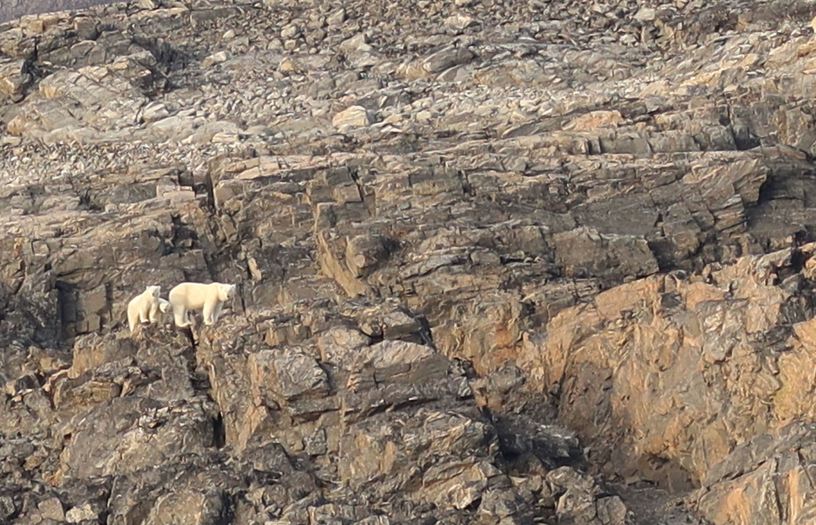
Plan A for the day, was to do a landing, a little bit further North, where a deep bay in the West of the narrow island and glacial activity in the distant past, had slightly softened the terrain. As I sat drinking my tea in the lounge, the tannoy announced that a Polar Bear and two cubs had been spotted on shore. Wonderful, but that was, obviously, Plan A out of the window (or, possibly in this case, out of the porthole).
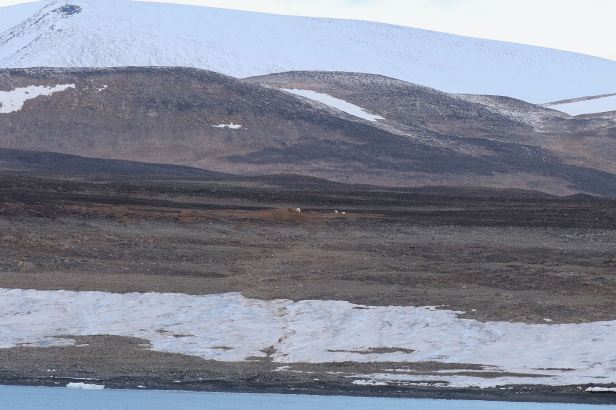
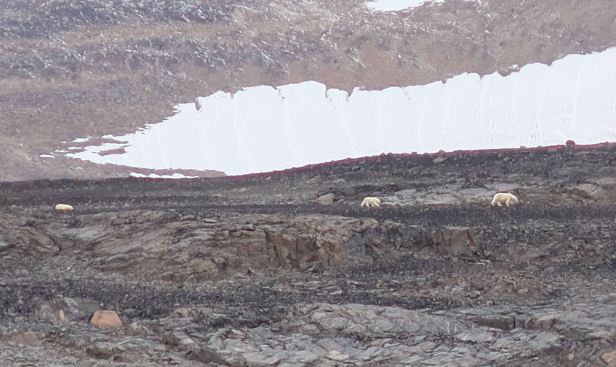
Lucie had a bit of a sore throat so, because it was so cold outside, she declined the opportunity to go for a Zodiac cruise around the bay. In truth, apart from the fact that we did get marginally closer to the Polar Bear family, she did not miss much. The bears were, of course, enchanting, but as soon as the mother detected us, she led the cubs away on a long climb into the interior and, eventually, they all moved away and out of our sight.
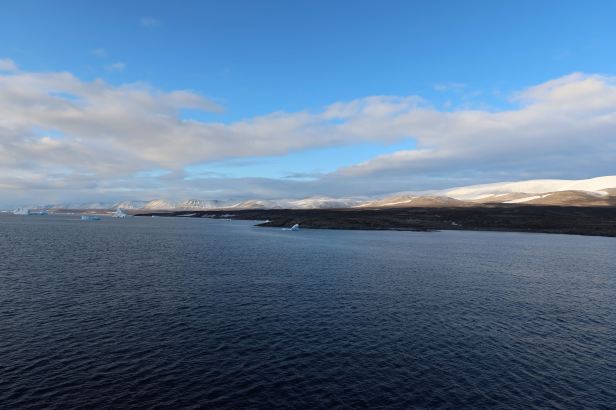
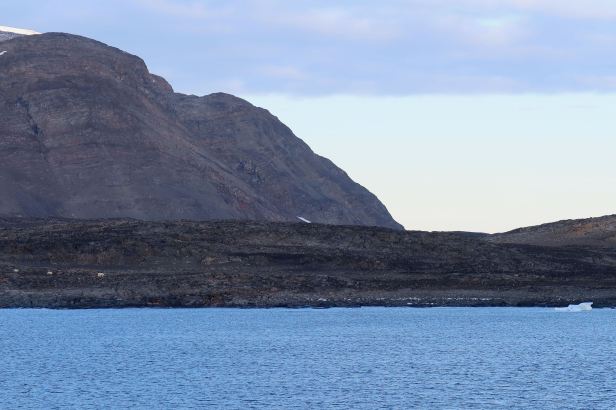
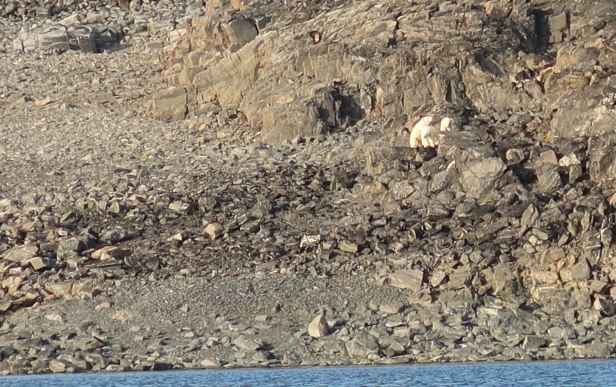
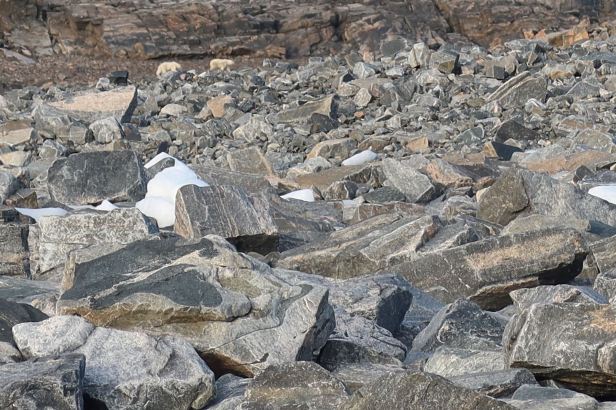
Out on the water, there was a stiff breeze and it was bitterly cold (and this is me talking) and I was very glad that I had “layered up”. We cruised around, looking mainly at rock formations and icebergs, from the water, whilst constantly scanning for Mama Bear, but she did not reappear.
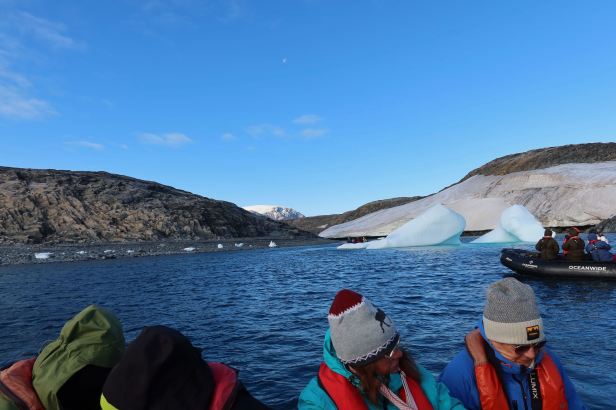
Some people, on a number of Zodiacs, got too cold and had to be returned to the ship. Of course, being English, I had a stiff upper lip and toughed it out until the end. The reward for my stoicism was to see a pair of Black Guillemots, in their speckled Winter plumage ……
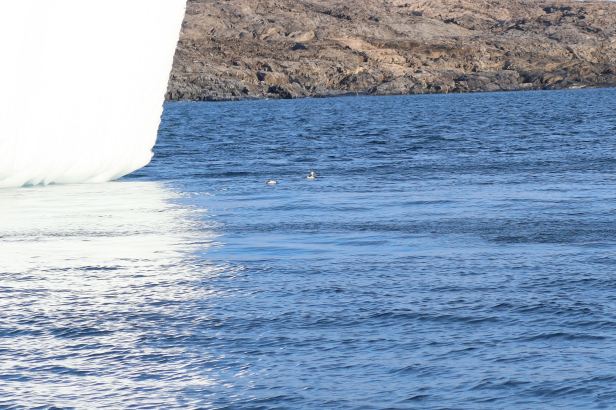
……. and an iceberg which was exhibiting signs of meltwater refreezing (the bluer stripe on the left-hand one), which is called recongelation !
Do not say I never tell you things.
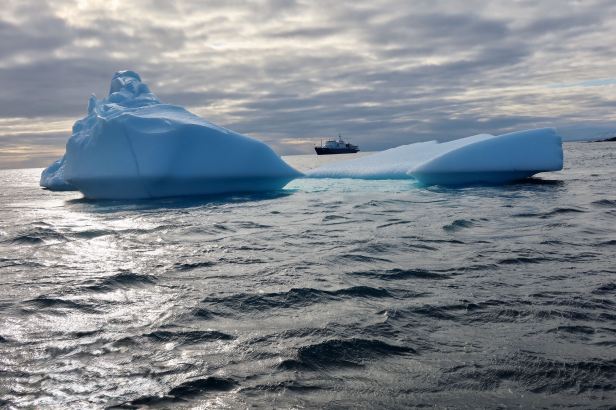
Being almost frozen to death is strange – you do not really notice it – until you get back in the warm. Even on the open deck of the Plancius, out of the biting breeze, felt like being in Spain and our little cabin, with its snug inhabitant, felt like a furnace. THAT, oddly, was when the real shivering started !
I warmed up in the lounge with a couple of cups of tea while all around me, people with better cameras compared close up shots of Mama Bear and her cubs. So fluffy, so cute and so deadly. Even out at sea, each pair of Zodiacs had been carrying a rifle just in case Mama had decided that it was time for the cubs to take swimming lessons.
Then, inevitably, it was lunch time where I joyfully replaced the calories that I had shivered off whilst out on the water.
Skibshavn, Danmarkshavn
By the time lunch was over, the Plancius had dropped anchor at Skibshavn. This is also the site of Danmarkshavn, which was where the ship Danmark anchored and the main base was established, for the Denmark Expedition of 1906. From here, teams on sleds had set out to explore Northern Greenland. This region of Greenland is called Germania after the ship that also overwintered in a bay we visited a little way further South. Nowadays, Danmarkshavn is a weather station that receives a degree of international funding. The station is off-limits for landings, so the expedition team prepared sites a little further to the West for our promised hikes.
As usual, there was one long hike and two medium ones as previously described. We again went for the faster of the two. It was also possible to do a short hike which appeared to be walking up and down the beach.
We landed on what we thought might be our last Greenlandic beach, doffed our lifejackets and headed to join the medium hikers. Again there was a split into slow and fast medium and, of course we chose the fast guys. I always try to be fair, we are not all the same and one Chinese lady always joined our fast group and usually ended up holding us all up. Put it this way, if she had been part of “The Long March”, it would still be going on now and not be something from the history books !
On previously uncharted territory (they did not know the terrain and where a Polar Bear might possibly be hiding) the guides were extra vigilant.
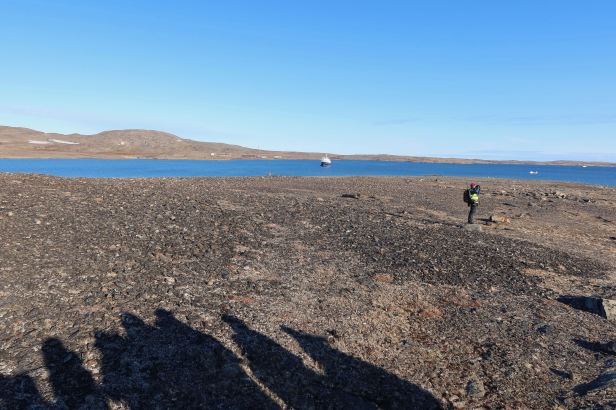
Before we went anywhere, Uehli, the Swiss geologist who once explored these parts and another guy, also a geologist, gave a very brief chat about the rocks upon which we were standing. Although time, erosion and glacial activity had reduced it from dramatic folds and ridges to the sort of terrain that geologists call gneiss, they are amongst the very oldest rocks on the whole planet and are 2.8 billion years old. The rocks also started life in the southern hemisphere, closer to Antarctica than to the North Pole. Tectonic activity moved them all the way to where they now are – and then collided with another plate which exposed them.
Then, after the customary Polar Bear warning and fronted by a rifle toting Pippa, we started smartly off for a distant ridge. Koen walked patiently at the rear behind the Chinese lady. Pippa set a fast pace, the ground was new to her too as, in her two attempts on previous voyages, sea-ice had prevented any landings. We climbed steadily, but not dramatically. The terrain was fairly smooth with a few smallish boulders and the occasional rocky outcrop.
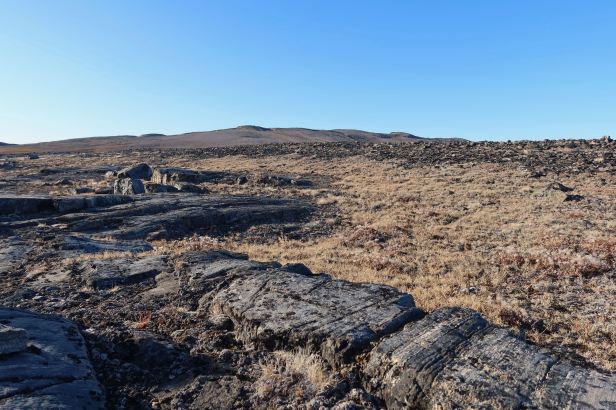
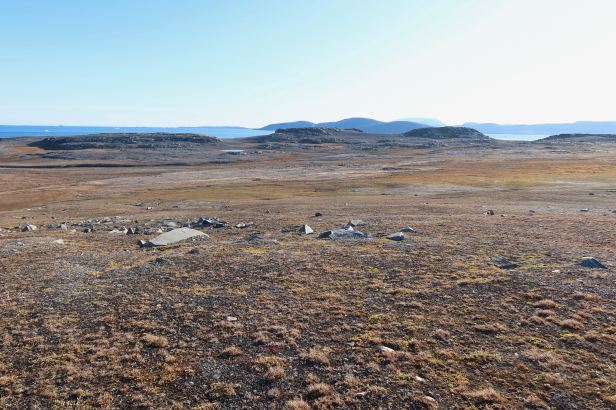
At the first small plateau, we halted and had a glorious panorama over Skibshavn, Danmarkshavn and the entrance to Dove’s Bay. The sun was out, the wind had dropped and the waters reflected the brilliant blue of the sky. The Plancius, anchored far below, looked like a toy and it was only the icebergs, scattered here and there, that fixed the scene in the Arctic and not in the Caribbean.
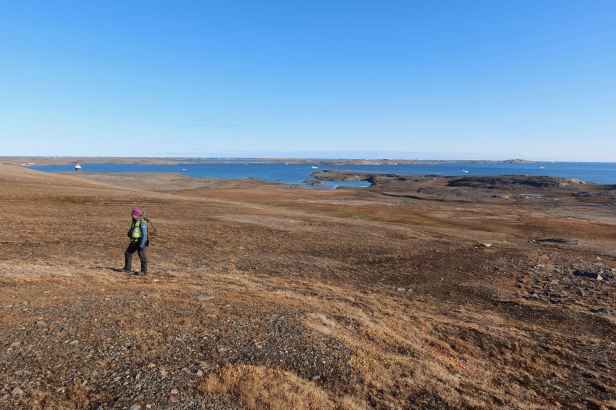 As soon as we moved off again, we spotted an Arctic Hare. They are a brilliant white and you can scarcely miss them against the dull coloured surroundings. It was not a new sighting, but the photographers went as mad as always. Even when we were within fifty metres, the hare basically ignored us. It simply went about its little hare life as if we were not there at all.
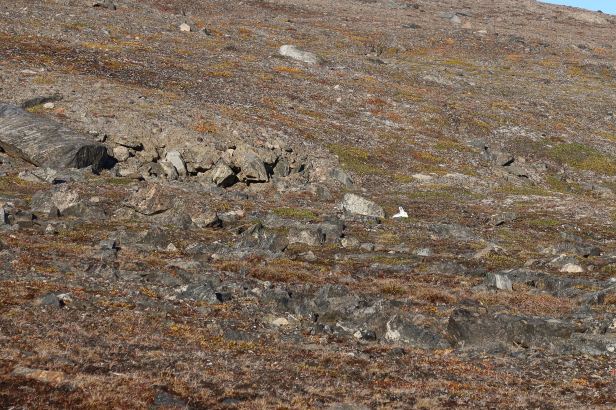
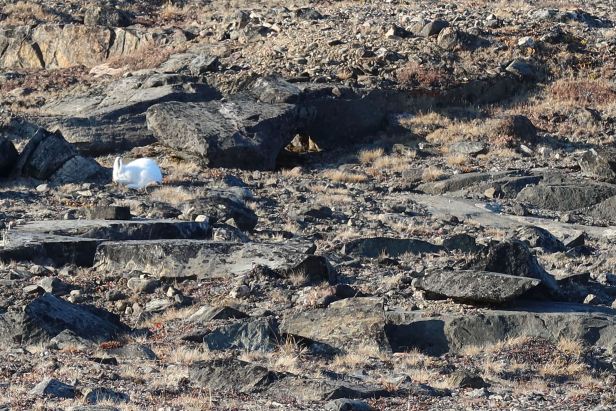
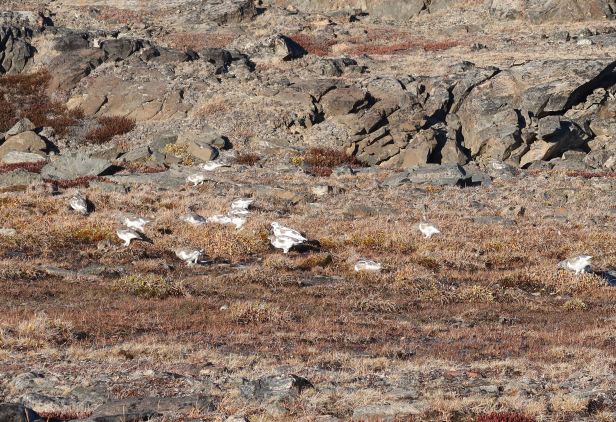
Any form of wildlife seemed fairly scarce in those parts, so much so that two Fieldfares (a kind of Arctic Thrush) caused a stir when they appeared half a kilometre away. They were identifiable with the monocular, but far too tiny to photograph. Just imagine then, our collective surprise when we crossed the next rise and saw in font of us no less than TWENTY Ptarmigan foraging in the thin grass. In the UK, these are the rarest and shyest of birds. They live on the highest moors of Scotland and are shot as sport. I had never seen one before and here was a whole flock or, possibly, as they are game birds, a covey.
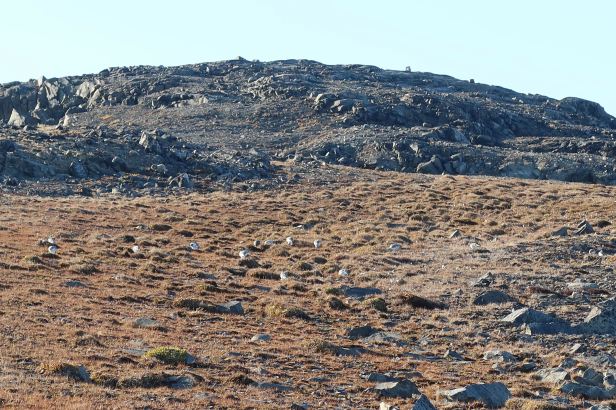
We slowly approached, cameras clicking away and, just as the hare had done, they completely ignored us. Forbidden to disturb the wildlife, we closed to about thirty metres and they just kept pecking away. Once again, as with the hare, it was us that left
Onwards and upwards we climbed, with Pippa setting a good pace at the front and Koen at the back goading the Chinese lady forward with the barrel of his rifle. We came to a point where the whole of Dove Bay was, literally, at our feet. A glorious blue vision, dotted with icebergs. Pippa called for an “Arctic Silence” so I sat on a handy boulder – which promptly rocked and slid about twenty centimetres. It could have been sitting there, unmoving, since being left there by a glacier ten thousand years ago and I shifted it with my bum in two seconds. I hope its “new” position does not confuse a geologist in the future !
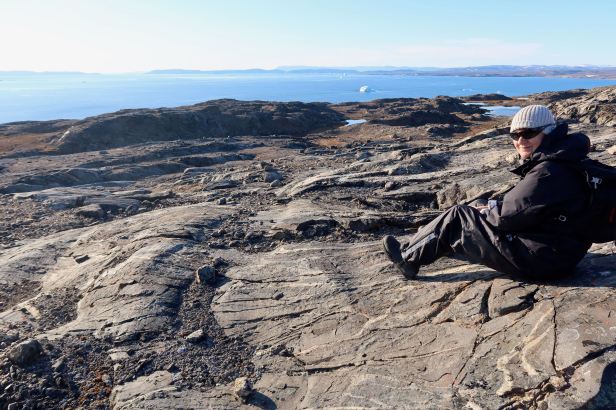
We all went quiet. Well, when I say “all”, I really mean nearly all. Maybe silence has a different meaning in other places like, say for example, Beijing. Still, it was, nonetheless, another moment of great peace and tranquility.
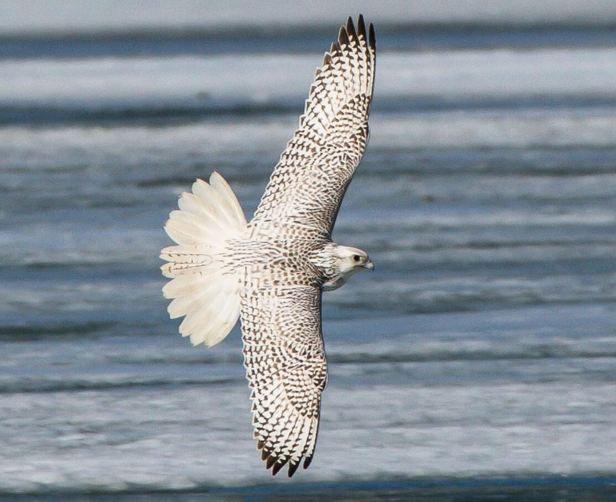
As we all stood up, there was a moment of high, avian, drama, right above our heads. A pair of handsome Gyr Falcons appeared in the sky. This was another great rarity, I had never seen a wild one before. They were far too quick for us to capture with our camera, but it is a handsome bird, so here is a “stock” photo.
Just before the summit of the plateau we were then on, we had passed six more Ptarmigan, sitting in the rocks, but only six had scarcely clicked a single shutter.
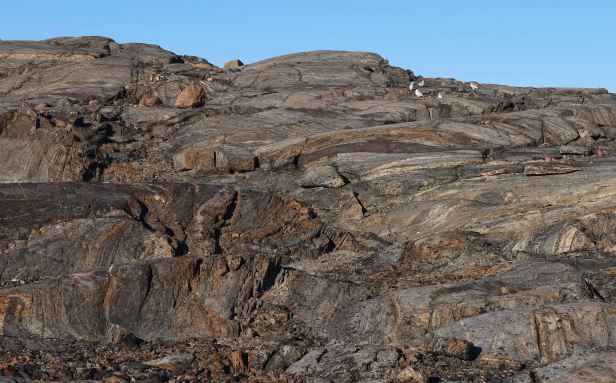
They excited the Gyr Falcons though and one dived in, seeking its lunch. The Ptarmigan scattered in all directions but the falcon fixed on one. It chased it, but its potential prey was more agile, so it eventually gave up before flying away in disgust. The Gyr is the fastest of all the falcons under its own power, but how lucky that Ptarmigan was that it was targeted by a Gyr and not a Peregrine, Falcon. The latter, which dives from a great height, is the fastest living thing on the planet !
We took a few snaps of the view and the geology.
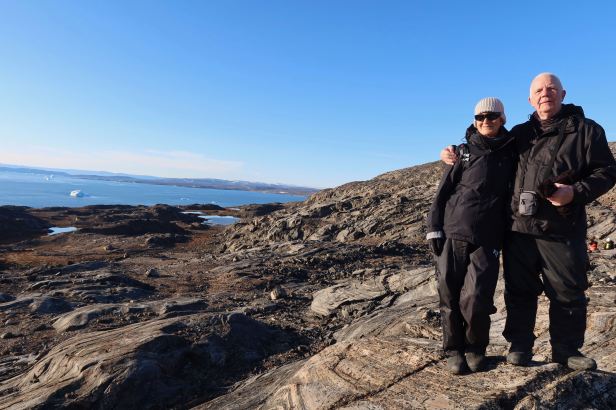
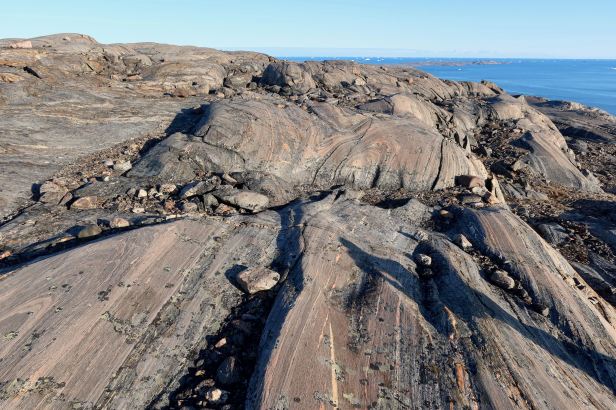
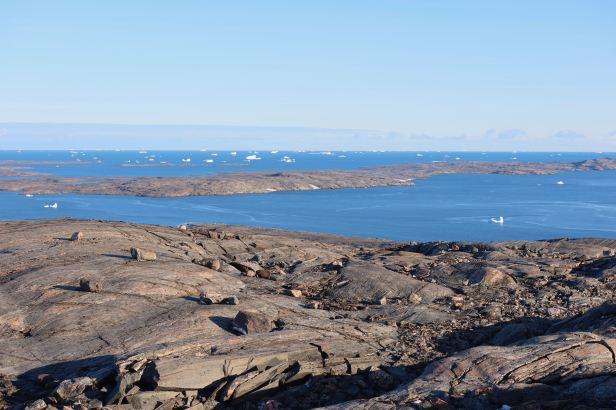
Then climbed still further. Koen, now leading, was like a mountain goat once he got going. There was a further peak ahead, with a small cairn which proved, dammit, that others had been here before us, but time was running out, so we could not go that far to kick it over. We began our descent, which is always more tricky than going up, but we all managed it and were soon striding in a long line down a slope towards the sea. The “pattern ground” phenomenon was clearly visible there too, although the shapes were much smaller.
We came to the beach, donned our life jackets, washed the mud and traces of ptarmigan poo off of our boots and took our Zodiac taxi back to the ship.
The recap was soon up. Pippa revealed that, because satellite imagery showed that the long arm of sea ice had parted in the middle, we had a little extra time. For this reason, she would try and attempt one further landing even further North. This would be at Depotnaesset, which is opposite a small islet called Belle Isle. This is in the very high 70s of latitude and we could only think about it because, unusually, it was not already iced in.
Charlotte then treated us to a short talk on the Arctic Hare and was followed by Koen with another of his provoking chats about photography. We had already noticed (because we were doing it ourselves) that lots of passengers were following his tips !
Then it dinner, during which we had a long and fascinating chat with a Canadian couple, Ann and Gregg. They are both art restorers and had led interesting lives. For some reason, Ann was wearing a badge, of her own design, that cleverly incorporated the red and white flags of both Canada and Greenland.
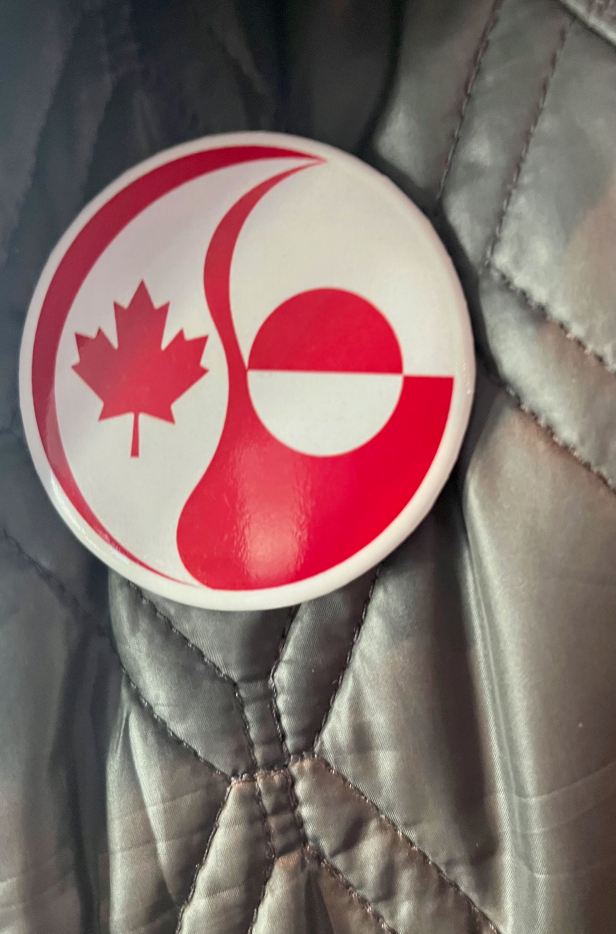
The sunset was, once again, truly breathtaking.
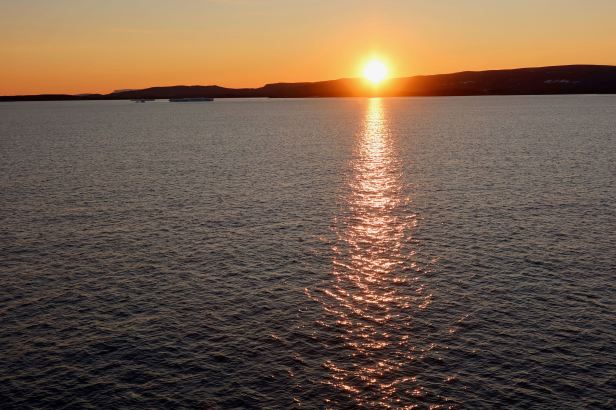
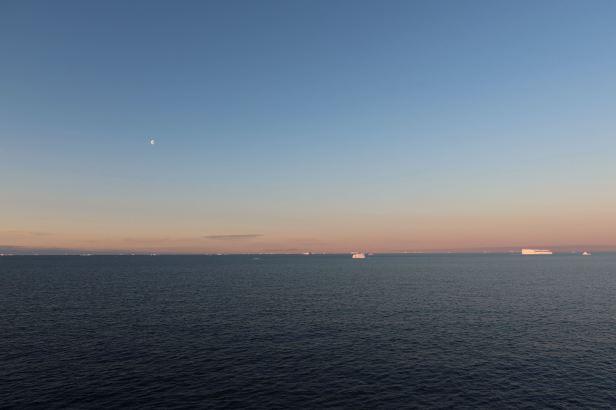
Then, it was off to bed as the Plancius, once again, began to head North.

