Thursday, September 3rd, 2026
Distance Hiked – 4.1 Kilometres
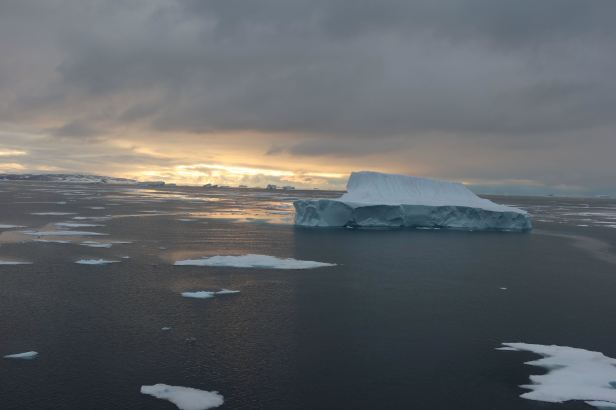
Because Lucie again had set the alarm, I woke up, at the right time. I felt well rested, but my right knee was a little stiff from my fall two days before. As always, my first action was to undraw the curtains. There was a glorious dawn going on and I when I went upstairs to get Lucie’s coffee, I took a moment to capture what would be our last sunrise in Greenland.
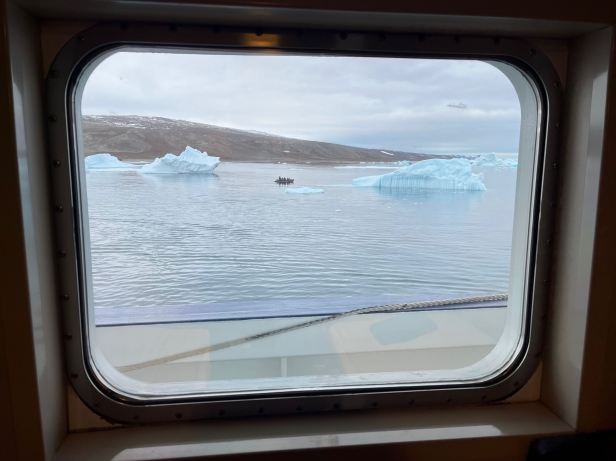
By the time I went up again to get my cups of tea, outside the picture windows it looked a little gloomy and, at first, I feared we had entered a landing-preventing fog. But then I realised that the reason I could see nothing, was because there was nothing to see. I was sitting on the same side as our cabin, on the Port side, which was the land side on this part of the voyage. The Plancius was crossing a wide inlet, so the land was there – but it was a long way off. I went outside again as the light grew and the Sun came back. According to my iPhone, we were more than 77 degrees North. The same device indicated that the outside temperature, in Celsius, was 77 degrees less than our latitude. As I watched, a large iceberg passed across my sightline about thirty metres away.
Back inside, I fell into conversation with what I had previously thought was a German lady. We had exchanged a few pleasantries before because, like me she is an early riser, but this was a proper chat. It turns out that she was actually Austrian and lives at the Faaker See, where there is a huge, annual, Harley-Davidson festival. She was pleased to find out that Lucie and I had been there – but, of course, we went there when there was not 100,000 bikers milling around.
Breakfast was called and while we were overeating, Pippa came on the tannoy to announce that we would be making a landing. Once last walk on Greenland then. We scurried (well, ambled) to our cabin to change.
Depotnaesset
I had finally developed an efficient way of getting into my over-trousers and muck boots, so getting ready did not take long. Even though it was zero degrees outside, with icebergs just outside the window, I did not go crazy on the layers because, when I hike I get very hot.
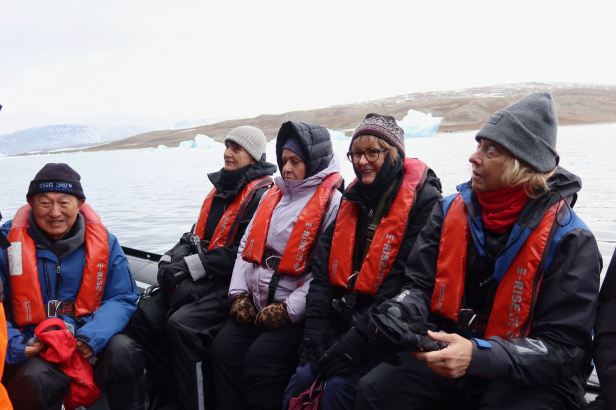
We Zodiaced (is that a real word?) to the shore and joined the merry throng of medium hikers. By way of a change the split into two groups had nothing to do with anything, so Lucie and I chose the one with less of the known “dawdlers” which was led by Marco and rear-guarded by Mark.
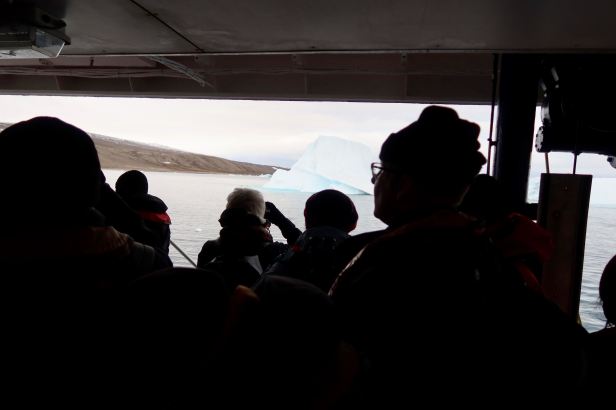
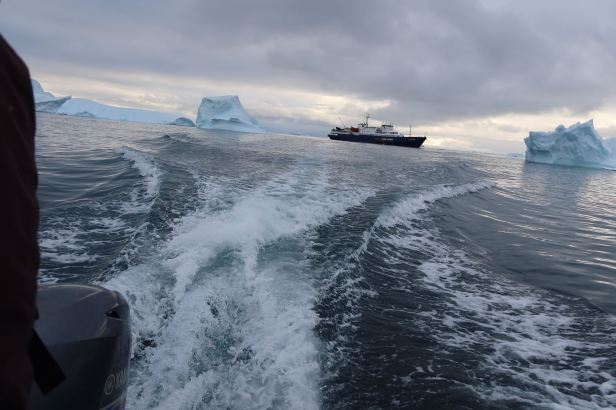
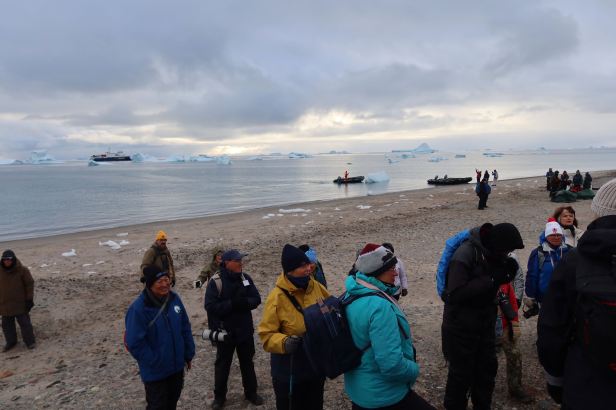
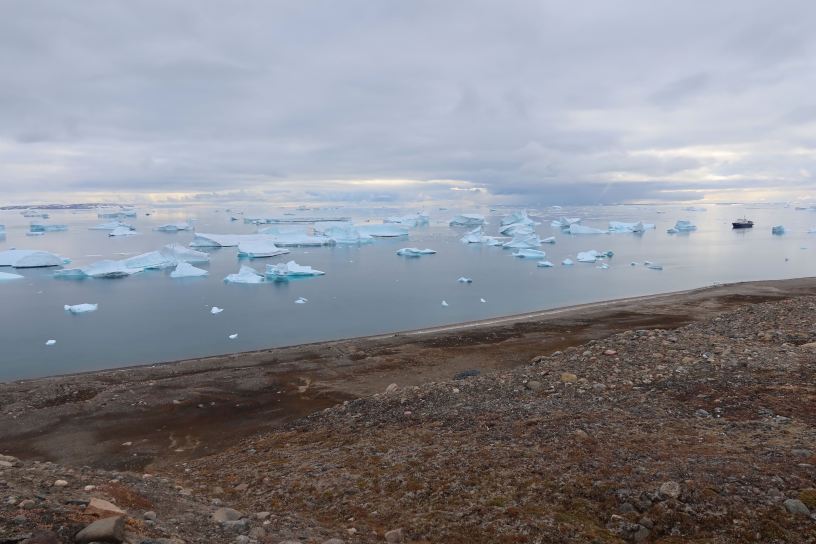
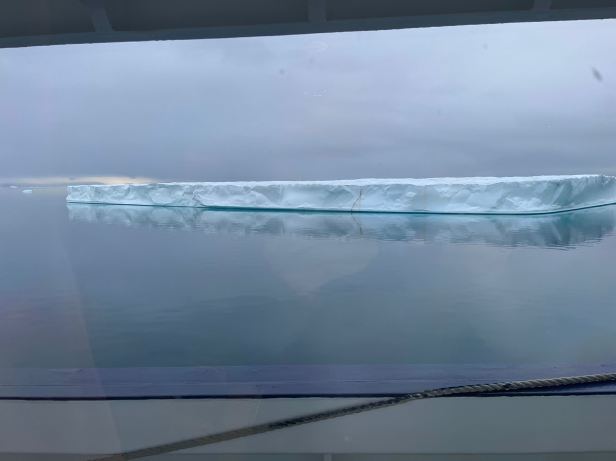
The terrain was a lowish promontory which meant that, once we gained a bit of altitude, we had a simply glorious panorama in front of us of about 270 degrees. The Plancius was anchored quite scarily close inshore (later, at lunch, Captain Christophe again sat with us and assured us that there was six fathoms (eleven metres) between the keel and the sea floor) – and was surrounded by icebergs of varying sizes. The inlet was again what is referred to as an “iceberg graveyard” as many icebergs ground there for the final time and eventually melt. Because of quality of the light, the views across the bay were almost ethereal.
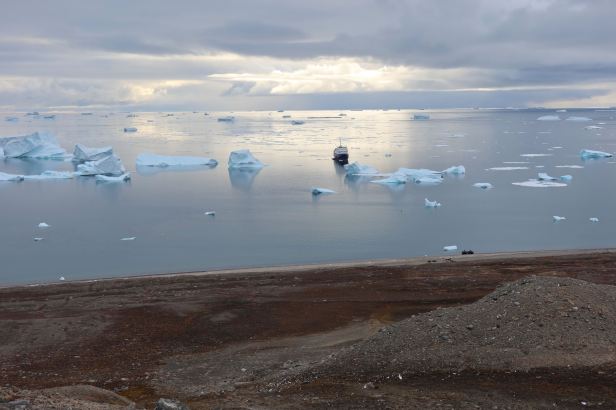
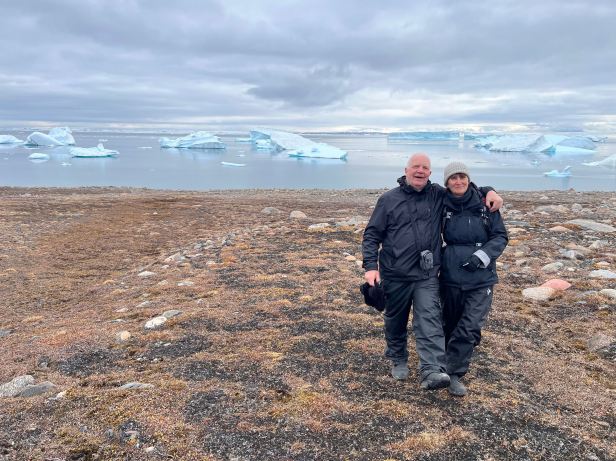
In the middle distance was the low shape of Belle Isle, a small island named by a French expedition. It contains a large number of historic sites and, because of that, is off limits to visitors. The same prohibition went for the waters immediately to the North, this was again “Narwhal territory” and ships cannot go there.
We hiked here and there, but the terrain and, hence the scenery, was fairly unchanging. We walked along a high ridge to its northern end and enjoyed our last “Arctic Silence”, at least in Greenland, on the sunlit summit of a rounded mound above the bay.
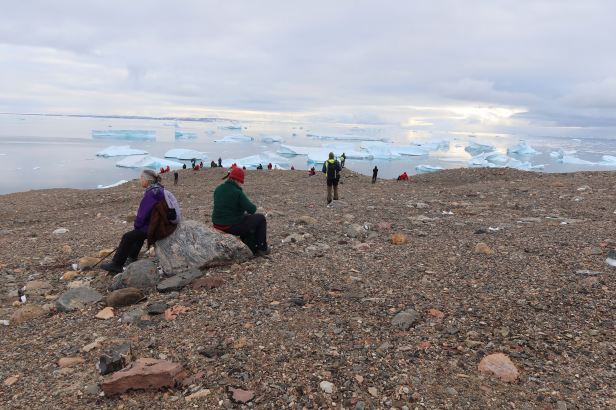
Oddly, on that flat and fairly smooth plateau, Lucie somehow contrived to fall down. It was an odd, seemingly almost controlled and slow-motion, descent, that planted her firmly and quite gently onto her behind. It was smiles all around, not the least from me, now that I was not the only clumsy buffoon in our group.
Sunny it may have been, but warm it definitely was not, particularly if you were not walking. Marco called his troops to order and, as we all stood, a solitary Gyr Falcon flew rapidly overhead. That made three sightings of what is a fairly rare bird. It comes in three plumage variants. There are dark ones, found principally in Canada, light ones, found principally in Europe and speckled ones, found where the two variants overlap. All the three we saw were of the light variety. Mark, the expedition team’s “birder”, told us that the pair we had seen the day before had, after we had witnessed an unsuccessful chase, subsequently made a kill. He had some gory snaps of a decapitated ptarmigan to prove it.
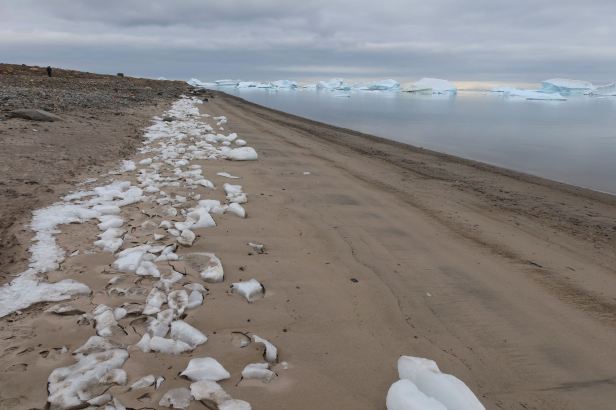
We moved off down the slope and eventually found ourselves walking along the beach. As there had been in Antarctica, there were chunks of ice on the tideline that had been deposited there by the waves.
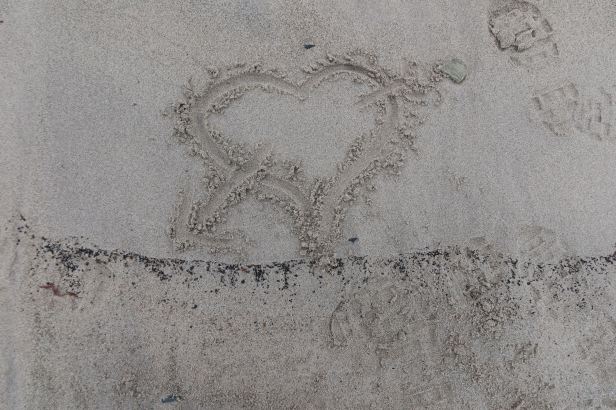
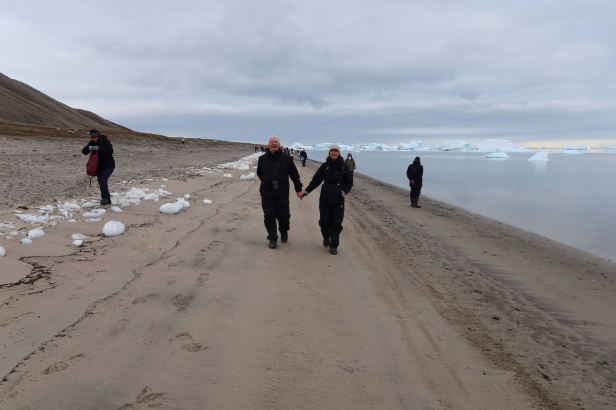
We took a few Koenagraphs, our term for a photo inspired by the teachings of the master.
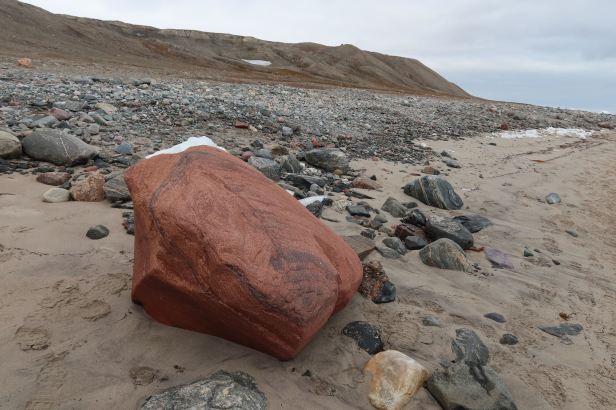
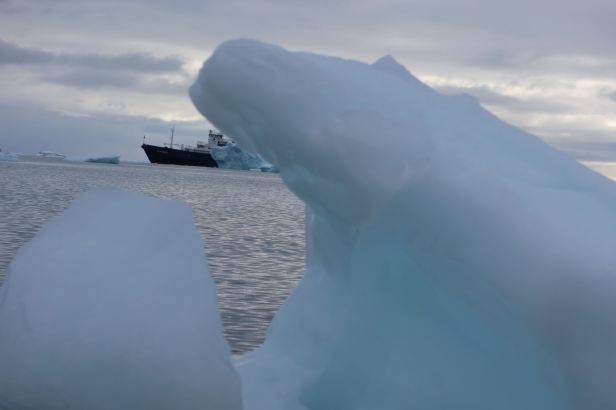
Even Herman was willing to get his boots wet for the “unusual” angle ……….
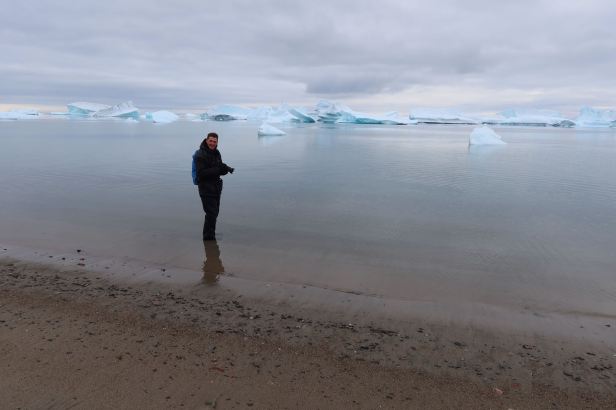
Then we came to the Zodiacs, donned our life jackets, washed the sand off of our muck boots in the shallows and, piloted coincidentally, by Koen, we sadly took our leave of Greenland.
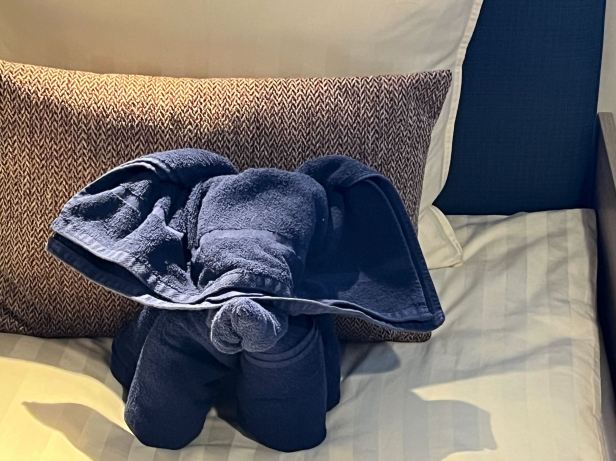
Back in our cabin, Raisa had been busy playing with the towels again.
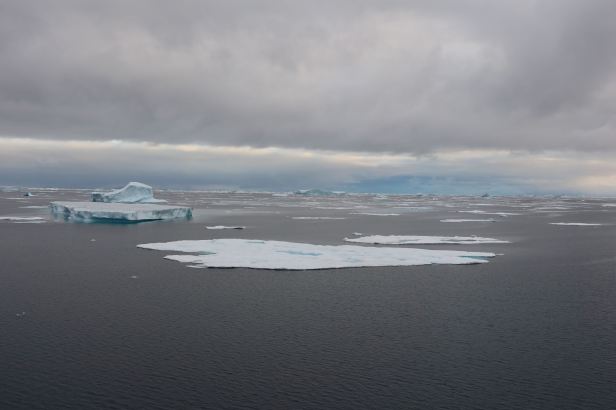
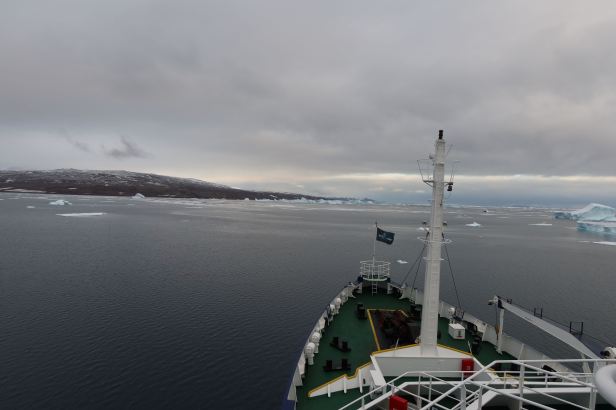
As we ate our lunch, the sound of the Plancius raising her anchors could be heard and we slowly began to sail East. I was glad that our seats at the table was facing backwards. I could clearly see as we passed the tip of Belle Isle and began to navigate an open sea that was still dotted with icebergs, many of which were of a substantial size.
In the afternoon, Marco gave a fascinating lecture on sea-ice. We were all treated to an ice-cream at the door, which soon disappeared in an eerily prophetic way. Sea-ice forms naturally when the temperature of the sea drops to around minus 1.7 degrees C. There are seemingly an endless number of factors that affect its creation and proliferation, but sea temperature, sunlight and salinity are key. Unlike pack-ice, sea-ice is relatively thin and because it is not so dense as the compacted ice of an iceberg calved from a glacier, floats on the surface. It extends and retreats according to the season and the amounts and extent can vary enormously. In some years, Germania Havn, Danmarkshavn and Depotnaesset, where we had just come from, would already have been completely inaccessible. Next he highlighted how the “exchange” of waters between the northern and southern oceans and the pan-global undersea movements that engenders, were at risk because less sea ice (attributed to climate change) is already having a knock-on effect to that circulation. He painted a slightly disturbing picture of possible future scenarios – and left us all nervous.
Because we are now sailing East, we “lost” an hour in the afternoon, so the recap rolled around before I could have my afternoon nap. Pippa thanked us all for our patience and enthusiasm and for bringing such wonderful climatic conditions with us. The expectation was that, early the next morning, we would encounter sea-ice. up close and personal. This might give us the opportunity to see yet more Polar Bears and perhaps some seals. The Plancius would attempt to nose its way through the gap in the ice and then continue on to Svalbard. I have never seen the film “Titanic”, so I was not worried.
We had three short talks.
First was Charlotte, giving us the full info on Musk Oxen. Not really anything key that we did not already know, but the photos of the young ones were cute.
Then came Mark with a talk about Gyr Falcons. A lot of the facts, I have already related above but, for the sake of completeness, it is the world’s largest falcon, with a wing span of over a metre. There is sexual dimorphism which means that the females are larger and heavier than the males and the female does the bulk of the egg incubation.
Then came Chloe. She is a veritable female version of Koen. She went into the specialised microscopic life that inhabits the sea ice and, as usual, she contrived to make things we cannot even see, interesting. Her bubbly style means she seems a bit scatterbrained but, quite obviously, she is not and the same, endearing, “style” meant that we all hung upon her every word about things we have never heard of, could not see – and would certainly be unable to spell ! Luckily for me (at least), the underside of sea-ice also provides a safe haven for baby cod until they are large enough to join the chips on my plate.
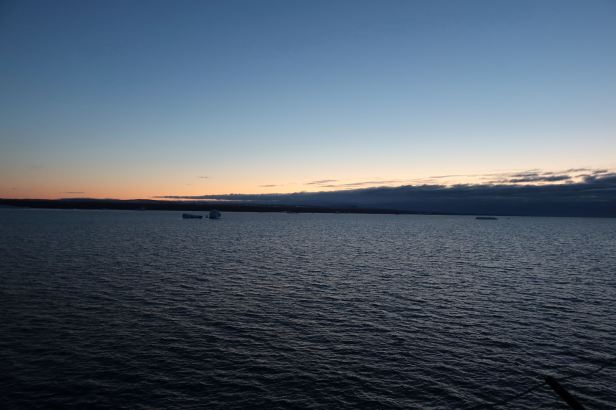
Dinner came and went, in tandem with a glorious sunset. In the twilight we sailed steadily East on a calm but steely-grey sea.
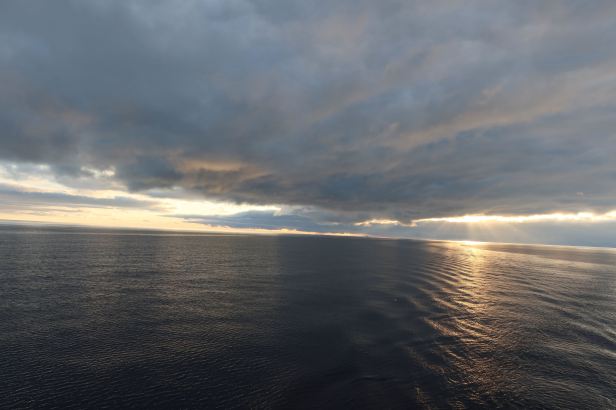
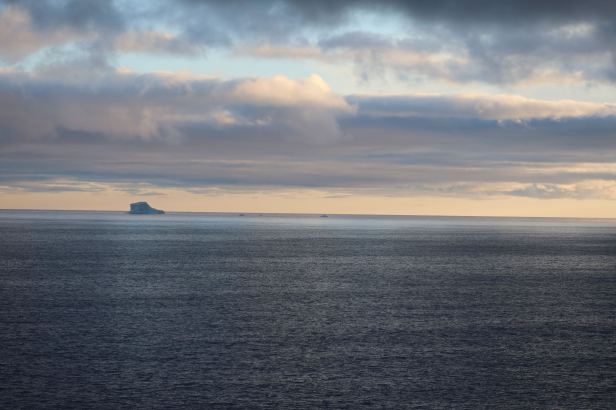
Greenland was gone, but first the sea-ice and then the delights of Svalbard still lay ahead.

