Tuesday, September 8th, 2026
Distance hiked – 3.6 kilometres
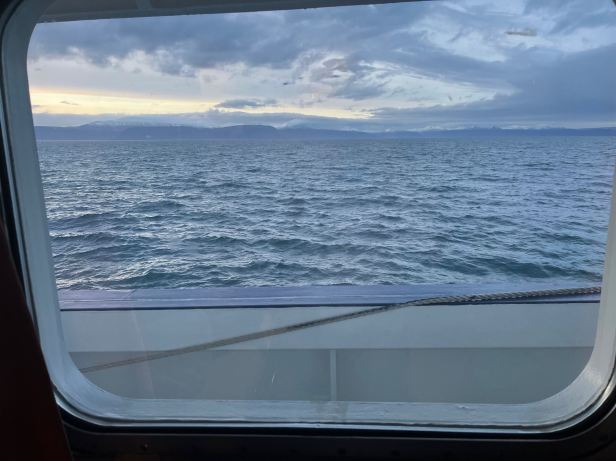
Tiredness appeared to have caught up with me and before my, now “on time”, iPhone started its insistent alarm tone, I had not stirred a single muscle. My customary, start of day, appraisal from the cabin window revealed a dark and slightly forbidding coastline about a kilometre off of the Port side, upon which a largish glacier was visible.
I stumbled upstairs to the lounge for my cups of tea and was mildly chided by my Austrian early bird friend, Jo, for my tardiness !
After the paucity of birdlife on the coast of Greenland, in Svalbard, it was relatively abundant. Various types of gull, mostly the harder to identify juveniles, were all around the ship. Most were swooping around, but quite a number were sitting on the gently undulating surface. I think that I saw a few Kittiwakes, but again, because of the greyer plumage of this year’s hatchlings, it was hard to be sure.
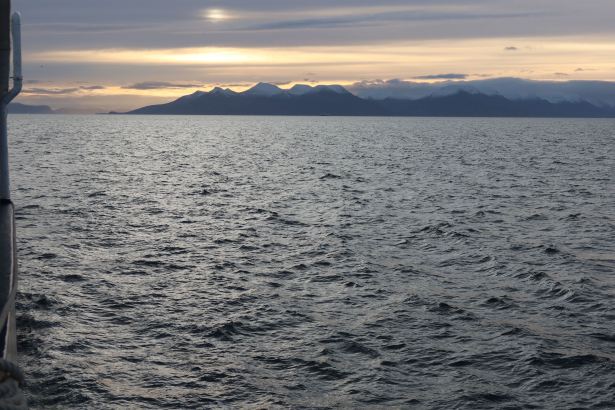
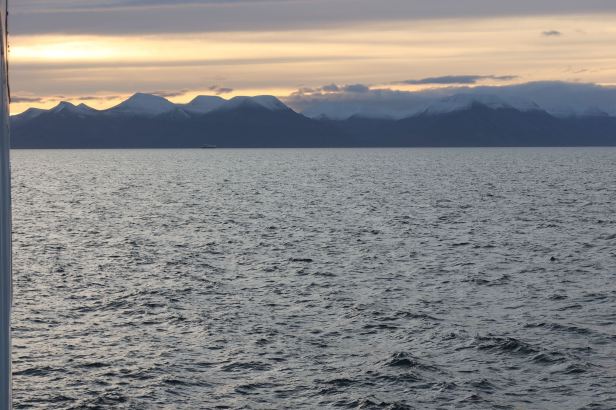
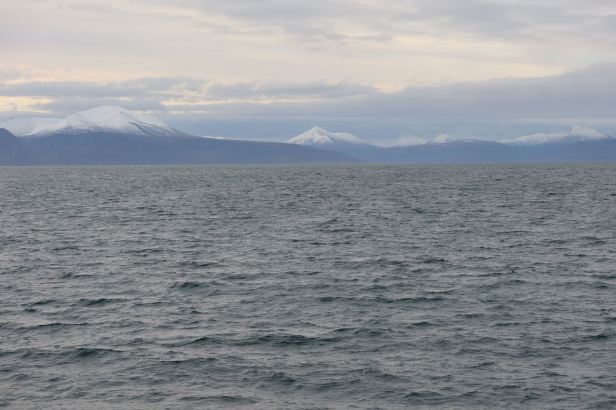
The sun came up in the picturesque manner that I was coming to expect, so I went out on deck. It rose dramatically above the ridge on the Port side and gave a soft glow to the mountainous edge of the fjord away to Starboard.
We went for breakfast and, again, it was quite quiet. It is strange how, when you have less people, the milling and hubbub appears to diminish disproportionately and not in any linear way.
While we were eating, Captain Christophe manoeuvred the Plancius into the small bay of Borebukta and, back in our cabin, we heard the distinctive clanking as the anchor was lowered. The new joiners were having their Zodiac safety lesson and shore behaviour instructions in the lounge, so we had to wait a while before wriggling into our waterproofs. We hoped that the new passengers from, say for the sake of example, East Asia, were listening carefully.
Pippa’s dulcet tones came over the tannoy, with the five-minute warning. So, on went the layers (it is chilly out on the water), the waterproofs and the muck boots and we shuffled off to the gangway. Less passengers meant less waiting and we were soon in a Zodiac with the redoubtable Koen at the helm.
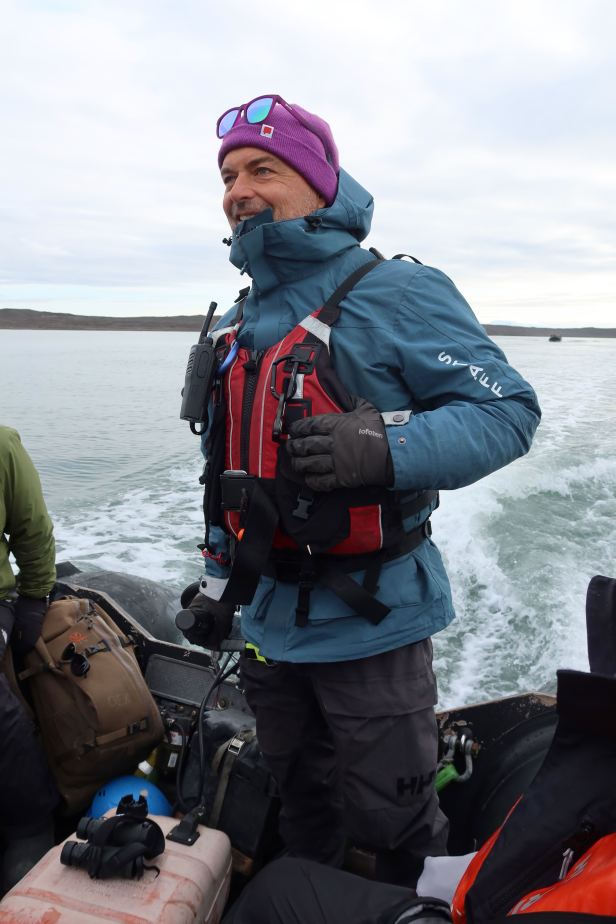
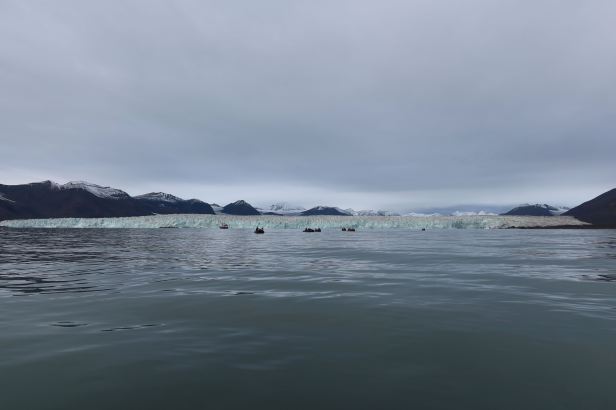
Borebukta Bay and Borebreen Glacier
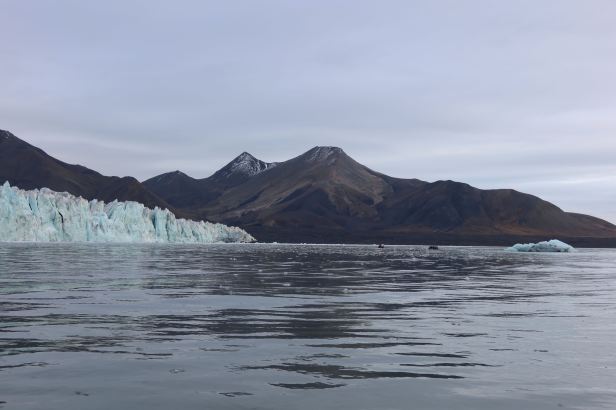
We were soon cruising in front of another large glacier, Borebreen, one of over 2100 glaciers in Svalbard.
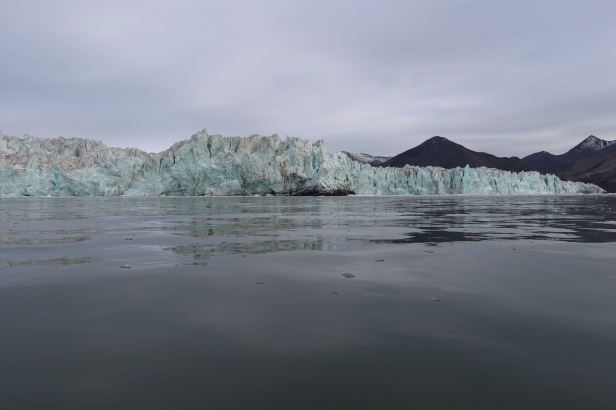
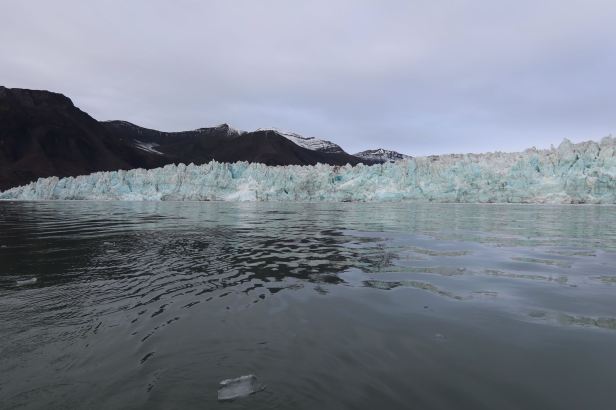
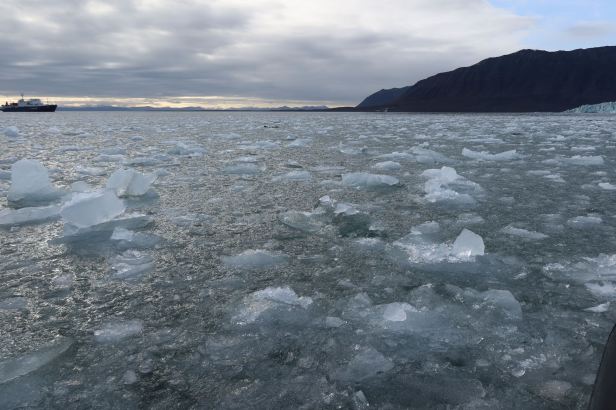
It is what is known as a “surge” glacier because its internal pressures are currently driving it forward with unusual rapidity – up to 2.5 metres a day. The waters directly in front of it were awash with brash ice and there were a number of minor “calvings” of large ice chunks while we were cruising in the bay.
Almost as soon as we were in the Zodiac, a wave of excitement was transmitted across the airwaves via the short-wave radios of the guides. A Polar Bear had been spotted swimming in the sea on the left hand edge of the glacier. In a low engine revolution convoy, the Zodiacs began to head in that direction, trying to get close without scaring it. In front of the glacial outfall was a mass of brash ice and this was moving slowly up and down in the swell. The bear decided to swim right across the bay, but close to the glacial wall. Because the only part of the bear which was above water was its snout, which is, of course, white. It was very hard to spot, even with our monocular, as it merged very well with the bobbing pieces of ice. I believed I had seen it a couple of times but, in the rolling swell, these were fleeting glimpses and I would not have put my hand on my heart. The regulations forbade us to “follow” a swimming bear, so that had to be it for the time being.
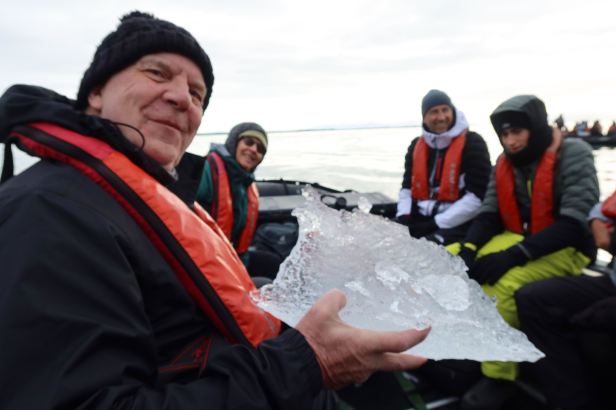
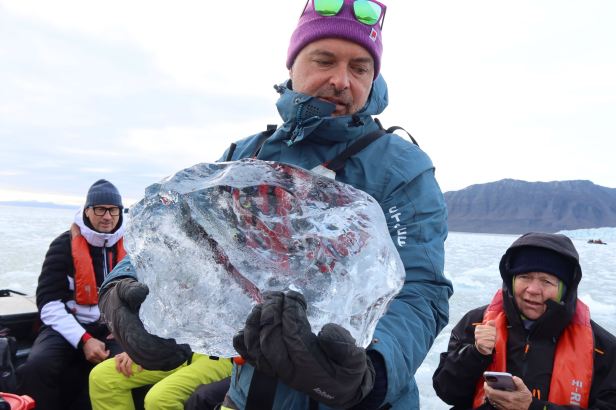
We cruised the front of the glacier. It was three kilometres wide and its speed of movement had rendered it very rough and broken. This was no smooth mass of ice, such as the glacier that Lucie and I had landed on, in a helicopter, in New Zealand. It would not, we felt, have been possible to even walk around on top of this one because the “surging” had opened countless crevasses. Koen is a brilliant at explaining things and, as we had a majority of “new” passengers in our Zodiac, he was kept busy talking about glaciers, calving and all that stuff. He fetched a chunk of ice out of the water and we passed it around. I bit a piece off – cold, fresh and probably at least 10,000 years old. In your face, Evian !
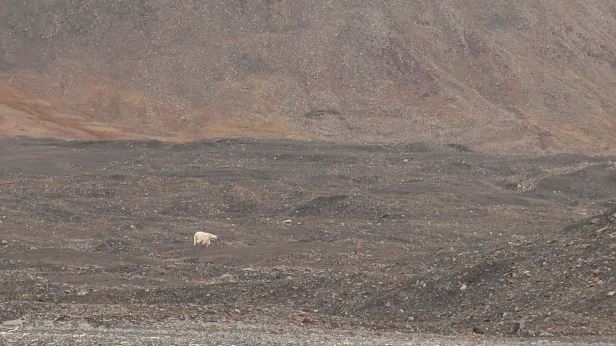
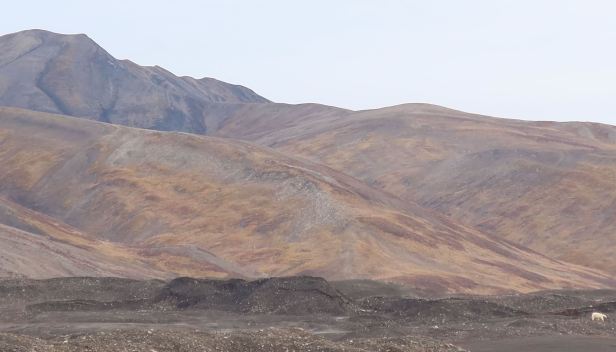
Another ripple of short-wave excitement made its way across the water. The swimming bear had now hauled itself out of the water and onto the land at the right hand side of the bay. That meant it had swum three kilometres in about forty minutes – that would be quite a good pace in your speedos, never mind in a fur coat. Luckily for us, this meant that, subject to the proximity rules, we could get near it again – and it was an off-white bear on a brown slope. The Zodiacs set off across the bay.
We closed in and the bear became a media star as all our cameras clicked away. Polar bears do live in Svalbard, but are not often seen, so all the new passengers got lucky on their very first Zodiac outing. The on the shore bear did what bears do and eventually that meant that it disappeared over the ridge and out of sight. We estimated that it was the 10th one we had seen, yawn ! Now, where were those Walruses?
We went back into an area of very dense brash ice.
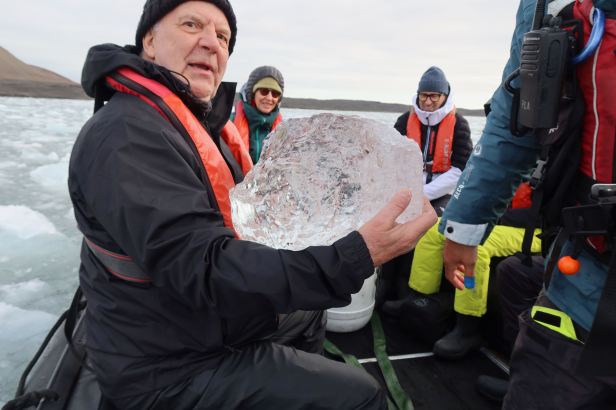
 This time, Koen hauled out a really big piece, containing air bubbles, for us to examine. We all had photos taken of us holding it, before throwing it back in. Did I say all ? We missed a lady, so Koen circled round, fished the same piece back out again, the photo was taken and back into the briny it went for a second time.
Then we had a “what ever were the odds” moment. A radio call went round, from Sven, asking if anyone had lost a glove, because one of his passengers had noticed one floating – and had fished it out of the brash ice. Unbelievably, it belonged to the guy sitting next to me, who had not even realised he had lost it.
–
Then it was back to the Plancius for a warming drink and, not long after that, an even more warming lunch.
After lunch, as the Plancius headed towards our next destination, I was dragged from the cabin by the tannoy announcement that there was a Minke whale outside. I grabbed the camera, but only got on deck in time to watch it disappear. No emblematic “tail” shot, just a dark back, a ripple in the water and it was gone. We all hung around for a while, but it did not come back up.
No sooner had I got back into the cabin, taken off my coat and sat down, than Pippa was back on the tannoy. This time there was a feeding frenzy of White-Beaked dolphins happening just in front of the ship. Coat, camera, running shoes … and there they were. Not exactly up close and personal, but seething water, dark fins rising and diving and a horde of gulls and Kittiwakes circling in the hope of an easy meal. How anyone could tell what type of dolphin that they were is beyond me. The Plancius circled for a time, but that was a good as it got. Back to the cabin.
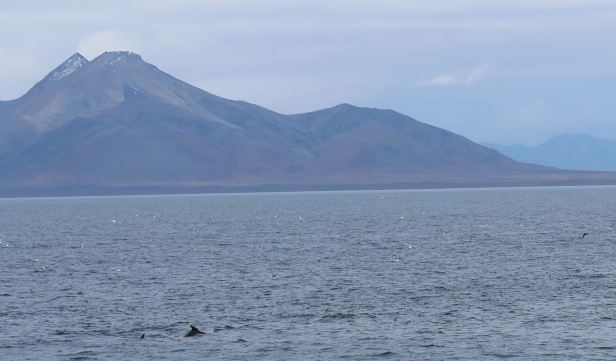
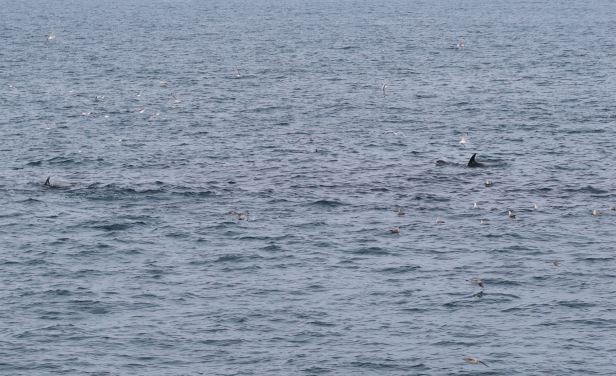
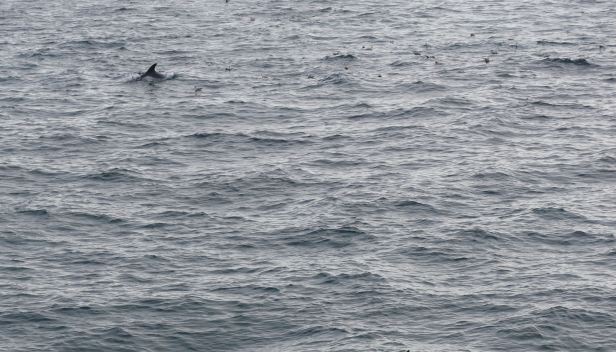
Alkhornet
The dolphins delayed us slightly, so it was 15:15 before we were called to the Zodiacs for our landing. We probably beat our getting “rubbered up” record and, with less people, we quickly found ourselves in a boat driven, yet again, by Koen. We landed on a small beach, from which we needed to extract ourselves via a steep, muddy and slightly slippery path. Then we found ourselves on a gently sloping and grassy plateau which rose inland to the impressive massif of Alkhornet. This 617 metre high tower is known as “Bird Mountain” and, at the height of the season, hosts over 10,000 pairs of breeding sea birds. Nearby was the ruin of an old trapper’s hut, but nothing much was said about it at the time.
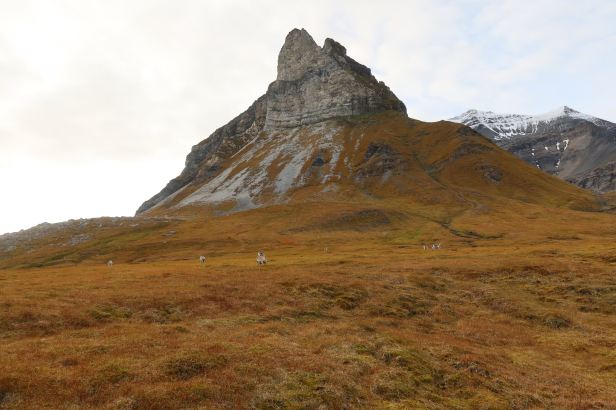
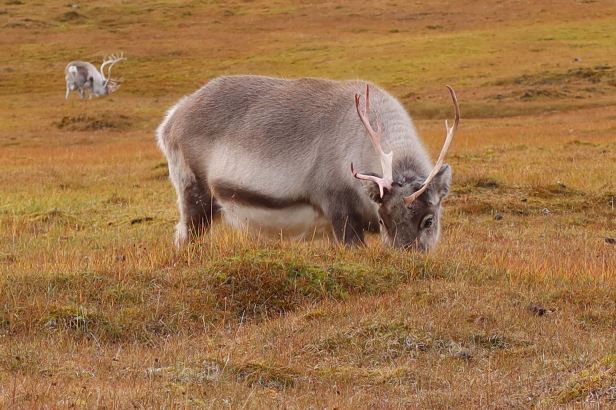
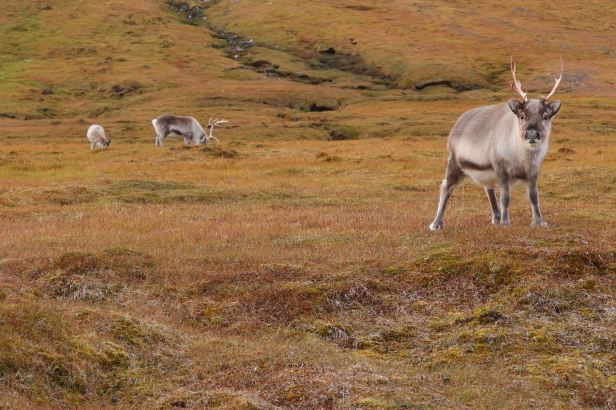
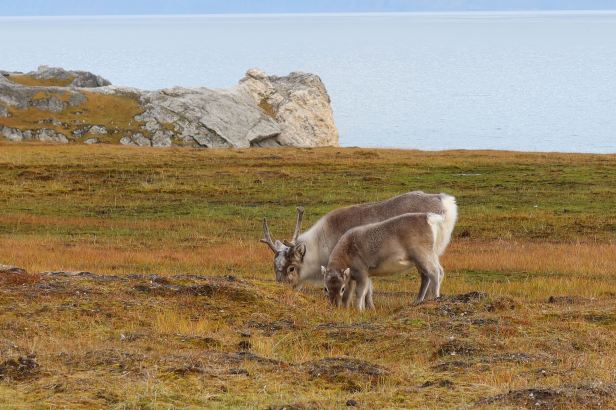
It was the usual “faster” and “photography” split for the medium hike and choosing the faster group delivered us into the tender care of Charlotte at the front – with Koen as the back stop. Charlotte set off up the hill at quite a clip and, as it got steeper, it became quite hard to keep up on the springy grass. At the top of the first rise, we all stopped, entranced. The plateau in front of us and away up the slope was dotted with reindeer. Some of these were mere metres away – and they all ignored us and just kept on grazing. We all snapped away to our heart’s content.
Then there was a movement in the middle distance and a small, dark, shape appeared. It just kept coming and it was not long before, even with the naked eye, we could tell that it was an Arctic Fox. As if that alone was not enough, this was one of the rare (just 2%) “Blue Morph” variants. It skirted in front of us at about 100 metres and disappeared.
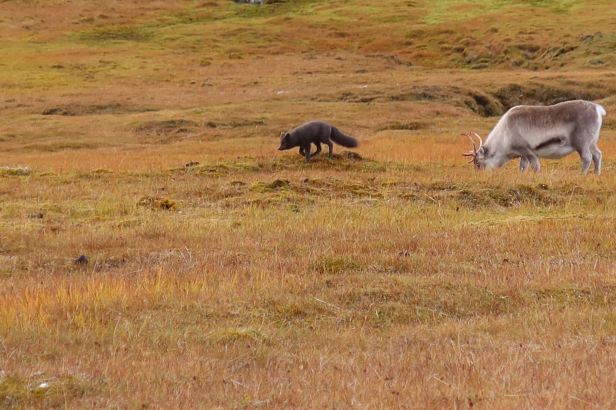
We walked on, not around the reindeer herd, but through it. Not one of them even stopped chewing to look at us.
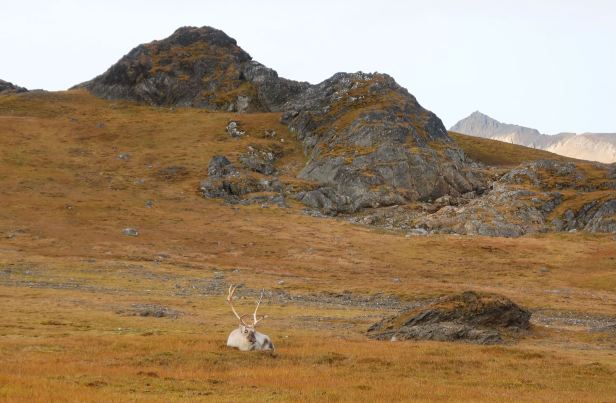
The way became very steep and I for one was quite glad when Charlotte called a halt below the towering cliffs. While both Lucie and I removed a layer, we stood and watched thousands of Kittiwakes flying in to feed the late chicks still huddled on ledges hundreds of metres above our heads. Guillemots also use the same cliffs, but all of those chicks had fledged. Apparently, the first real flight that the chicks of both species have to do is a long glide down to the sea. They make it, or they don’t, Mother Nature is not big on second chances.
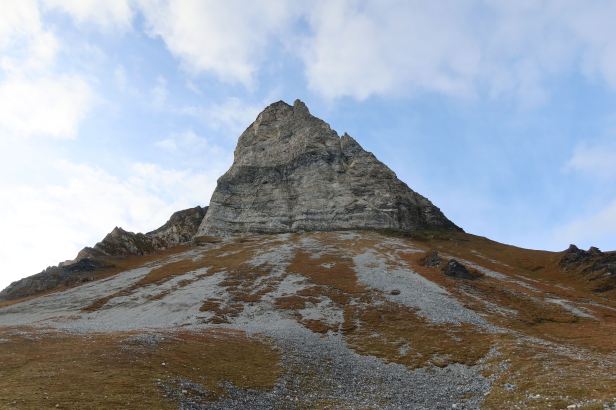
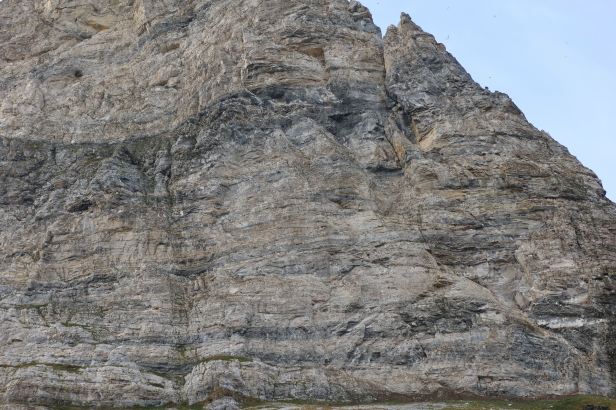
Our next stop was a small rockier mound where we sat and had our “Arctic Silence” overlooking the waters of Ijsfjorden, steely-blue in the sunshine and with the snow tipped peaks on the far shore. For once, everyone took it on board except, in this instance, the thousands of Kittiwakes wheeling high above our heads. Their cries seemed even louder when we were all being quiet.
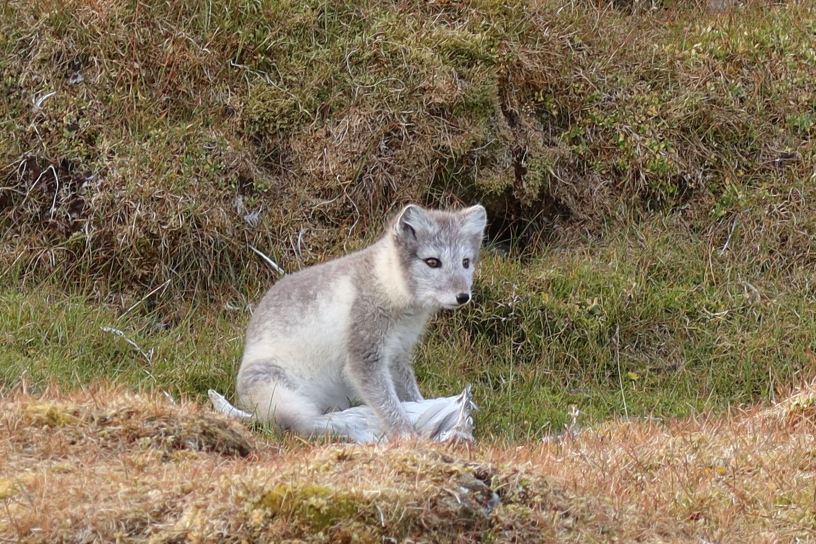
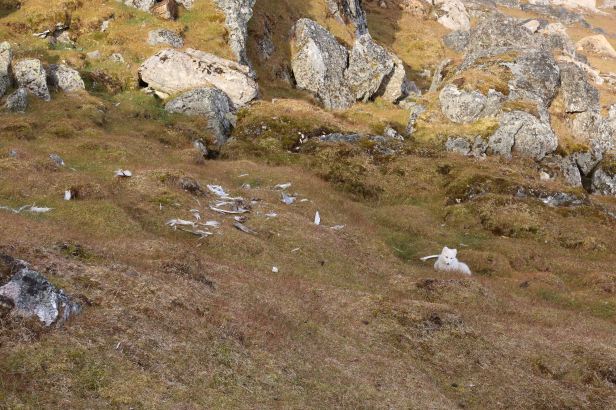
Charlotte eventually ended our period of serenity with the announcement that, when the guides were preparing for the landing, a white Arctic Fox had been seen near to where we now were. At this stage of the season, a white coat indicated that its wearer was a cub, born in the Spring. Adult foxes are grey in the Summer and grow thicker, white, fur for the Winter. Cubs are born white and stay that way until the following Spring.
Hardly had we moved off again, than we came upon the cub. It was laying in a small depression and gnawing away at some pieces of a dead bird. As I indicated earlier, not all of the chicks making their first flight from the mountain, that still towered above our heads, got it right. Almost unbelievably, the youngster ignored its audience and just kept nibbling away, only occasionally stopping to play with its lunch. We were only a few metres away from it for over twenty minutes. Eventually, either full up or bored, it stood up and trotted slowly away down the hill.
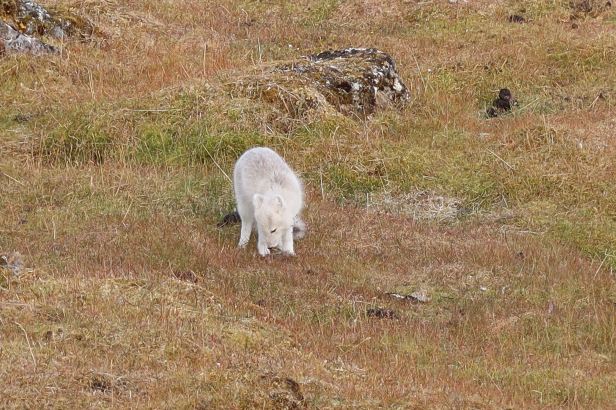
Our group was all set to follow it down the slope when Eagle-Eye, Junior Spy, sometimes called Lucie, spotted a third fox sneaking through the rocks behind us. We all turned around and, almost in exactly the same spot that the cub had just vacated, there was an adult, just beginning to show the white first traces of its Winter coat.
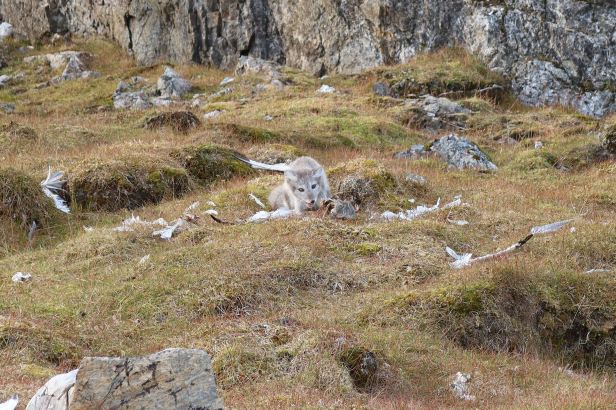
This too was chewing on pieces of dead guillemot – and this too just ignored the large audience, as the throng had now been augmented by the arrival of Pippa’s group from below.
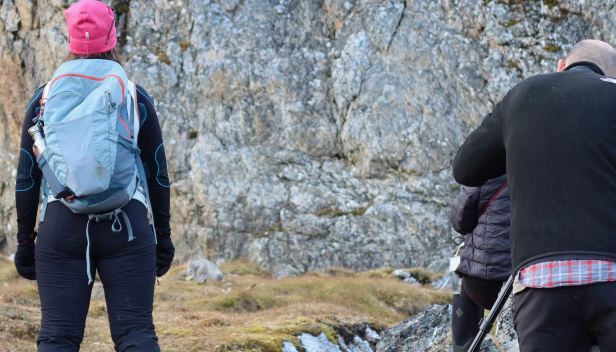
It was the same story for another twenty minutes, the fox was the fox, the people were people. The fox chewed, the people took pictures. Finally, this fox too tired either of guillemot or of fame and wandered away through the rocks.
Still lost in wonder, our group made its way back across the bouncy green sward towards the beach. Other adult foxes were seen scurrying across the grass in the distance and we passed through the (by now, very ordinary seeming) reindeer herd with scarcely a glance. Had we not walked close to a cute youngster, I doubt if any of us would have even broken stride.
The white baby fox did make an almost “cameo” reappearance, trotting across our path in the middle distance, but all too soon, we were back on the beach.
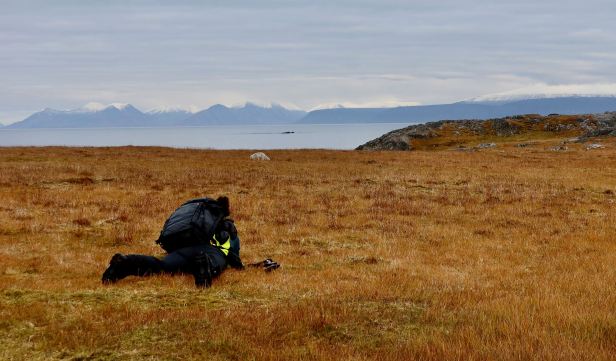
What an afternoon, what a day. I joked with Pippa that all we needed now for a “full house” was a Walrus. She gave me a look !
–
Back on board, our fox related dallying meant that it was quickly time for the daily recap.
Pippa told us what we had seen, which seemed a bit unnecessary as we are all very unlikely to ever forget it. Then she went through the Plan A for the next day, a landing, a second “Polar Plunge” (which I would NOT be doing) and a glacier cruise in either the ship or in the Zodiacs.
Then it was Marco, with a reiteration, for the new arrivals, of glacier formation followed by an explanation, for all of us, of how glacial surges occur. This included some aerial shots of the Borebreen Glacier, that we had seen in the morning, taken 12 months apart. The glacier had advanced 1.8 kilometres in the interim, completely engulfing a small island in the bay. Another glacier, elsewhere in Svalbard, advanced 7.8 kilometres in the same time period. Internal pressures within the glacier cause the surge and, once these are dissipated, the glacier will again enter a period when it retreats back up the valley.
Then came Charlotte. She gave us a brief chat on the Arctic Fox, that she had pre-prepared, in case we did not see any. But we all had, so most of what we got was a note about its range and some cute snaps that we could probably have matched.
Last up was Michelle, with the tragic love story of Ewald Schmutzler. Ewald was German and initially came to Spitzbergen to be a coal miner, but he met a fur trapper and decided to make a career change. After a shaky start, he became moderately successful. In the Summer, Ewald would travel to Tromso to sell his furs to a dealer named Grau and often lodged with him. Grau had a sixteen year old daughter, Ilse, who fell in love with, the then thirty-one year old, Ewald. Her father forbade their courtship. When she was eighteen, Ilse eloped to Spitzbergen with Ewald and, after their plan to get married somehow failed, they lived together anyway in a few locations. One of these was at Alkhornet and she helped him with his trapping. After two years together, a fierce storm, at a time when Ewald was away in Longyearbyen collecting his mail, kept him from returning for eight days. When he did return, Ilse was nowhere to be found and a search eventually located her body in a river. Devastated by his loss, Ewald returned to live a solitary life in Alkhornet and the remains of his hut was what we had seen near the beach. Eventually, the Second World War broke out and that made Ewald, a German, the enemy and nobody would buy his furs. When Svalbard was evacuated, in 1941, Ewald was somehow transported to England and was promptly interned as an enemy alien. A resourceful trapper, he promptly escaped and, after failing to gain Norwegian citizenship, is known to have worked menial jobs using an alias before disappearing, forever, from history.
Then it was dinner, which was as wonderful as we had come to expect and, after a very satisfying and magical day, I soon went gratefully to my bed.

