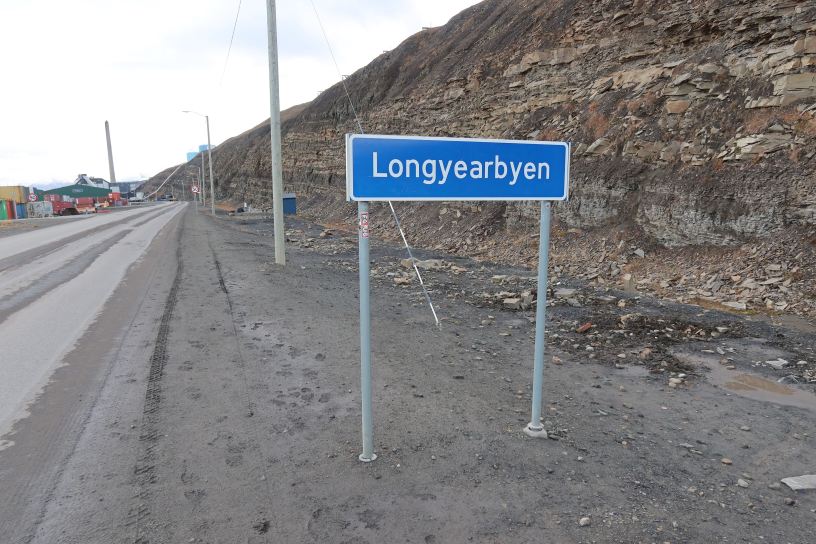
Monday, September 7th, 2026
Walk in the Gruve 3 coal mine – 3.1 kilometres
Walk around Longyearbyen – 3.8 kilometres
I had another really early wake up, but at least it was few minutes before 05:00. That is what I tend to do at home and I was back on Prague time again. Even my iPhone had finally caught a signal and was proudly displaying a time that I could actually relate to. Outside the window, it looked grey and cold and the mountains that flanked the fjord were capped in frost and snow. My iPhone claimed that it was 3 degrees C outside and also informed me that we were a short way North of 78 degrees of Latitude.
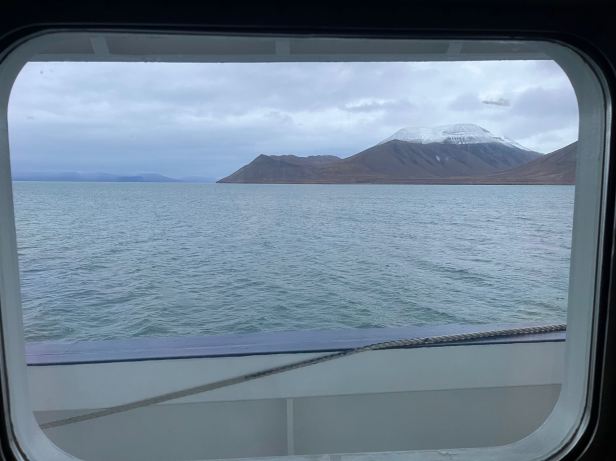
I got up for my cups of tea, but could not have them because there was no milk and no crew to fill the jug. In fact, there seemed to be nobody on board but me – was I on the Plancius, or was it the Marie Celeste ? I made myself a lemon and ginger fruit tea and sat at the window to watch as the ship moved slowly down the fjord.
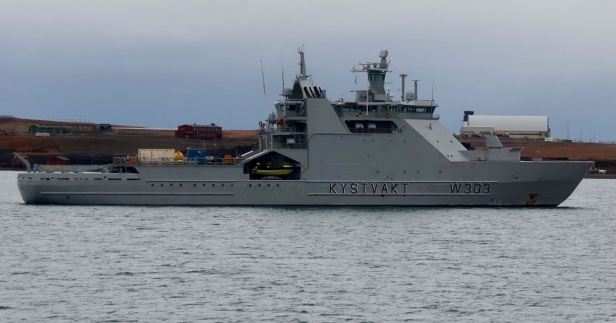
A grey and very purposeful looking small boat, which appeared to have an armoured front and a gun mount, came slowly past and gave the Plancius the proverbial “once over”. It was every inch a naval vessel, but Svalbard, because of the 1920 Treaty, is officially de-militarised. Maybe the Norwegians thought that drawing “KYSTVAKI” (Coast Guard) with a crayon, on the side of a gunboat, would fool people. Personally, I had had to doubt that.
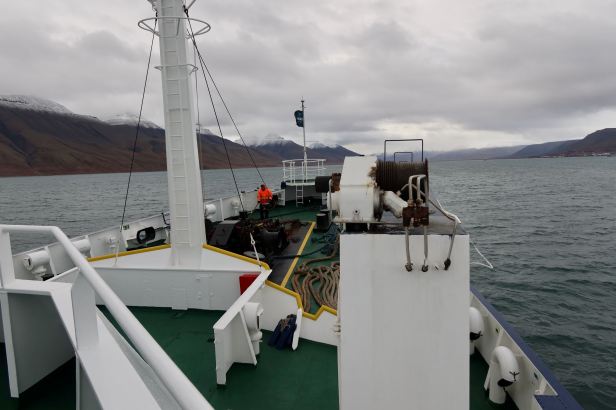
The Plancius cruised slowly deeper into the fjord. The sides were composed of harsh looking mountains, many capped by snow. Gulls of some sort were all around us.
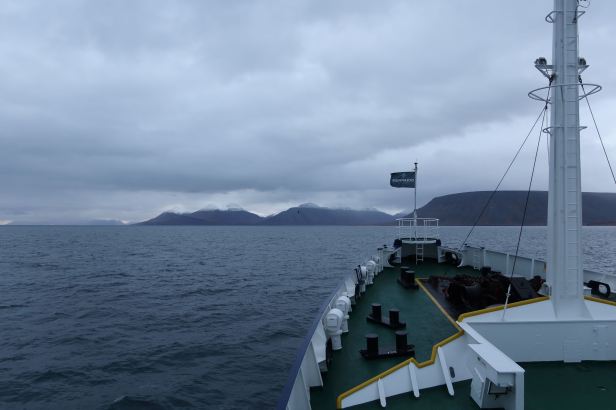
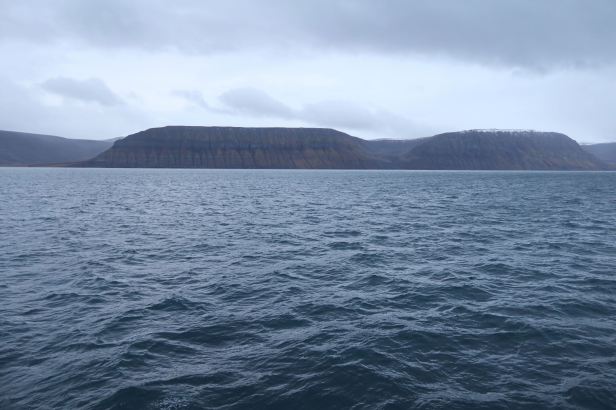
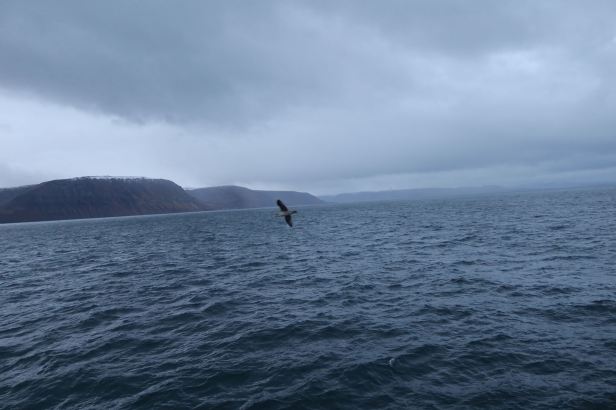
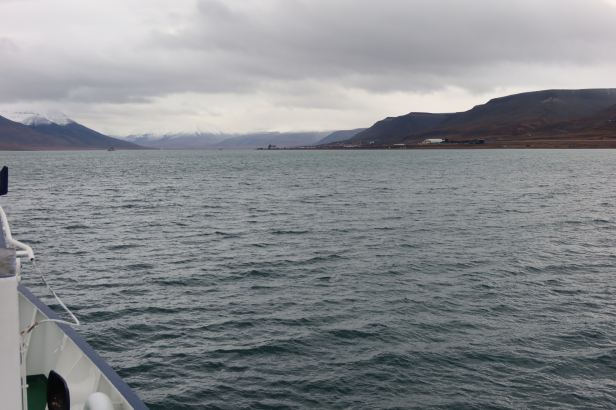
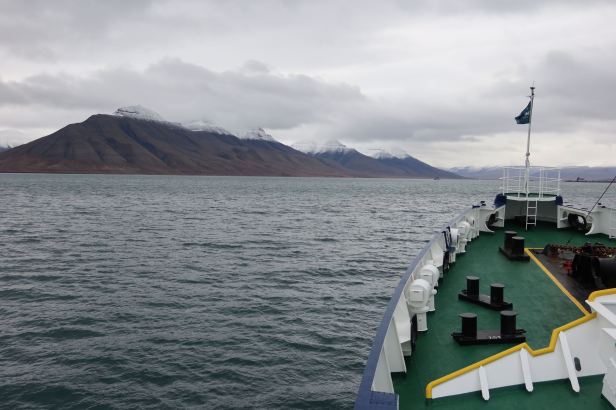
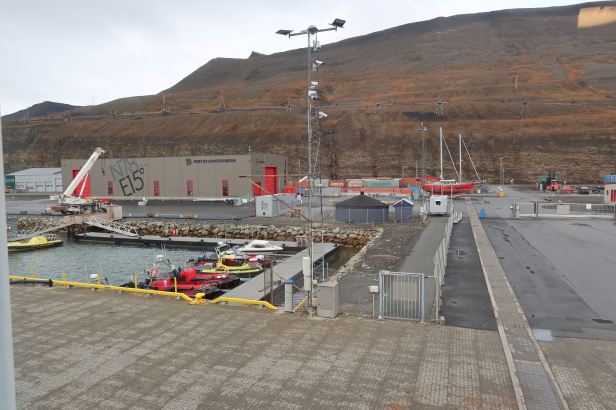
The harbour of Longyearbyen came into sight off of the Starboard bow and the crew materialised on deck to prepare for the docking.
The previous evening, we once again dined with the Captain at our table. He seems to like us and he is itinerant who does not have one of his own. He told us he had been to Svalbard before, so we asked him what would be a fun thing to do. Somewhat surprisingly, he recommended a visit to a coal mine. So, even before breakfast, we (that is Lucie) managed to book a visit there online. In today’s digital world, this could only be achieved without downloading the same App to both her iPad and her iPhone. Tedious or what ? Then we went to breakfast and again sat with the Captain – he did like us ! We were like relieved schoolchildren when he asked if we were going to go to the mine – and we could truthfully answer “Yes, we were”.
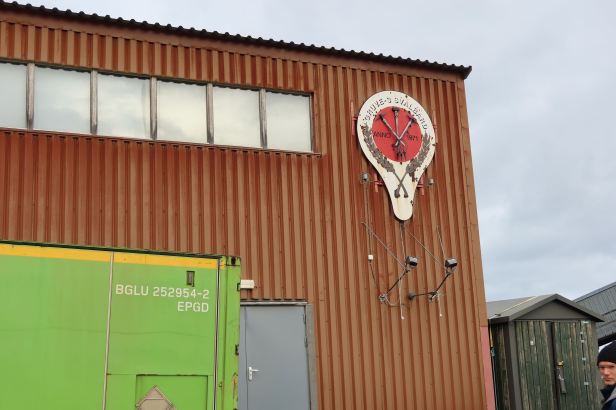
As we went to disembark, I noticed a sign on a building that gave our position as 78 degrees North, 15 degrees East.
Gruve 3 (Mine 3)
“Workin’ in a coal mine,
goin’ down, down, down.”
Lee Dorsey
Our booked trip included transport from the Plancius, as the mine lay outside the town limits and, therefore, in bear country. Promptly, at 09:00, a minibus turned up, driven by a tall girl called Caroline and we climbed in to find some other British tourists already there. Despite the fairly short distance to the mine and the 50 kph speed limit, we were advised to belt ourselves in. That was sound advice, as it happens, because the road up to the mine was steep, bendy, unsurfaced and bumpy – and Caroline fancied herself as a Svalbardian Lewis Hamilton.
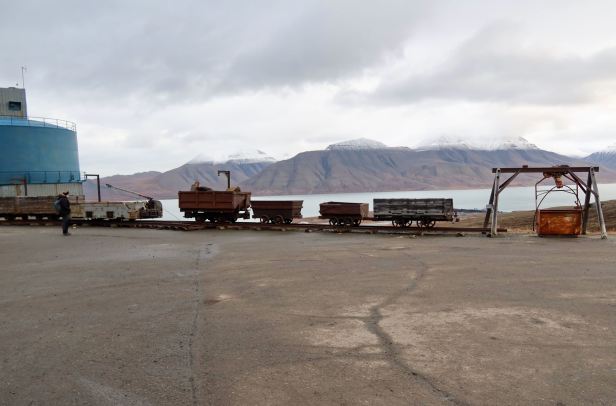
There were a few other visitors already in the car park and the tour began right there. When the mine ceased to be a mine, in 2025, there was no other mining left at all, anywhere in Svalbard. So everything was just abandoned, trucks, tools, equipment, the lot. The workers simply put their stuff down and walked away (presumably to the bus stop as walking around is not advised). Caroline pointed out various things, including, down on the shore far below, the few remaining piles of mined, but as yet uncollected, coal. It would go to Germany to make the steel used in BMW and Volkswagen cars. When the last lump is loaded, a line will be forever drawn under the Svalbard coal industry.
We went inside and were treated to a talk about the coal and a film about the mining processes. The coal is only about 65 million years old (usually it is about 300 million) and of an unusually high carbon content that varies between 80% carbon (Wikipedia) and 90+% carbon (Caroline). This purity was caused by the extreme Tectonic pressure at the time of its formation. As we now could tell, without being told, thanks to Sven and Marco, it is metamorphic rock.
Mining was initiated by John Longyear an American industrialist. He had heard rumours about the coal and just happened to bring his family on “holiday” to the then Spitzbergen, in 1901. He formed the Arctic Coal Company to exploit the deposits and, eventually, sold out to the Norwegian State coal company.
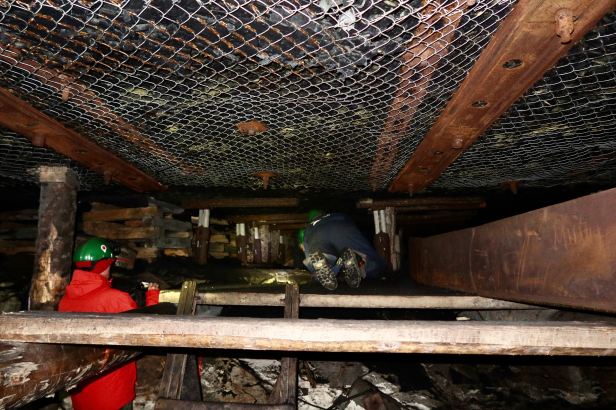
In Svalbard, the seams are in the mountains, as opposed to being deep underground, but the seams are often also shallow, many under a metre thick. This means most of the mining, which initially was done purely by hand, had to be done either hunched over or laying down. Some seams were too shallow to be safely mined at all.
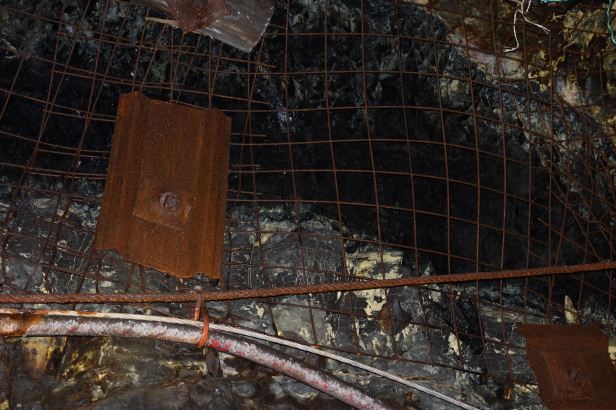
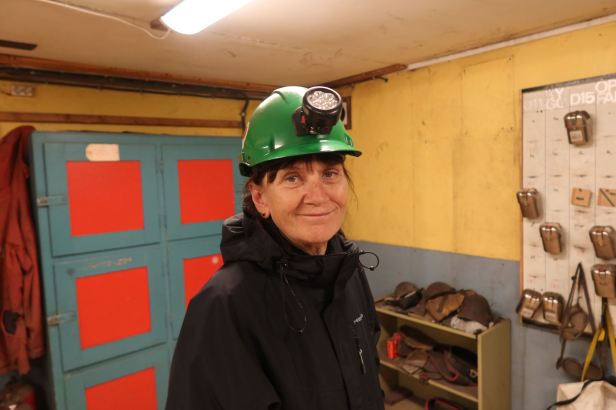
Shifts were eight hours long, with a thirty minute break. There were three shifts a day, with each shift having a different role. Shift One cut out the coal, Shift Two scraped it away for transport and Shift Three was in charge of propping up the “new” ceiling and un-propping the older ceiling to actively encourage it to fall in. Dangerous work indeed. Mining went on for thirteen days in a row and then lime powder was spread throughout the mine to dilute the proportion of explosive coal dust in the air. This meant the miners got every second Saturday off. New miners wore green helmets, experienced ones got yellow helmets and the bosses got white helmets. I know what Lucie can do, so I would never deny the right of a woman to do whatever she wants. I admit to being surprised though, that some of those who were engaged in the hard toil in the freezing mine were women.
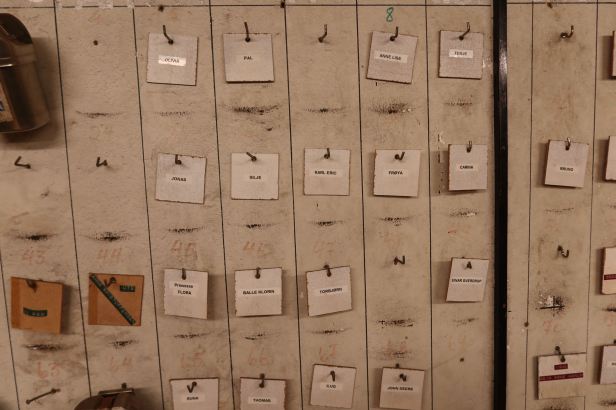
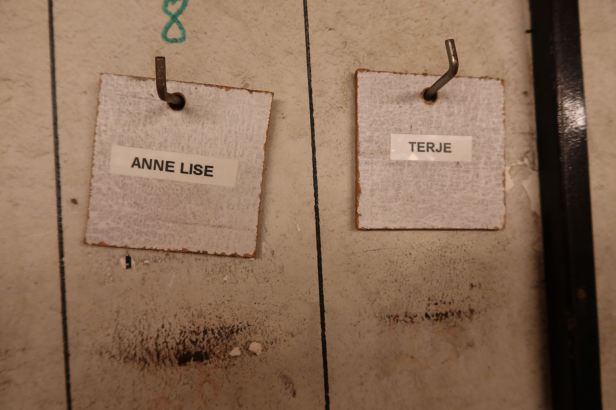
For our own visit underground, we all got green helmets wth LED lights and, in a subliminal messaging exercise, Caroline had a white helmet. In the subterranean depths to which we were headed, it would be possible to crawl into a 90 cm high seam. Visitors who wanted to do that were given special suits, but (un)luckily, my knees are too bad for me to do that.
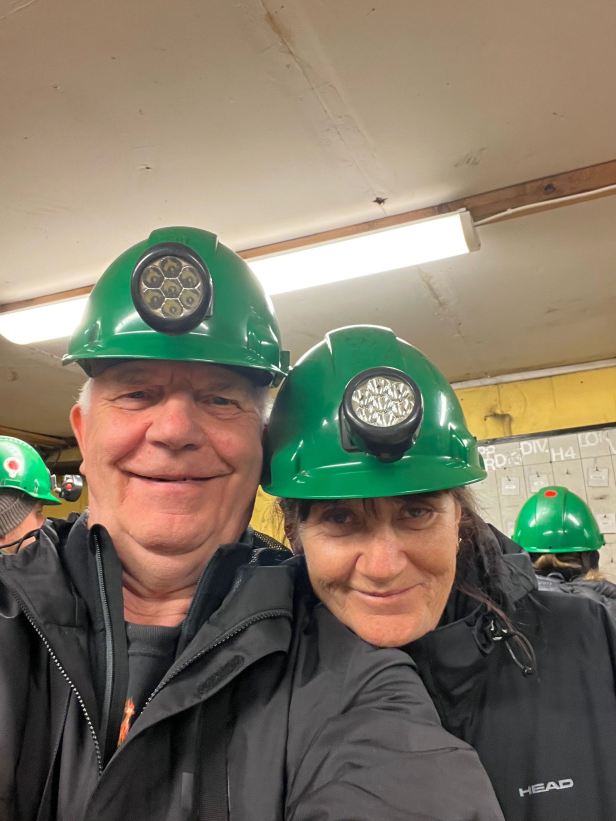
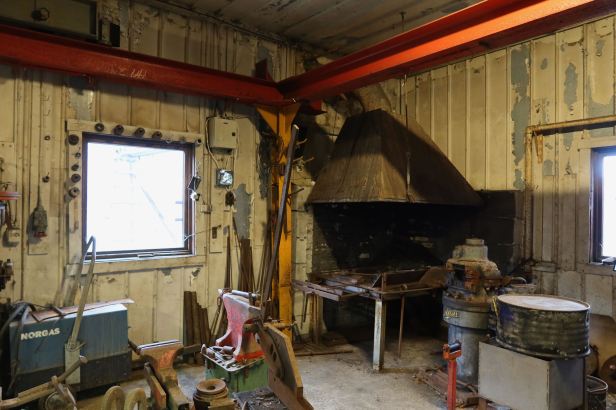
We set off. The first stop was the blacksmith’s shop. In an environment where the harbour was icebound for much of the year, this was a very important role in the mine. All of the miners were Norwegian, but the blacksmith, who needed to be able to fix anything and everything, was a Swede.
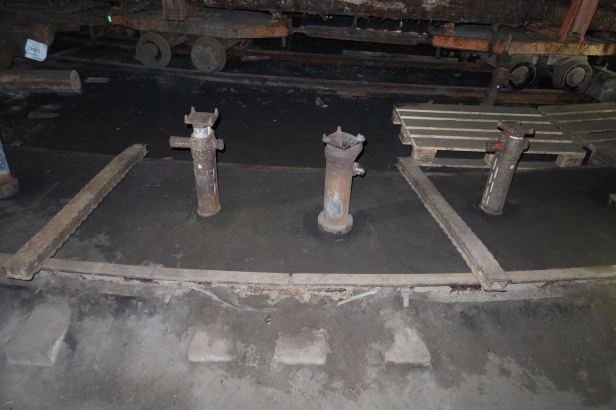
Next we were shown the jacks which had held the roof up. Originally, these were of a friction type (on the left) and each one weighed 17 kg. Following a fatal accident, these were changed to a hydraulic type (on the right) – where each jack weighed 42 kg. As the Third Shift had to move over three hundred of these jacks a day, even with the increased safety (read “life expectancy“) that they offered, this was not a popular change.
The mine is actually in the Permafrost, so the ambient temperature is below zero. For this reason, miners could not wear masks over their mouths, because they would have frozen solid. There was also the constant danger from Firedamp (methane gas). The usual method of using a canary to detect it (by dying) did not work as the canaries died of cold long before they could breathe. So, experienced miners were sent in first, to sniff the air. Caroline had a very sensitive electronic detector.
Then, with our way lit up only by the lights on our helmets, we descended into the darkness.
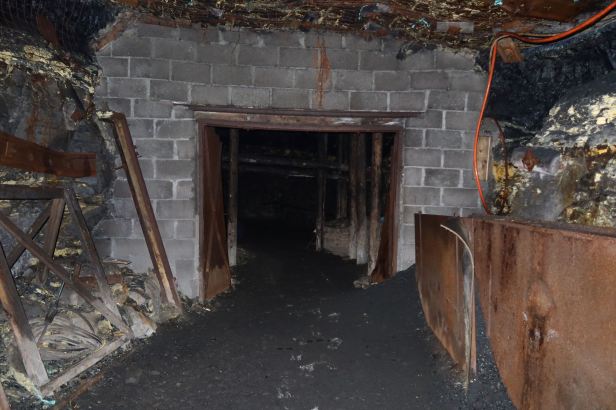
Although all mining in Gruve 3 stopped in 2025, the mine is maintained because it holds a couple of “secrets”. In a side tunnel, we came upon the first one of these. Behind a double door, we came to the original Nordic Gene Bank (a forerunner of the Svalbard Global Seed Repository). Identical sets of seeds were placed in boxes in this bank in 1984, where they are kept in the stable, freezing temperatures of the Permafrost. Periodically, a box is removed and the seeds are thawed under controlled conditions to determine their post-freezing viability. Caroline was delighted to inform us that wheat, which goes into beer, has an excellent resurrection rate.
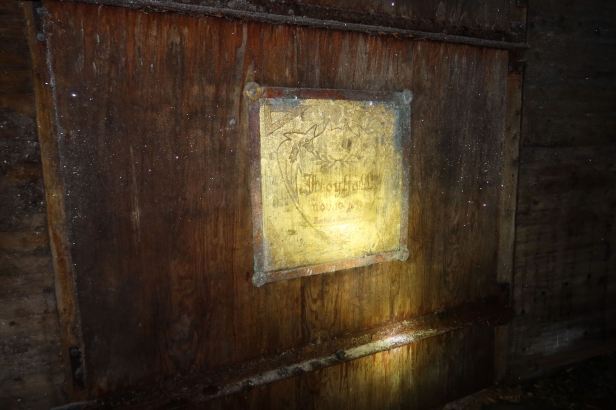
Outside the vault, Caroline told us all to turn off our lights. To say the darkness was total, or even stygian, would be to understate it. It was as dark as the sensory deprivation chambers that were so popular about thirty years ago, but not quite as quiet. When you have giggling teenagers present, it rather spoils the effect.
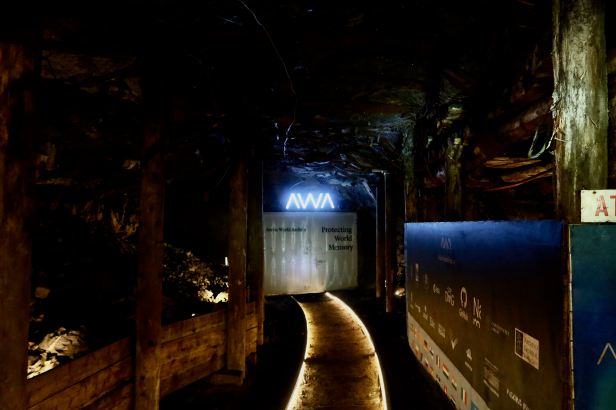
Further on down the gently sloping tunnel we went. The walls had shimmery flecks, not diamonds sadly, but ice crystals from the frozen breath of visitors. Quite soon, there was “secret” number two. This was another vault, even deeper in the permafrost and is the Arctic World Archive (AWA) whose doors bear the proud epithet “Protecting World History”. This vault contains data, from a number of participating nations about world history. Strangely, this is not in electronic form, but on special, cold-resistant microfilm with an expected life of over 200 years.
Still further down the long slope we went and entered another side tunnel, called the “strosser”. This sounds German, but is not and neither is it Norwegian. Caroline had no idea how the name originated. In this tunnel we were shown the 90 cm high seam and the suit wearers were encouraged to make a crawl in and out of it. As I said, with my knees, I could not do that – and, having seen it, I am not that sorry.
Then we retraced our steps to the gorgeous, light, comparatively warm, surface.
–
In all, seven mines were started, exhausted and then abandoned. This includes one that was deliberately set on fire during World War Two to prevent the Germans from using it. It burned for several years. The mining was ended arbitrarily by the government in Oslo and all the miners lost their jobs. Although Caroline made no direct criticism of this, a refusal, throughout, to mention Norway by name and instead referring to Norwegian mainlanders throughout as “they” could be seen as an oblique way of showing displeasure.
When we got out in the fresh air to take a specially provided taxi back into Longyearbyen, we discovered we had been in the mine for almost three hours. It is a testament to interesting content throughout that it did not seem so long.
The Svalbard Global Seed Repository
On the way back down the hill, we came to the modern day successor to the Nordic Gene Bank and that is the Svalbard Global Seed Repository. This was opened in 2008 and is an attempt to store and preserve the seeds of most, if not all, of the plants on Earth. It was started with 320,000 seeds and, as world interest grew, two more chambers were added and countless more seeds put into storage. The building is not at all obvious. It sits on the mountainside quite close to Gruve 3 and we drove past it on the way up without even noticing it.
On the way back down the mountain, the driver stopped to let us look. There are a few signs and a car park.
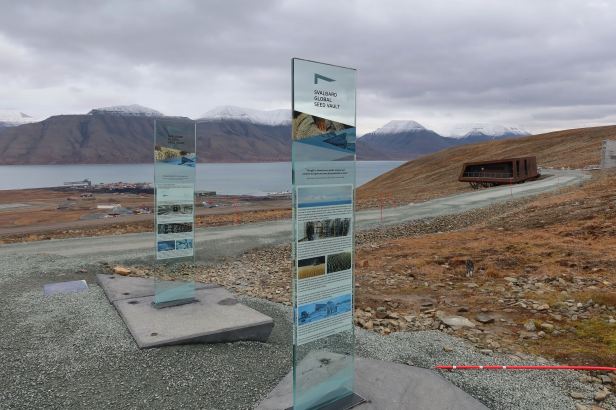
The vaults, however are situated deep within the mountain and the building is totally secure, so we could not approach, let alone go in.
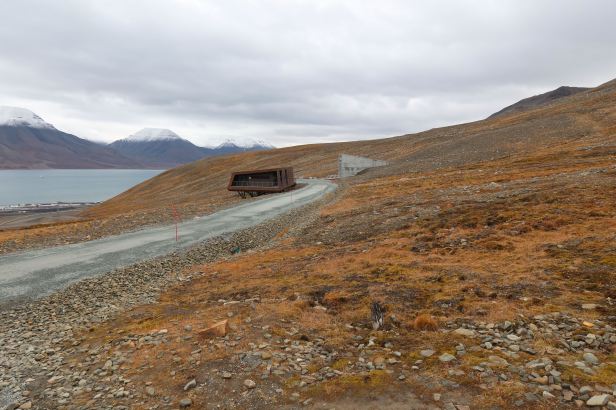
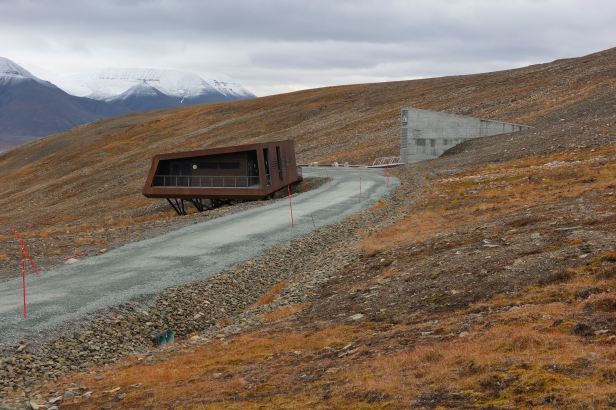
The only thing I wonder about is that, in the event of a global catastrophe and plant extinction, who will go there to fetch the seeds and then replant them all.
Longyearbyen
Our very genial taxi driver deposited us outside the Post Office in Longyearbyen. I had requested this, as there are a couple of folks of my acquaintance who like to get postcards from weird places. These were easily bought and sent off, bearing cute Polar Bear stamps. In the Post Office and all over the town, Norwegian flags were flying at half-mast to mark the recent passing of the much loved Norwegian monarch, King Harald V.
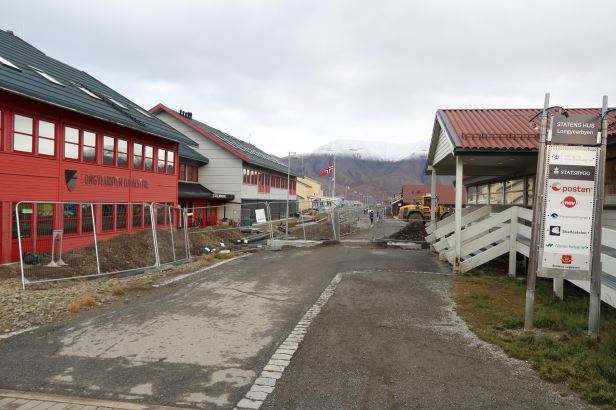
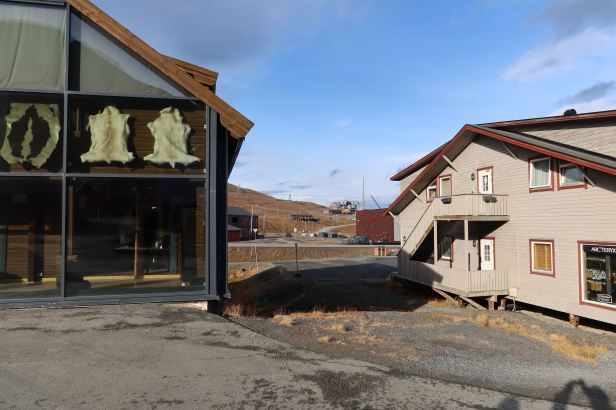
The town was small and, to be frank, a bit dismal. It had a strong air of nothing happening, or being likely to any time soon. The non-residential part was mainly a shopping area, presumably aimed, at passengers from cruise ships. There was a memorial to miners that had lost their lives in the mines.
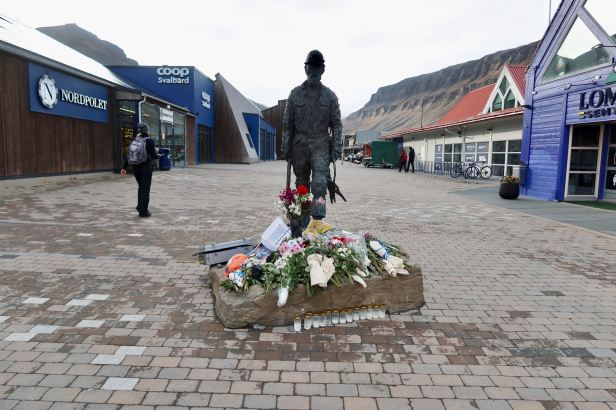
Although I do have a tendency to pick up small rocks, but, obviously, not from Greenlandic National Parks, Lucie and I are not really “souvenir” people. What we do buy on our travels, though, is a decoration for our Christmas tree. We started to search for one. We soon found a shop and got a nice, simple wooden decoration featuring Polar Bears (what else) on the front and the Svalbard name carved on the back.
Everywhere we went, we saw now departed (some had late flights) or remaining passengers – and, now that we know what they looked like, some of the joining passengers too. Longyearbyen is a fairly small place, whatever it would look like if a really big cruise ship arrived, we could only conjecture. We fancied a snack, so we found a cafe/restaurant/gift shop with a convoluted and hidden entrance. That meant that only ten of our fellow passengers and two expedition staff were already in there – and three more were shopping for blankets. The food, filled sandwiches with egg and salmon were great and my hot chocolate actually appeared to have had some chocolate in it.
In the sunshine, we ambled back to the ship. There was quite a lot of traffic, mainly the large 4x4s that are needed to cope with the harsh Winters. There were quite a few cyclists around too and it was notable that, without exception, these pedallers were carrying a rifle slung across their back. Signs everywhere warned of the danger of Polar Bears.
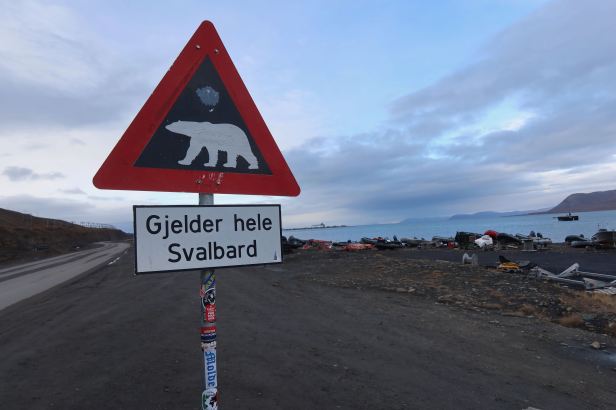
The 4x4s can, of course be used in any weather conditions, but we were amused by a huge parking lot full of snow-mobiles that were all awaiting snowy weather.
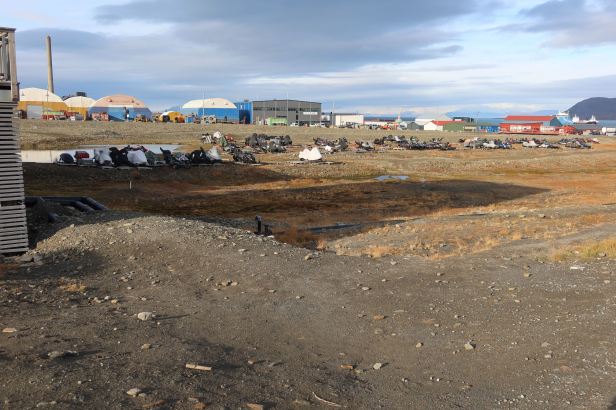
We walked back towards the ship. The scenery was certainly very dramatic.
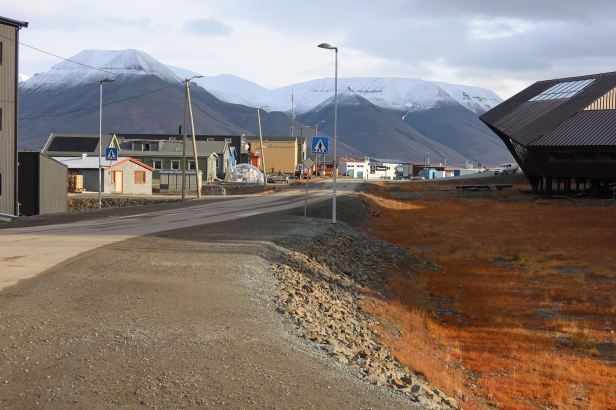
As we began to near the harbour, who should we meet, but Captain Christophe. He seemed really happy when Lucie showed him a lump of coal that had somehow fallen into her pocket while she was in the mine.
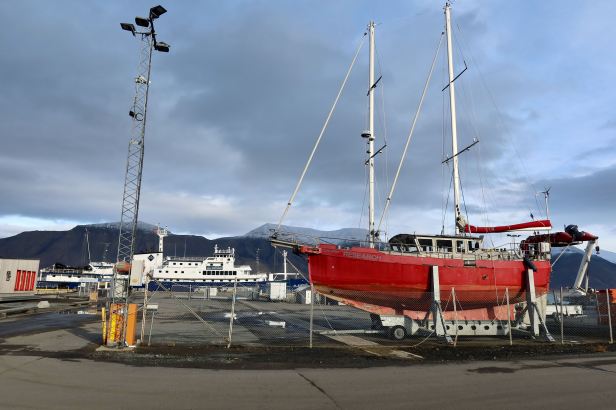
Right beside the Plancius was a red research yacht that had been hauled out of the sea and put on a trailer for the Winter. It was Czech registered !
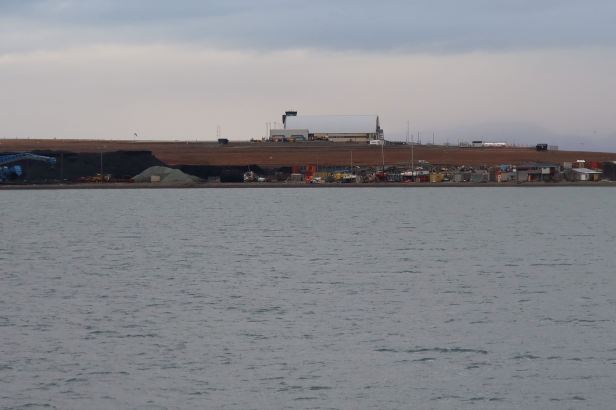
Back on board we prepared for the onslaught of new arrivals but there really were not that many. When we attended, with the newbies, the compulsory evacuation procedure and lifeboat drill, the rear deck was not really crowded. There were also seats in the lounge when we did the “meet the captain” thing and Pippa gave us the “Plan A” for the next day. It seemed that we would attempt a Zodiac cruise in a bay where there is a glacier and icebergs and the faint possibility of the elusive Walrus. This would be followed by a landing in another bay nearby. Dinner too was a little subdued, but the food was as good as ever. As the Plancius made its way back down the fjord, we passed the last mounds of coal, extracted from Gruve 3 and still awaiting collection..
With only a short distance to go to the first activity the next morning and, safely ensconced in the calm waters of the Ijsfjord, the Plancius seemed hardly to be moving, After an early morning and with another one in prospect, the big dinner had made me even sleepier than usual. I headed off to bed.

