Saturday, September 5th, 2026
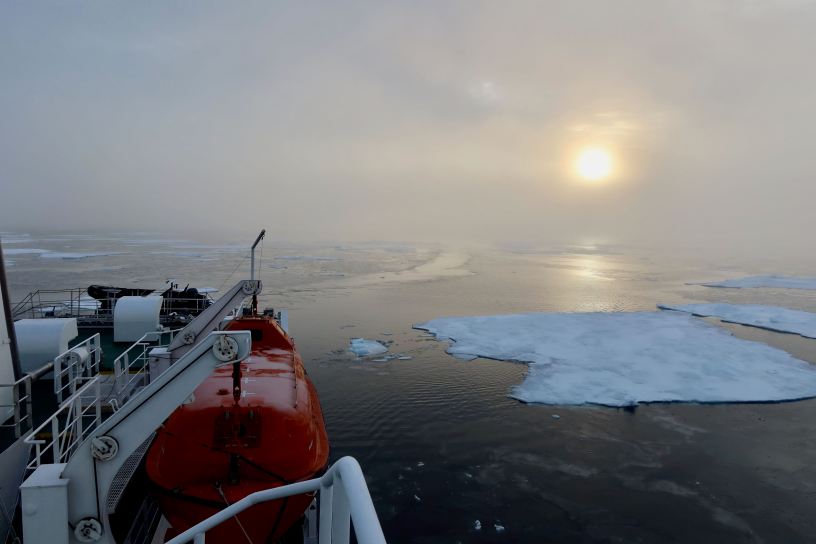
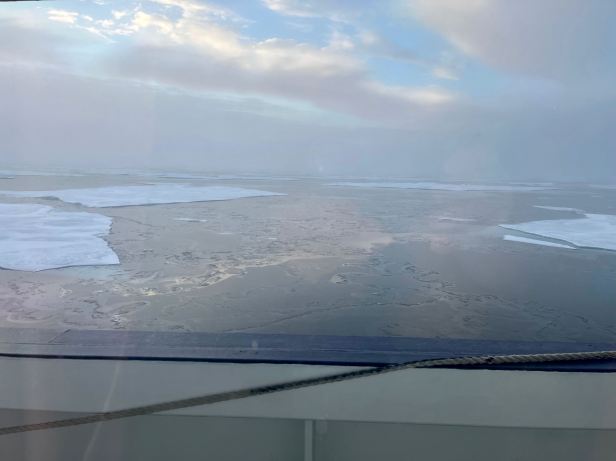
Amazingly, after spending so much time in an almost comatose state the previous afternoon, I still managed to sleep well. When I woke, my first look out of the window revealed that we were still in the sea-ice. Now that I was conscious, it was possible to hear pieces of that same sea-ice being ground under the prow or pushed aside, but if it had been happening in the night, I had not heard it. There was a bit of sea fog, but the faintest glimmer of the sun was visible which, as our cabin is on the Port side, implied we were still heading South. As ever, the engines were all but inaudible and our progress seemed calm and serene.
I went for my teas and chatted again with the Austrian lady from Faaker, which made me vaguely aware that, back home (and, therefore either one or two hours later), the last ever Prague Harley Days would soon be starting. Heresy it may be, but having seen those wonderful bears the previous evening, I somehow did not seem to mind any more that we were going to miss it.
Like almost all the people on the boat, the Austrian lady, Jo, was a big traveller and our talk ranged from the Australian outback to zoos. I grew up near Whipsnade Park, in Bedfordshire, which was the first real attempt, in the UK, to give animals some real room to exist. I had always thought that the Polar Bears at Whipsnade had a lot of room in their enclosure, until I saw the vast area in which they live and roam around, in the wild.
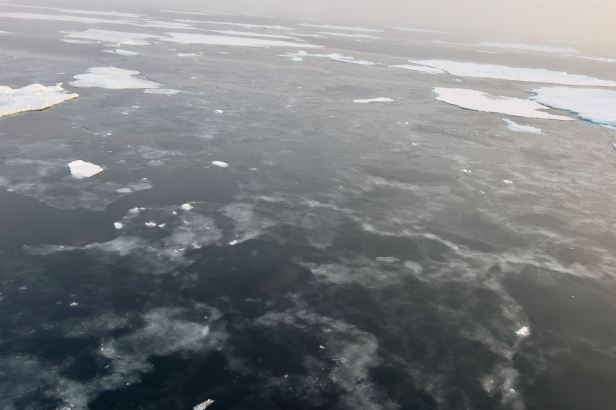
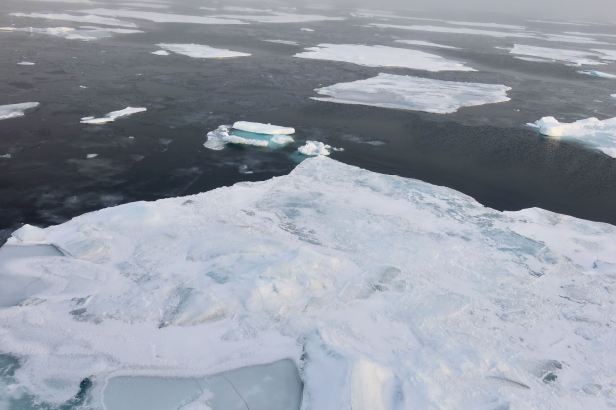
All through the morning, the Plancius was periodically thwarted from an easterly progression by impassable ice floes and, each time, we once again found ourselves heading West and then South.
I am often amazed at just what you can get your ‘phone to do (if you can be bothered enough) and many of my fellow passengers seemed to have special Apps that pinpointed ships. Some of those, who had flights home from Svalbard were, somewhat unsportingly, I felt, looking for nearby ice-breakers !
The morning talk was done by Pippa and was about Pinnipeds which, as I expect you know, are more commonly called seals. We had seen plenty of them from the ship, but mainly just their heads, because they usually dived in the sea when we approached. Lucie had photographed one on the ice, the day before, but the only one that had stayed where it was for long enough for me to get a good look at it, was the one killed by Mamma Bear the previous day.
The Hooded seal (Mama Bear’s lunch) has a hilarious courtship display in which it hugely inflates a red sac contained in its left nostril to attract a prospective mate. The short video of this happening caused universal amusement.
Like so many Arctic mammals, seals can actually control the start of their pregnancy so that the resultant birth occurs at the optimal time. In the Arctic, there are several species of seal and there is also the Walrus. All of them are predated upon at varying levels. The smallest of them, the Ringed Seal, is basically the packed lunch for anything that passes by. The biggest, the Walrus, in which both sexes have sharp tusks, is safe from everything, when an adult, except perhaps the most daring, or desperately hungry, Polar Bear.
Walruses, have lips and can generate an enormous suction force with their mouths. They are principally eaters of shellfish, which they first suck from the bottom of the sea and then suck out of their shells within their mouths. They can eat 60 to 90 kilograms of molluscs a day. I was surprised to learn that, although traditionally seen as quite comical, a Walrus will happily latch onto a baby seal – and suck the victim’s brain out through its mouth using that same, powerful suction.
At the end of the lecture, Captain Christophe put in an appearance. He looked a bit tired, but I suppose that, in the sea-ice he probably could not leave the bridge. He reassured the nervous App people that he had now located a clear way through the ice and that we should be out of it and into the open sea by early evening.
Finally, Pippa announced that although the clock still said 12:00, it was 13:00 – which was the same time as in Svalbard. That meant my iPhone and my iPad were now two hours behind, my eReader was correct and my brain was confused. I was also aware that, should the Plancius get near enough to Svalbard to catch a signal, my iPhone would immediately correct itself. I might need to stay up all night so that I did not miss breakfast the next morning. Nothing quite beats a “First World” problem !
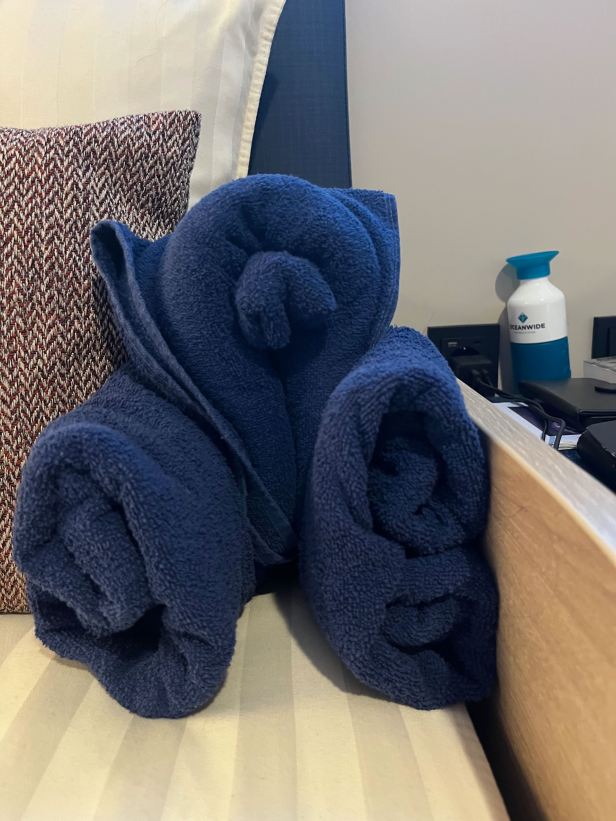
Back in our cabin, Raisa had been busy with the towels again. We wondered if there was some school in the Philippines that taught “towel tricks” !
After lunch, we had a talk from Michelle about the discovery and history of Spitzbergen – which is of course now known as Svalbard. The first name, was meant to be descriptive. The “spitz” part means pointed, the “bergen” part means mountains and was coined by Dutch sailors to tell others that saw it where they were. The second name comes from Norse and means “cold edge”. There are archaic mentions of Svalbard in an Icelandic chronicle of 1156 and a mention of the “land” by a British trading ship from the Muscovy Company in 1550. the archipelago was first partially charted by the Dutch. as mentioned yesterday, who gave it its original name.
Too far from land for migratory colonisation, the first residents were Russians, sent there by Peter the Great in the early 1700s. After the First World War, The Spitzbergen Treaty of 1920 granted sovereignty to the, then young and poor, country of Norway. Various provisions granting “rights” to other signatory nations were also in the text of the treaty.
Since 1969 when Norway decided that Spitzbergen was only one of the islands and named the whole archipelago Svalbard, that State has sought to “Norwegian-ise” the whole place. This has been done by carefully drafted laws that, whilst not directly discriminating against the non-Norwegians, does make it all but impossible for them to do many things, including vote. This means that even many long-term residents cannot meet the retroactively applied criteria and so, effectively, have been disenfranchised and have no say in what is going on there. This is up to 35% of the population. There are also plans for new oil fields and undersea mining, both of which could be environmentally detrimental, but which cannot be effectively opposed at the ballot box. Michelle had lived there for twenty-two years, as a resident and tax payer – and, never having lived on the Norwegian mainland, lost her say in local affairs overnight.
The daily recap was slightly vague as, until the Plancius finally got across the sea- ice, a lot of stuff was a bit up in the air. Pippa stressed that breaking through was when, not if and that the only real variable was the time we would actually dock in Longyearbyen, the chief town of Svalbard.
The majority of the passengers seemed to be leaving in Svalbard, so there were instructions from Marleen, the hotel manager, about settling bills, giving tips, etc. Lucie and I would have to settle up too, even though we were staying for the next part, as that was advertised as a separate trip. We would have to have new room cards, even though we were keeping the same room and, most annoyingly, new internet ids and passwords. These were random combinations of letters and numbers and I had only just managed to memorise the ones that I had.
The first talk was by Mark, about the Ivory Gull, but a lot of what he said was conjecture because it is very rare and both lives and breeds in some totally inaccessible places. Despite its rarity, we did see several of them the previous night, because it frequents ice floes and sea-ice. The gull is an opportunistic feeder, so some Ivories, both pure the white adults and the black faced juveniles, had been prowling around the kill Mama Bear had made, hoping for a nibble or, perhaps, a peck.
Then it was Chloe, talking about yet another micro-organism, the Water Bear. Another minute wonder, the Water Bear is an invertebrate less than one millimetre long, but enlarged to a visible picture, it looked like a sci-fi monster from a “Star Wars” film. There are a number of variations in body shape, but Water Bears live in every known environment. They are practically indestructible. They have survived being sent into space, being gassed, boiled or deep frozen. They do this by shrinking themselves into an even tinier ball and slowing their metabolism to 0.01% of its normal speed. We were shown film of one that had been deep frozen for thirty years. It thawed out, started to move, began eating and then asexually reproducing – all within 21 days of being taken out of the ice-box. Chloe claimed to have one as a pet. When she leaves home for an expedition, she said, she simply pops it into the deep freeze until she comes back.
Finally, Pippa talked about the remarkable nose of the Polar Bear. The bear lives in a harsh environment where it is usually either pitch dark or blindingly white, So, although it does have good eyesight, a lot of the time that sense does not help it. The bear’s nose has adapted to the point where its sense of smell is up to twenty times better than a dog. This is achieved by having nasal receptors that are endlessly convoluted with a huge internal surface area. A human nose is, by comparison, a straight and wide tube. The bear can smell some things, like a rotting whale or seal carcase from up to twenty kilometres away, downwind. When seeking food, it walks at ninety degrees to the prevailing wind, to maximise the area scanned by its nose. The nose can also sniff out seals, in breeding dens hidden beneath the ice or in breathing holes, from a smaller, but still significant, distance of many metres in the featureless white wastes.
Outside the widows, those same white wastes showed no sign of coming to an end. They knew differently on the bridge, we supposed, but it must have been worrying and disheartening for sailors in the days before radar and satellite imaging.
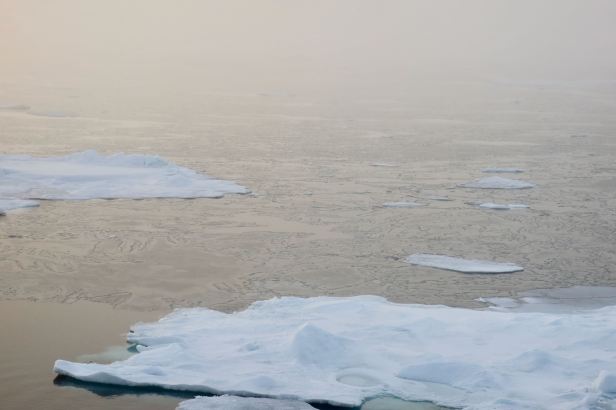
We could not smell Dinner, but it was ready, so we went and ate it. While the talks were going on, the Plancius had either breached, or sneaked through, the final piece of sea-ice and was finally on its western side and heading South. After all that time in the ice, the sea outside the window seemed to be flying by.
Outside, a slow day finally changed to evening.
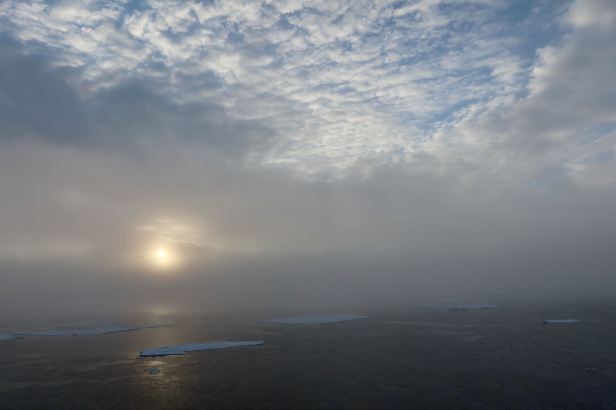
Changing the time on the clock meant that it was later than it felt, but I guessed we were then on Prague time and that would stick for the rest of our time on board.
I decided that I would go with the flow (not the floe) and go to sleep anyway.

