Friday, August 28th, 2026
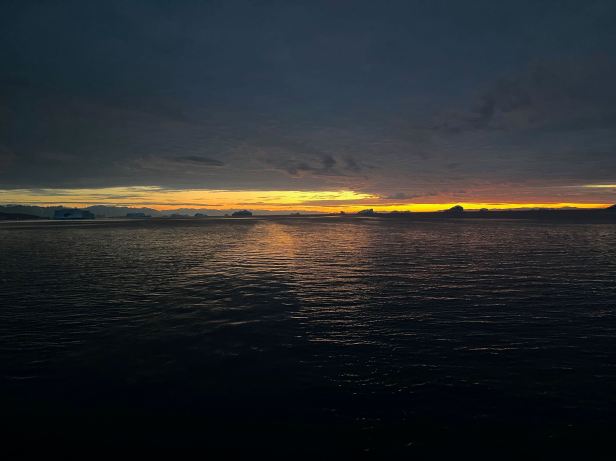
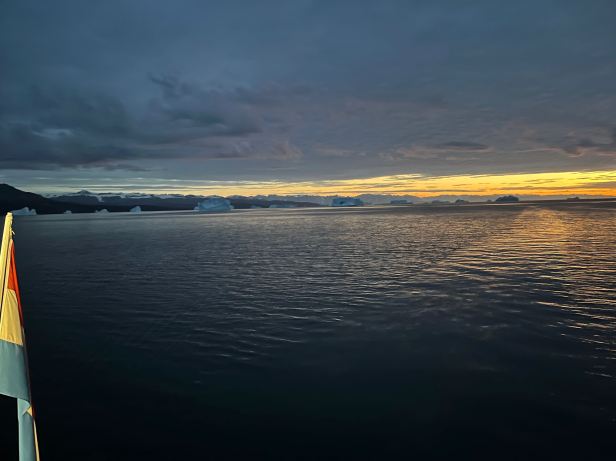
The day started at 04:00 when Lucie and I climbed from our warm beds and went outside to view the partial eclipse of the moon. Only we saw nothing, because whatever portion of moon that was not obscured by the shadow of the earth was, instead, obscured by clouds. Pink Floyd again ! The first red light of dawn, at the stern of the ship, made a nice photo though – as did the icebergs we were passing in the first vestiges of daylight.
We went back to our beds and I reset the alarm, failing to notice, as I did so, that my iPhone had somehow picked up a local signal for long enough to switch itself to “Greenland time” (an hour later than ship’s time). Thus, we were woken for the second time not by the alarm, but by the wake-up call on the tannoy. We had to move ourselves quite smartly to make breakfast !
The Plancius cruised nearer to our destination through some impressive glacial scenery.
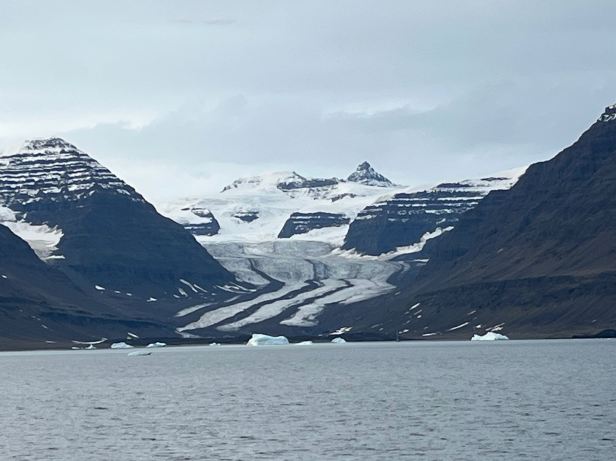
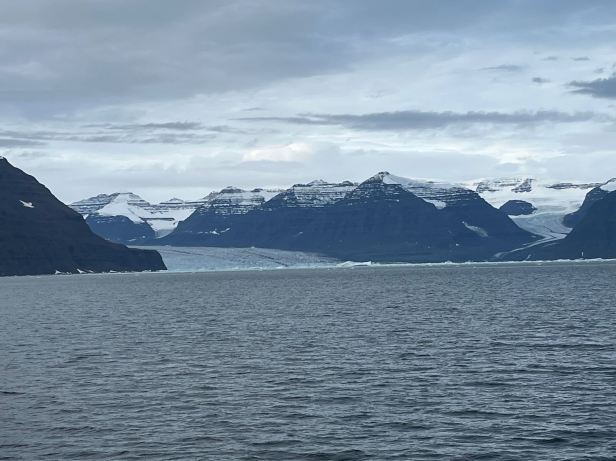
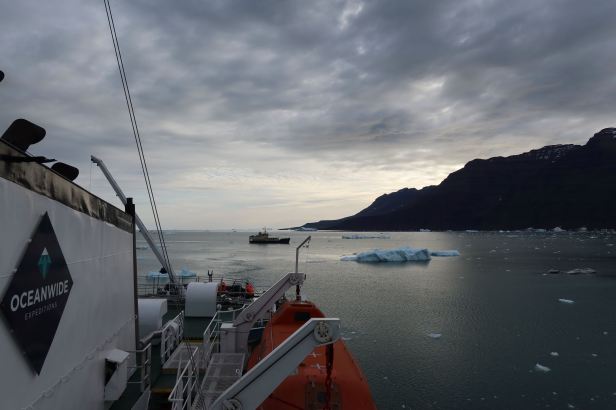
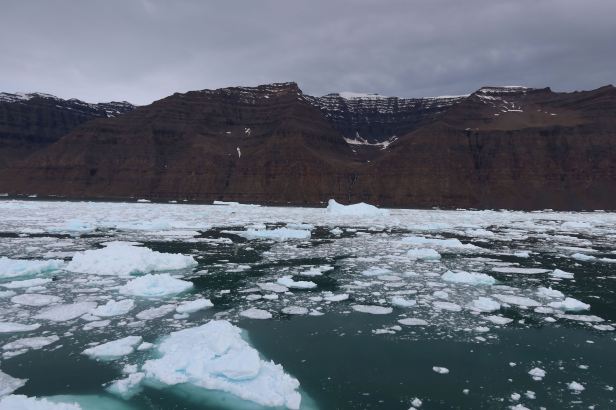
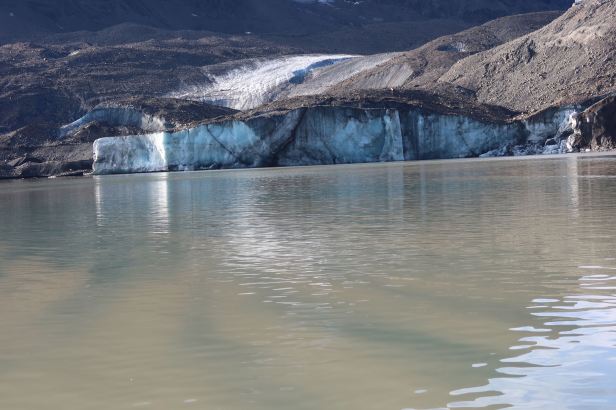
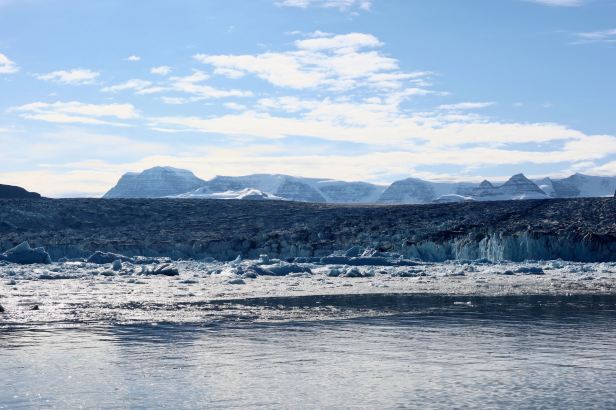
The Brede Gletscher Glacier
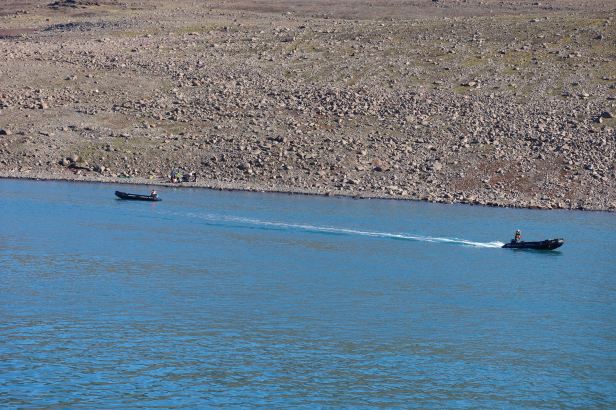
Instead of our expected landing, we were informed that the Zodiac cruise at the mouth of the Brede Gletscher Glacier would take place first. We wrapped up warmly, because even I could tell it was going to be significantly colder out on the water.
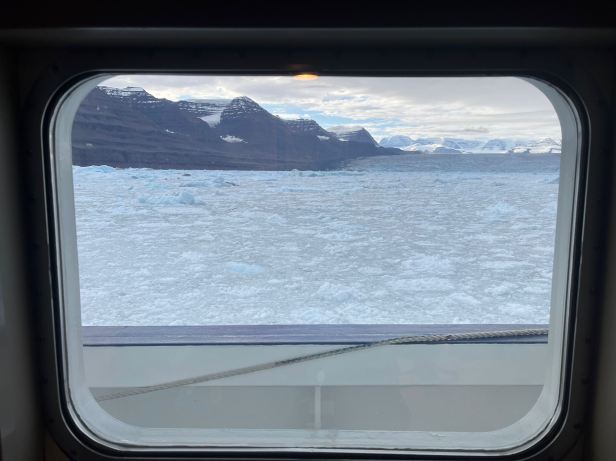
Strangely, we were once again in the final boat, but luckily with some Canadians, a group of Nordic ladies and, also Anna, the ship’s doctor.
Once in the Zodiac, piloted by Chloe, we were told that the change had been necessitated by another boat being at the basalt formations we had been due to visit and then further delayed because a Polar Bear had been spotted swimming in the sea near to the glacier.
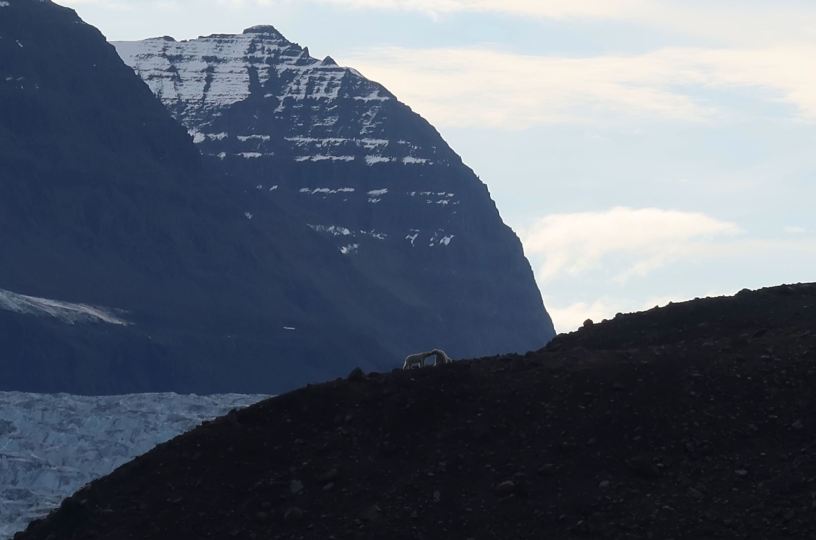
No sooner were we in the water than a message came over the radios that Polar Bears had been spotted at the water’s edge on the other side of the bay. As one, the Zodiacs set off towards the end of the glacier.
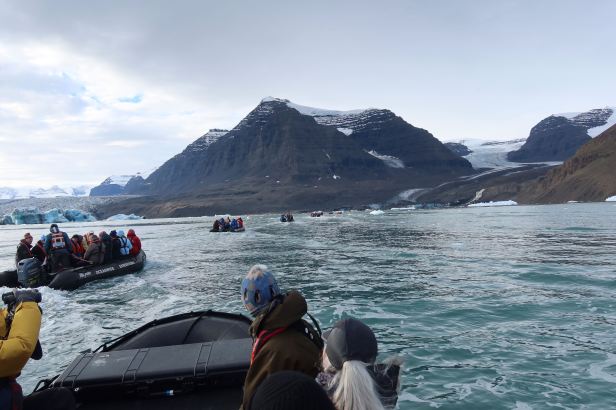
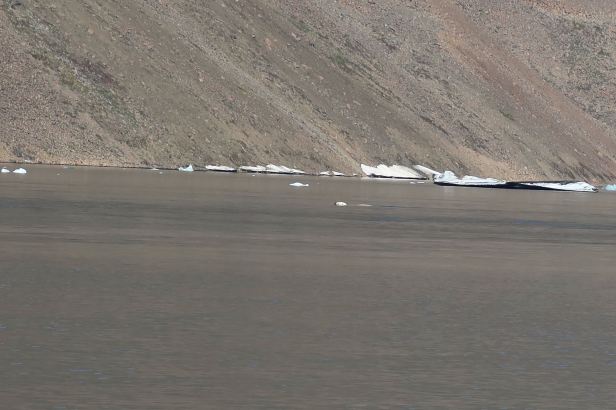
Almost immediately, it was all engines stop as, on the shore, we spotted TWO Polar Bears. Coming too close to them is forbidden, so we watched them through our monocular. It was a mother and quite a big cub and they were on the shoreline. Although we never got nearer than half a kilometre, they obviously detected our presence and unhurriedly climbed the moraine covered slope, before eventually disappearing from sight. They were a long way off, but the monocular brought them in very well and they even show quite in our photos.
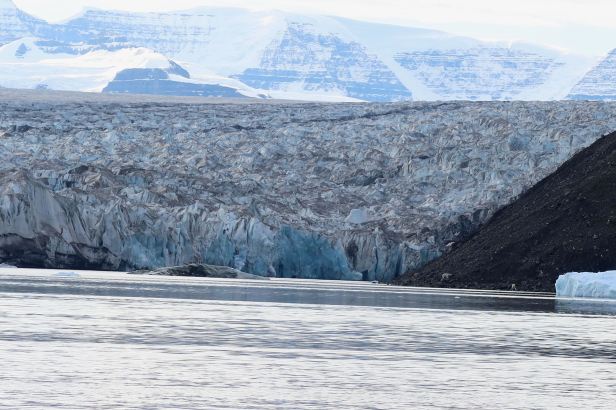
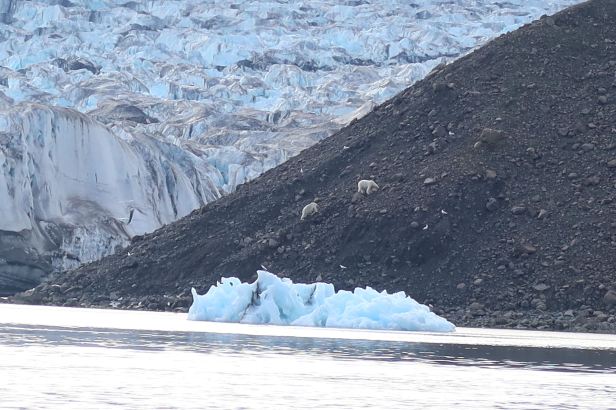
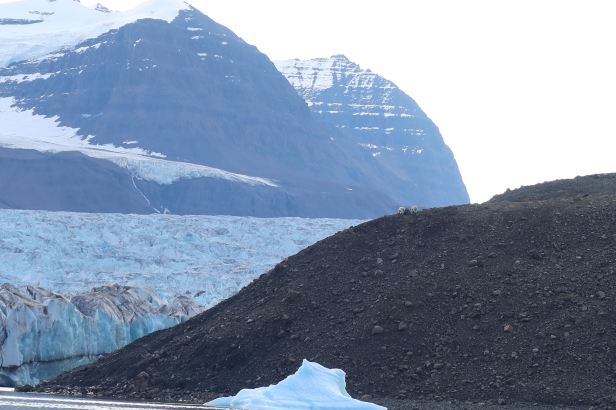
We cruised around the bay, marvelling at the never ending array of iceberg shapes. Chloe told us that, on a previous visit, the bay had been so crowded with icebergs that the Plancius had been unable to get into it. She also said that Polar Bears were very rare on Greenland (or at least sightings of them, presumably, otherwise why all the guns ?), so to see two together was a big bonus.
The Zodiacs manoeuvred around the icebergs and made their way cautiously through the brash ice that had fallen from the glacier. The guides were, of course, keeping an eye out for the third Polar Bear, which was probably swimming around somewhere to the North. It would have been very hard to spot as, in the brash ice, only the head would be visible above water – and it is also white.
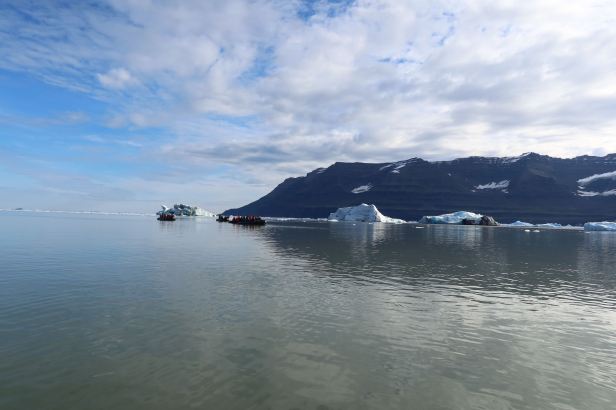
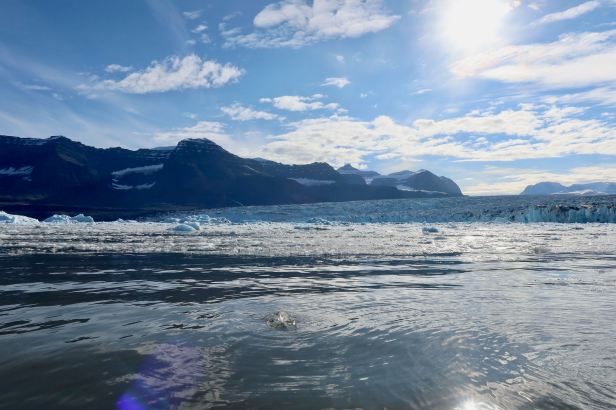
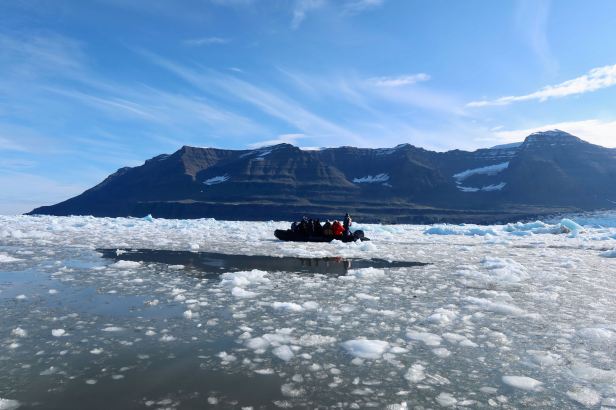
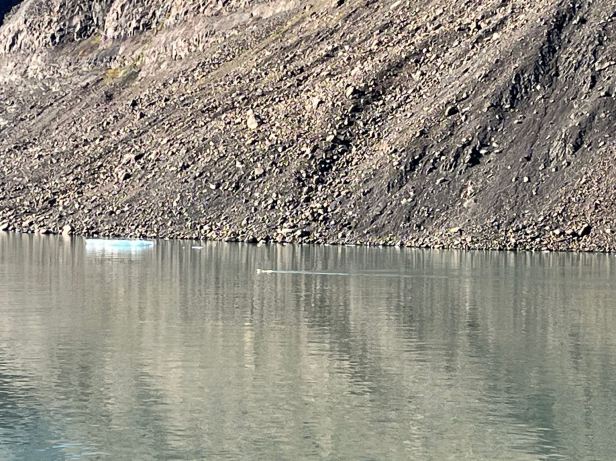
In the end, our time was up. Because we had Doctor Anna on board, we had to be the last to embark. As we waited our turn, the ever vigilant Chloe spotted the third bear. It was swimming across the bay about half a kilometre in front of us. Only its head was visible over the water and it would have been very easy to miss. Polar Bears are strong and quite rapid swimmers although, Chloe was at pains to point out, not as rapid as a Zodiac. One Polar Bear is recorded as having swum over six-hundred kilometres (yes, you read that correctly), so we hoped that, should a pursuit occur, we would not run out of petrol in less than that distance. Luckily the swimming bear chose to ignore us and, after only a few minutes ashore, set off swimming again, this time across the bay behind the ship. We embarked and crowded the rail to watch the swimming bear. It did, indeed, swim at quite a speed. Eventually, the ship moved off, leaving him on his own.
We ate a good lunch, Minestrone soup, salad, spaghetti, lasagne and cheese. Doctor Anna joined us at our table. Three times in two days – people would start talking ! Her specialty is emergency medicine in a Dutch hospital and, like Eva, the doctor on our Antarctic trip, she sees a spell as a ship’s doctor as a welcome break in her routine. Now she is fully qualified and has a contract, she admitted that it is harder to fit in.
Then, a brief rest and it was time to suit up again for the afternoon’s fun.
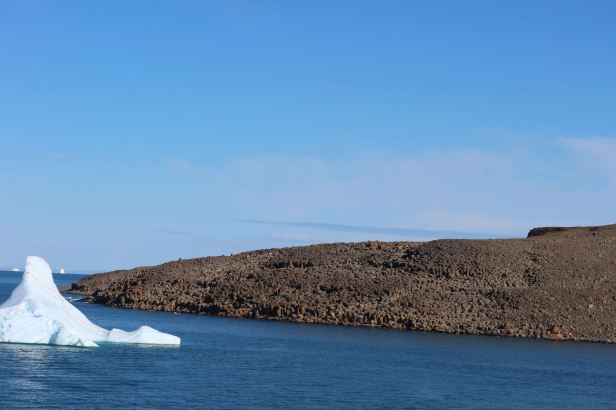
The Helgenaes Peninsular
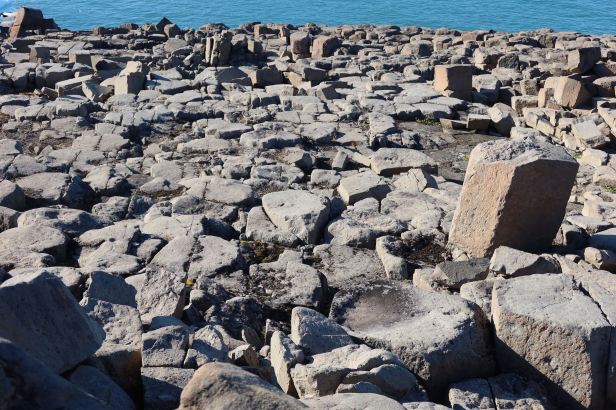
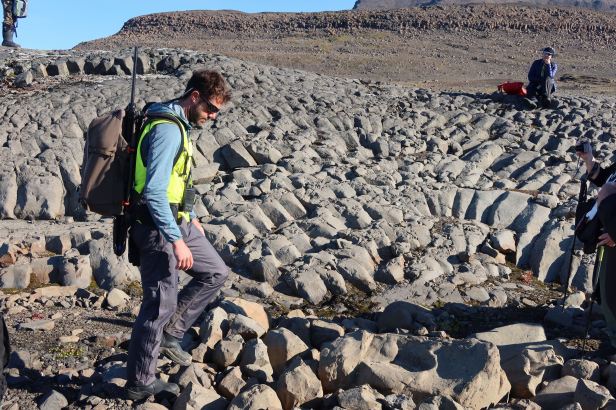
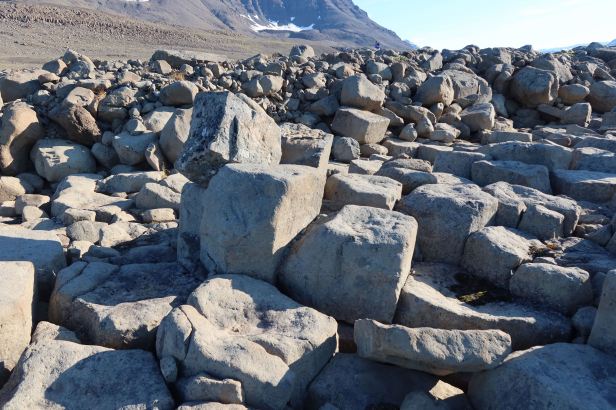
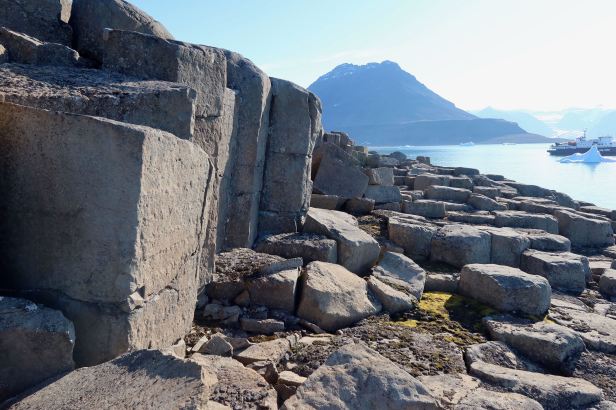
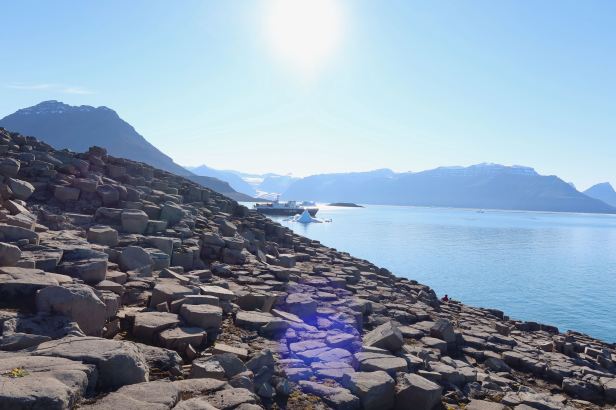
During lunch, Captain Cristophe had the anchor pulled up and moved the Plancius to a new location, where it went back down again. We had not sailed far, but the terrain on the port side, where our cabin was, was rugged in a different way. What we could see were the basalt columns of the Helgenaes Peninsular – and that was where we would be landing. Already the Zodiacs were patrolling and the guides, resplendent in their luminous yellow vests and toting their rifles, were staking out a “safe” perimeter.
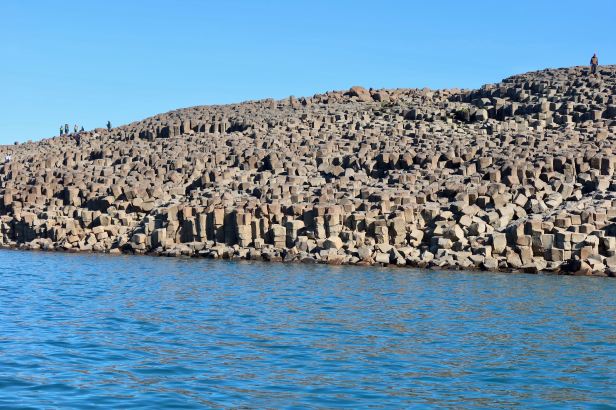
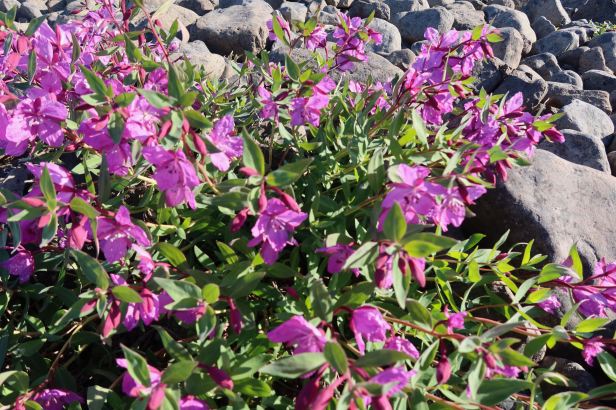
Amazingly, we were not in the last boat for once and were soon on the extremely rocky beach. We discarded our life jackets and began the trek up the boulder strewn slope. About halfway up, we came upon a large clump of Dwarf Fireweed (Chamerion latifolium) whose vivid purple flowers stood out sharply against the brownish rocks. Known in the Greenlandic language as Niviarsaq (which means “young girl”), this is a species of Evening Primrose. From what is, probably, quite a small selection, it is the National Flower of Greenland.
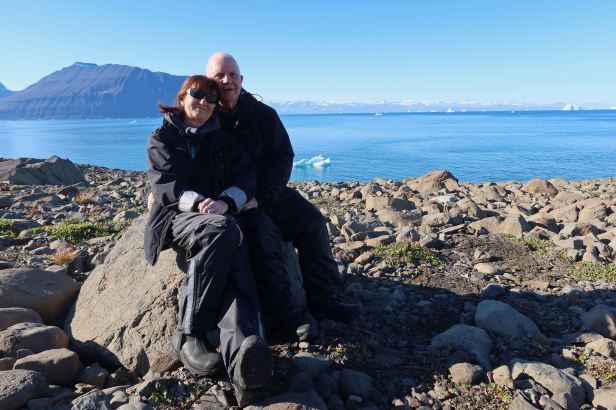
Like the Grand Old Duke of York (not the most recent one, I hasten to add) Lucie marched me up to the top of the hill. Although, of course, it was not the top – is it ever ?
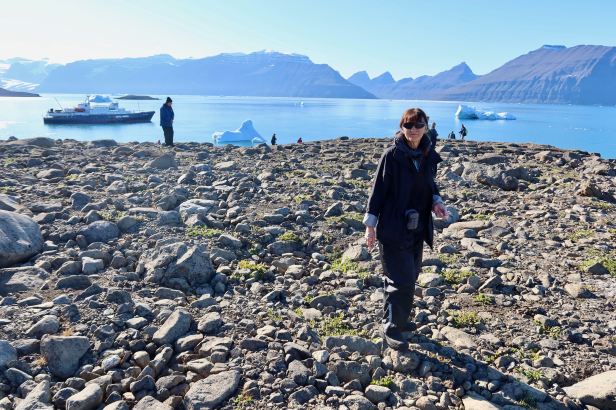
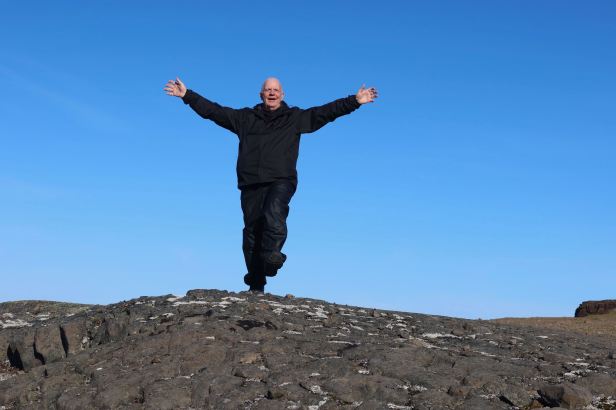
In the middle distance, but luckily within the perimeter, was a small cone of basalt upon which, somewhat predictably, I stood on one leg for a photo.
The whole area was a messy jumble of rocks, some huge, some not and, wherever the natural forces that had created that peninsular had left a small hollow, this had somehow been filled with a poor soil and sickly looking, low lying, plants were struggling to exist there.
To me, the most curious thing about the rocks was that, although a huge proportion were basalt or basalt fragments, here and there, were totally different rocks, just laying on the surface. Some were chunks of conventional lava, which, in itself is not surprising as the site lay at the end of a gigantic lava field. Basalt is a form of lava and gets its distinctive, often (but not always) hexagonal shape from shrinkage as the lava cools. There were also scattered chunks of what may have been granite and other, almost white rocks whose composition I could not even begin to guess at – but it was not lava of any description. One granite looking rock was a huge boulder. I would have liked to have asked Sven, the geologist, how these anomalies occurred, but he was menacing non-existent Polar Bears (with his very real rifle) over a kilometre away.
We saw all there was to see and returned to the Plancius in a passing Zodiac.
The evening recap was cock-a-hoop with our spotting of no less than three Polar Bears. The next day wewould visit the only settlement of any magnitude in East Greenland, Ittoqqortoomiit. This tiny town of around 350 people was artificially established in the 1920s to pre-empt Norwegian claims to the territory. For most of the year, it is cut-off by ice. We were given a long list of don’ts and no dos that I can remember. The high-point of the day seemed to be the launching of a weather balloon. It also had a football field, I would want to see that ! After lunch we would depart the Scoresby Sund and head up the East coast to another fjord system which is also a National Park. On the way, we would pause to re-victual another Oceanwide vessel, the sailing ship “Rembrandt van Rijn”. The animation illustrating this process was a bit strange, I did hope we would not need to throw bananas at it, as the diagram appeared to imply !
Then there was a brief talk by Sven, the geologist, on how the Greenlandic lava fields came to be (a seven million year long eruption, via fissures rather than the standard caldera, that began 64 million years ago) and how the “plume” or centre of the magma extrusions also moved Greenland away from Canada, Norway away from Greenland (and onto a separate Tectonic Plate) and the Faroe Islands from just off of Greenland’s East coast to their current position, which is much nearer Scotland than anywhere else. The “plume” then moved South and more or less created Iceland and remains the source of its volcanic activity to this very day.
Poor Marco had a tough act to follow with his talk on glaciers. He explained how glaciers are formed with precipitation, mainly snow, being compacted to ice by the sheer weight above it. In the current times of global warming the “accumulation” phase where the glacier expands is being outweighed by the “ablation” phase, where it retreats. He did have a couple of neat diagrams about how icebergs are “calved” where the end of a glacier meets the sea. He also told us that the “ice sheet”, which still covers about seventy percent of Greenland, is surpassed in size only by the one in Antarctica.
Then it was dinner. Still without a “gang”, we sat with Karsten, a German from Cologne. He was on his first voyage and admitted that, crossing the Denmark Strait, he too had been violently ill. More surprisingly, he is a scuba diver and told us that he also always gets sick when going in a boat to dive sites.
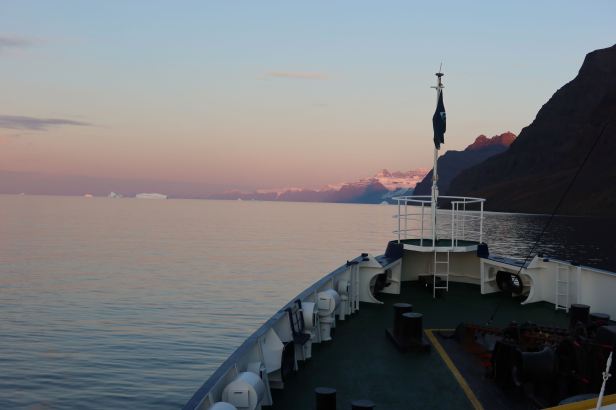
We retired to our cabin. Captain Christophe upped anchor for the fourth time that day and we began our trip to the mouth of the Sund. In the fading light of evening, the scenery was gorgeous.
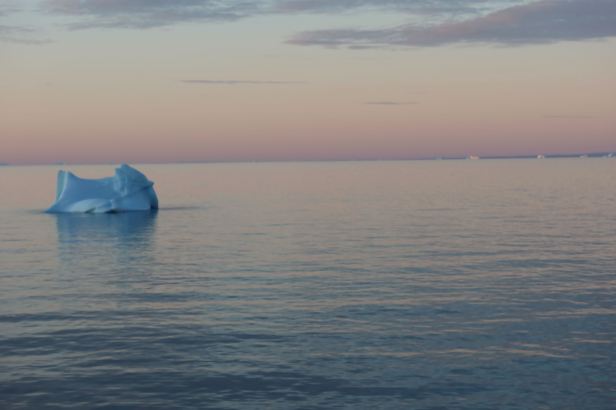
Not that I saw it for very long ……..

