Thursday, August 27th, 2026
Distance hiked – 3.5 kilometres
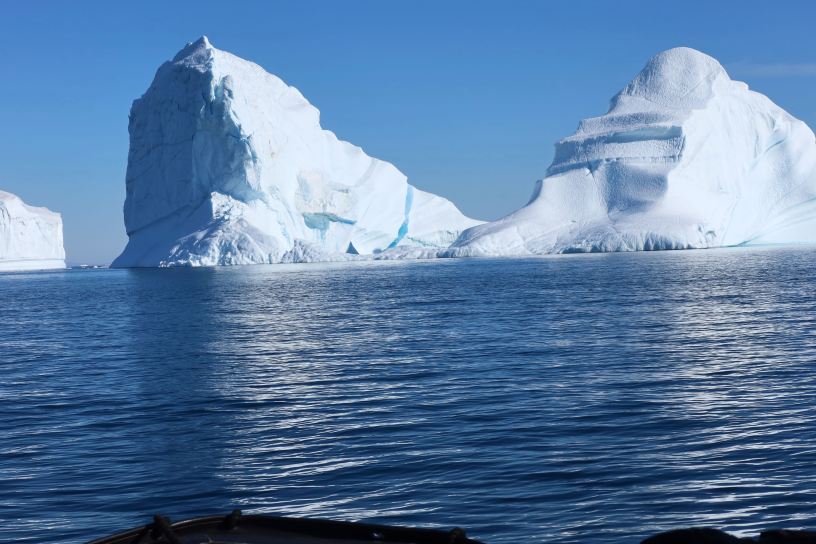
With a “picturesque” sunrise slated for 05:18, we quite naturally leapt out of our little beds at 05:05. It was already light enough to see outside and there were icebergs a few hundred metres from our window. We dressed and climbed to the lounge, where we made warm drinks and waited for the big moment.
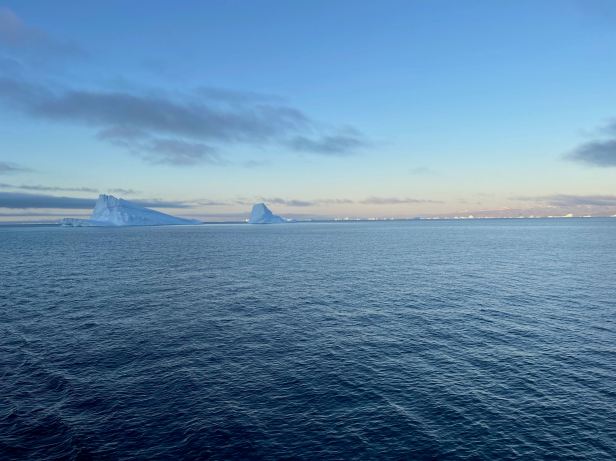
The sun rose above the horizon right on schedule. It did not significantly enhance the majestic grandeur of our surroundings, although the keener photographers did get a bit more excited by the increase in contrasts. It was all so incredibly grand and peaceful. You never realise just how noisy and frenetic a city is, until you are not in one. Obviously, the icebergs are continuously changing as they melt, break up and flip over, but it was easy to imagine that the surrounding cliffs were little or no different than when William Scoresby had first seen them in 1822.
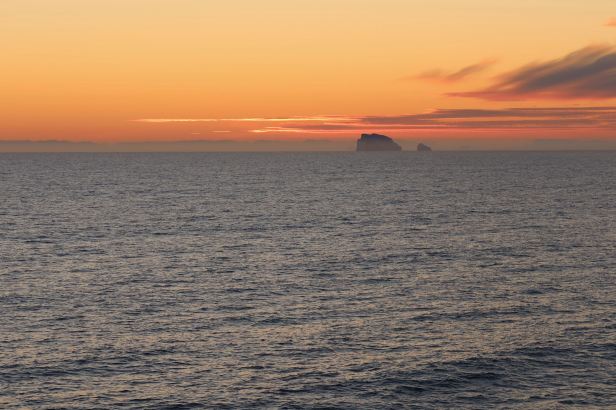
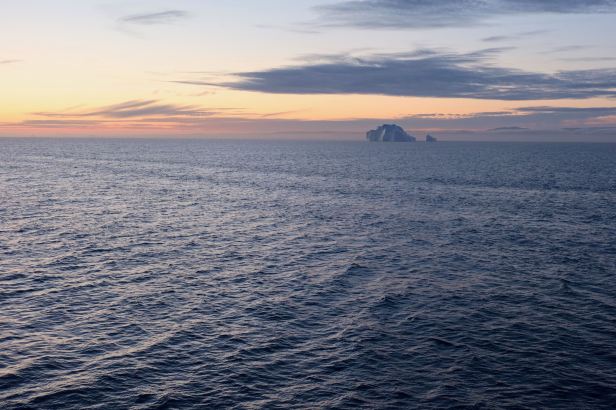
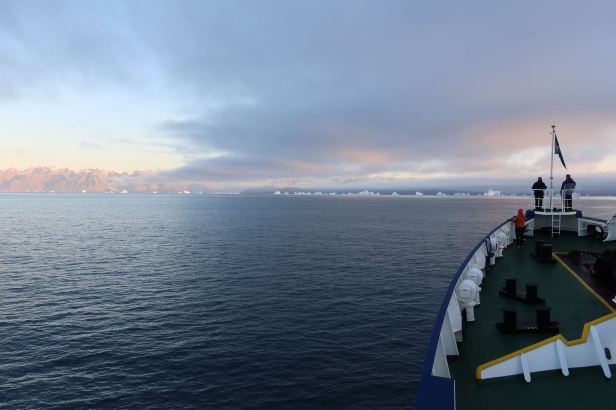
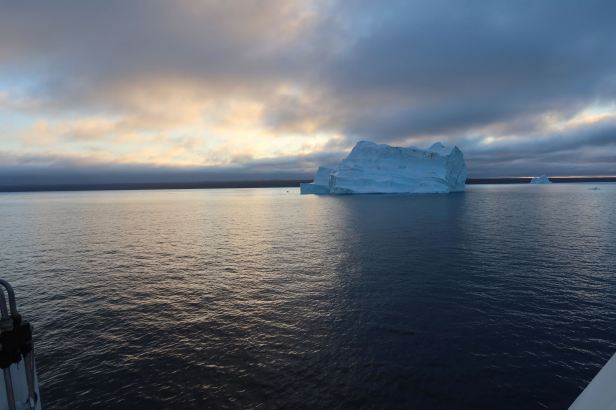
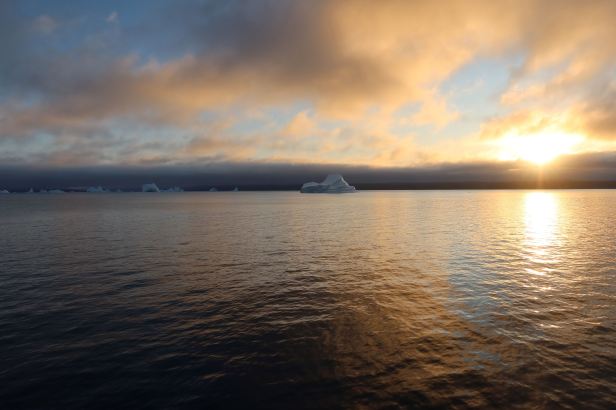
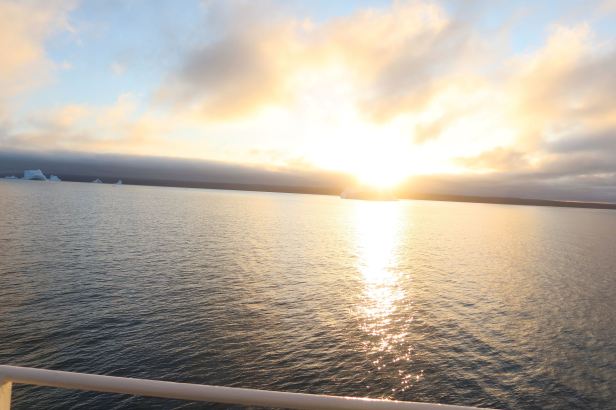
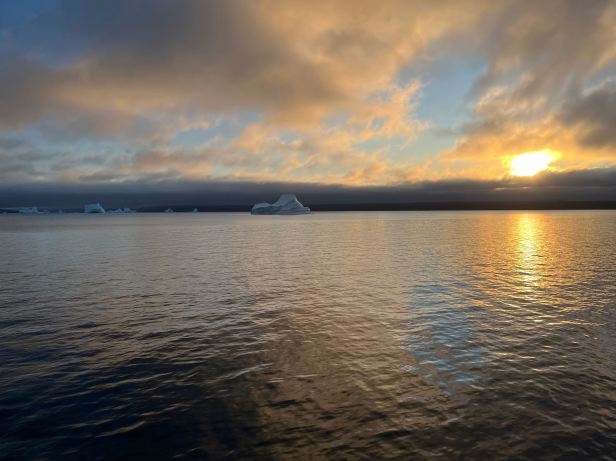
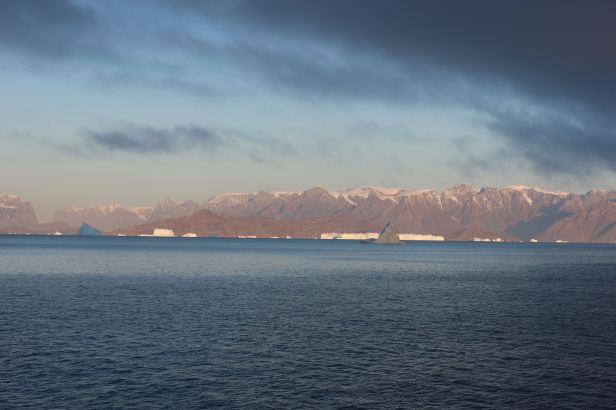
The panorama changed continuously as the Plancius slowly chugged along. It appeared that we were in the feeding grounds of the Narwhal and our speed was limited to five knots.
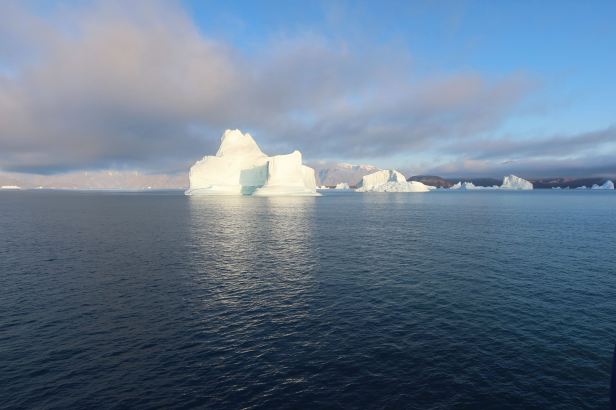
We ate breakfast with icebergs drifting slowly past, just outside the windows. Sometimes life can be extra surreal.
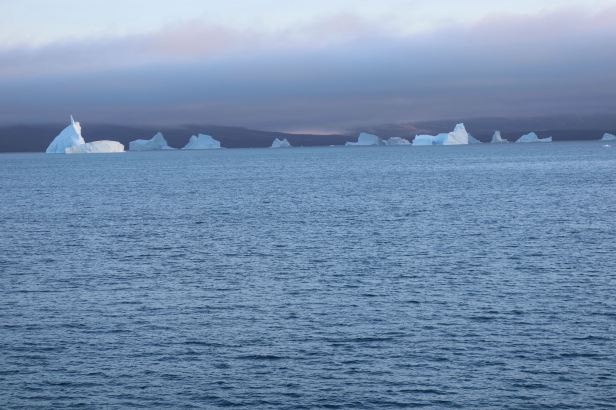
It was soon time for our first landing. Despite the fact that it was really quite warm and sunny outside, we had been warned that it could become cold very quickly. Waterproof gear for the crossing was mandatory anyway. We wriggled into our motorcycling over-trousers and muck boots and I put a fleece between my tee shirt my coat. In the end, I did not really need the fleece.
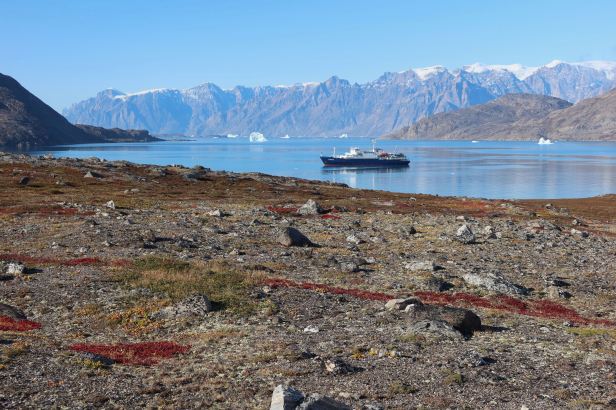
The Plancius was anchored in a scenic bay, between a large conical island and the shore. We boarded the Zodiac, like the “old hands” we were and made the short trip to the land across smooth, quite blue, waters.
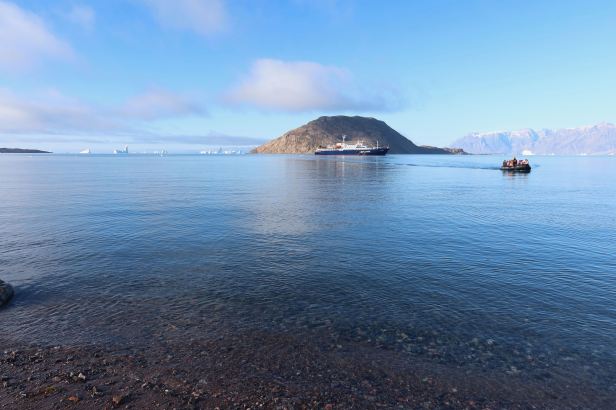
Nordostbugt, Sydkap
So, I did yet another thing that would have seemed an impossible dream when I was young. I set foot on Greenland. Lucie was first to disembark and beat me to it by ten seconds !
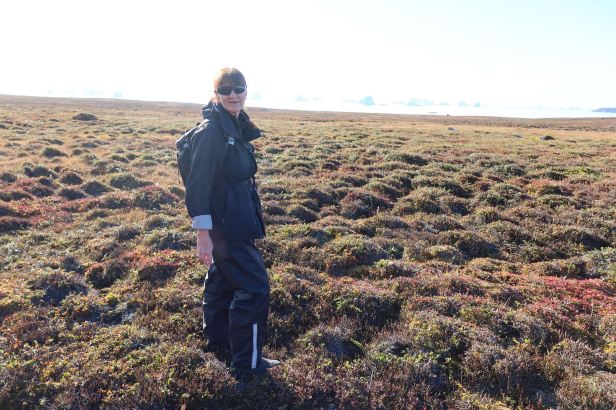
We stepped out of the shallows onto a rocky beach and discarded our life jackets into a large bag. We had elected for the “Medium” hike because the long one sounded a bit like a forced march. Ours turned into a gentle amble of about three and a half kilometres, that would not have given us even a sniff of a Tatranka biscuit back at home. Admittedly, it was very soft and springy underfoot when going through very low vegetation and felt like further. As instructed, we had to walk with a guide, carrying a rifle, at each end of the group.
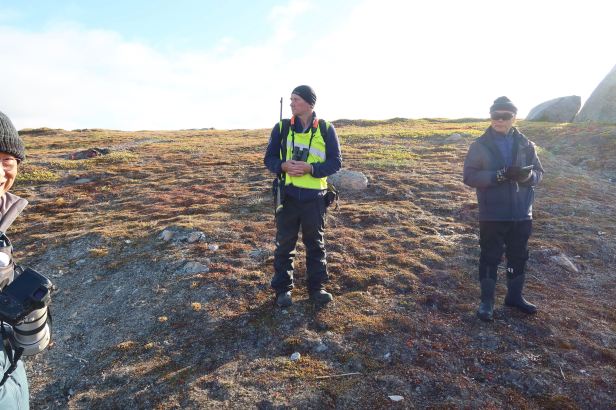
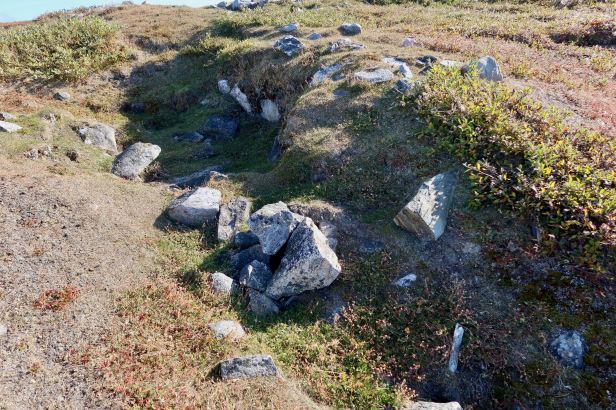
The bay (bugt) was the site of an ancient Thule settlement and we were shown the remains of their dwellings, which were pits dug into the ground and roofed, when in use, by whalebone rafters. If you consider it can get down to minus forty centigrade in that bay in the Winter, they must have been tough. One of the guides, Chloe, said the people were genetically enhanced, by nature, for cold weather living. This gave them layers of fat where we do not have them, including the tops of their heads. Their bodies also produced a special protein. This prevented their ultra high-fat diets from giving them heart disease in order that they could live long enough for their brutally hard life and the extreme cold to get them instead. The settlement was on a low rise about fifty metres above the sea. Apparently, when the land was covered in ice it had been at sea level, but, without the huge weight of the ice-cap, it has risen at a rate of about ten centimetres a year over the past half-millennium.
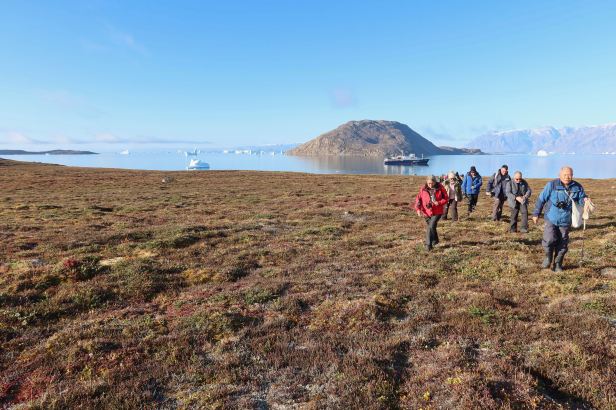
We moved off into the tundra. In truth there was nothing much to see and we marched merrily along through the often wet and boggy terrain. Chloe is a plankton specialist and hoped to show us some in a pool.
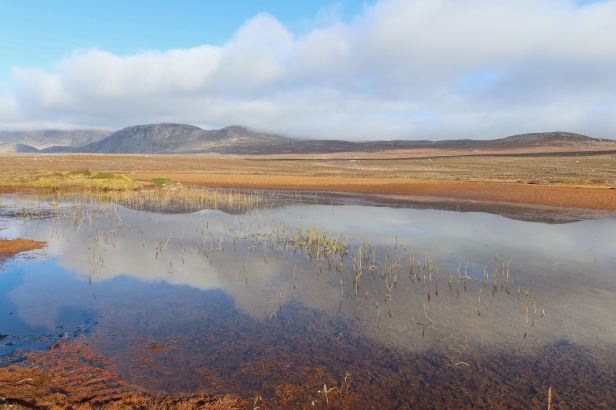 Perhaps fortunately, there was not any to be seen as it would have been quite hard for me to be enthusiastic, even though she was carrying a firearm. There were lots of feathers around the pool from the “catastrophic” (total) moult of migratory geese. These, having then regrown their feathers, had already migrated. There were also tracks from Musk Oxen and a lot of their poo. The local Inuit will hunt and eat anything that moves – and there was a Summer hunting camp in the bay, so unsurprisingly, the oxen were a bit wary. We did eventually spot three, in the far distance, but even with our monocular, they were still mere specks. If you knew what to look for, you might have spotted them but they probably do not show up on this photo that I took more in hope than in expectation.
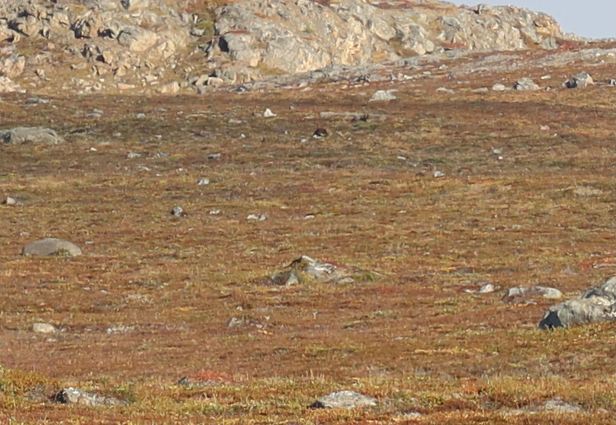
The hike was fairly uneventful. There is not the vast collections of wildlife in Greenland that there is in the Antarctic – there are the Musk Oxen and there are foxes too, but we did not see them. There was a scarcity of everything. It may have been that all the migratory species had already gone, the geese certainly had, but, inland there was nothing to be seen. The biggest problem for the guides was not the Polar Bears, but the Chinese passengers. Either they did not understand the instructions or they simply ignored them. They wandered everywhere at every opportunity and had to be continuously “rounded up”.
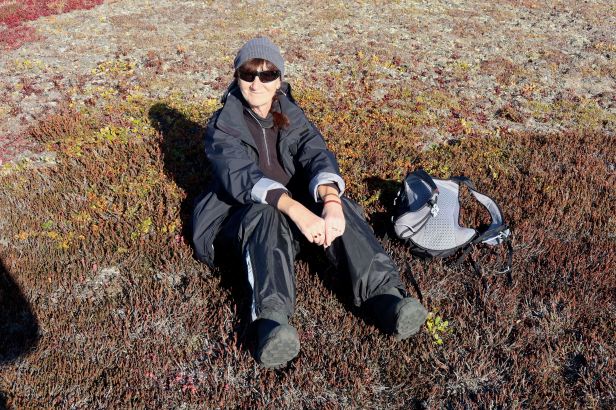
Unlike in the Antarctic, there were (luckily) no prohibitions on sitting down on the soft, springy plants.
In the bay was what is referred to as an “iceberg graveyard”. Dozens of them were grounded in the shallows and, unable to move, they were slowly melting. In Greenland, that can take many years.
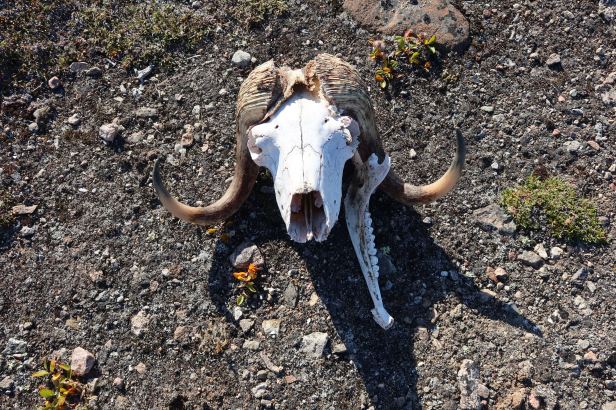
As we began to move back towards the ship, we encountered first the skull and then many vertebra of a dead Musk Ox. It was quite big, a male can grow to four hundred kilograms. According to the Charlotte, the other guide, the comparative lack of bacteria in Greenland can mean that decomposition is slowed dramatically. Obviously foxes, carrion birds and gulls would have had a good munch on the carcass, but it can take centuries for the bones to totally degrade. She estimated, from their state of degradation, that the ones we found could have been two centuries old – and I never argue with a blonde girl carrying a rifle.
Then it was back to the beach, on with the life-jackets, into the Zodiac and back on board. Smoothly and professionally done. As in Antarctica, we had to scrub our boots when we got back on board, but as we had not needed to wade through Penguin poo, that was more of a formality than anything else. Lunch was next. We were both surprisingly hungry. The offer was cod and ginger with rice, followed by what was called fruit custard but was, in reality, fruit with a bit of custard dripped on it.
A Zodiac cruise at Jyttehavn, Bear Island (Pookattaq in the East Greenland dialect)
As we had been told, plans can change. Plan A for the afternoon had been to make another landing on Pookattaq or Bear Island. This is a different Bear Island to the one in Svalbard – it was given the name because early explorers killed a bear there. For some reason, of which we were not informed, this changed during lunch to a Zodiac cruise along the shores of Bear Island instead. On command, we geared up warmly, it IS colder out on the water and lined up to disembark.
Somehow, we were in the very last boat with three Canadians and four Chinese people and Anna, the ship’s doctor, who is always last person off and last back one back on. Sadly, during the cruise one of the Chinese ladies, who had earlier claimed not to understand English, continuously complained, in that same language, about possible dangers and the speed at which we were travelling. Our pilot was Sven, the German geologist and he was very informative about what we were seeing and very good about stopping for photos at points of interest.
Wildlife may have been a bit lacking but the surrounding scenery was truly amazing in its range of grandeur, beauty and endless variety. Everywhere you turned your head there was something worth looking at and, five metres later, with a changed perspective, the same thing made you draw breath again. Superlatives to describe what we saw quickly become clichéd, it was all simply wonderful. There were also icebergs, many of them huge, scattered throughout the channels. No two were remotely similar and some of the shapes were amazing.
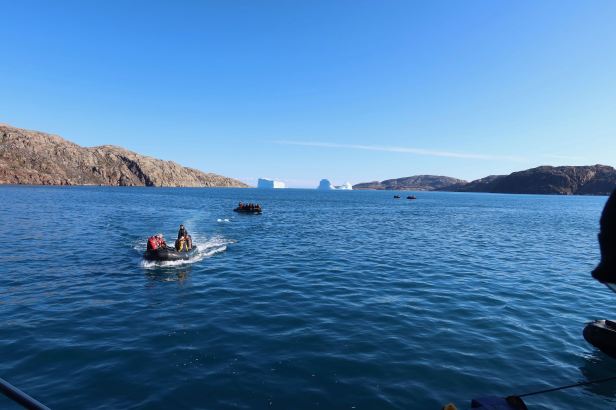
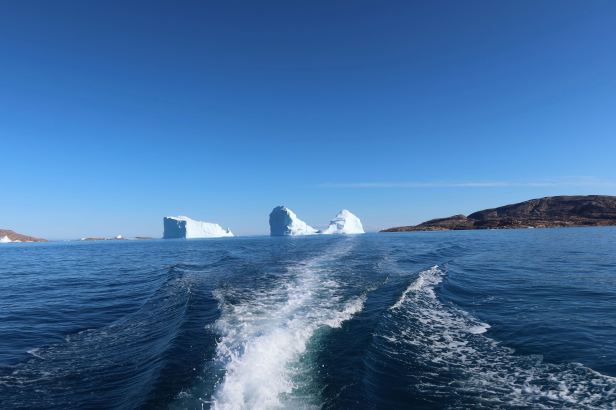
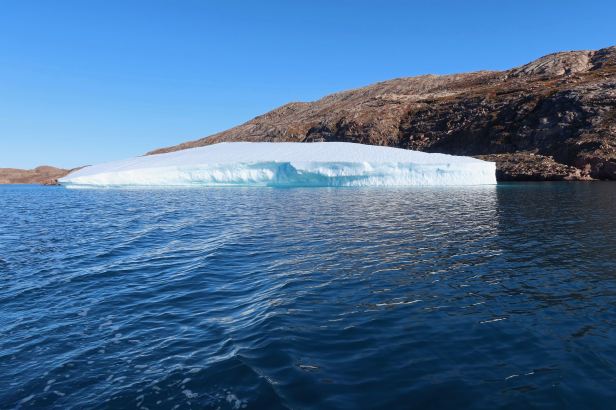
Sven was good at explaining various aspects of their origins, structure and composition. Navigation near the icebergs required caution. At any second a piece can suddenly break off and the resultant change in the centre of gravity can turn over the whole iceberg and unleash a dangerous wave. We actually saw this happen in Antarctica. We fished a piece of ice out of the fjord. It was fresh water and may have been frozen 20,000 years ago. Makes you think, doe it not ?
We were in a loose group of three Zodiacs and we were third in line. Attempting to pass through one channel, the leading Zodiac, piloted by Charlotte, an English girl, grounded. The second, piloted by Marco, a gallant Italian, went to assist her and quickly freed it, only for Marco’s Zodiac to ground even more fixedly. In the end, he had to jump into the shallows and free his own Zodiac by strength of arm, before being towed out by boat one. Sven, a stoic German, waited patiently on the fringes in case a disaster occurred. This may have been to record the mayhem for YouTube but was probably just as well because the complaining Chinese lady in our boat was beside herself with concern that we, too, might become entangled in the melee.
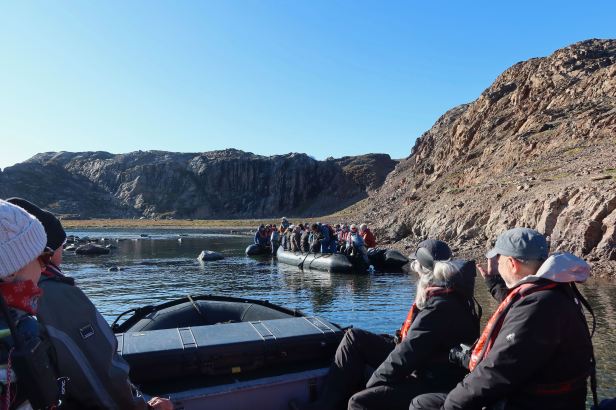
We did see some wildlife, a seal was spotted twice or, more likely, two seals were spotted once, an Eider duck with one remaining chick (she had obviously not had a good summer !) was seen and finally, grazing high on a bluff, a Musk Ox. Thanks to our new monocular, we both got a good look at it and, thanks to what seems to be a slightly better zoom on our new camera, Lucie managed to get a few goodish photos of it too.
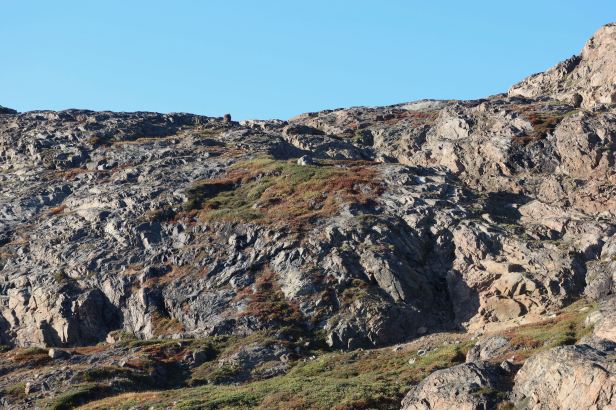
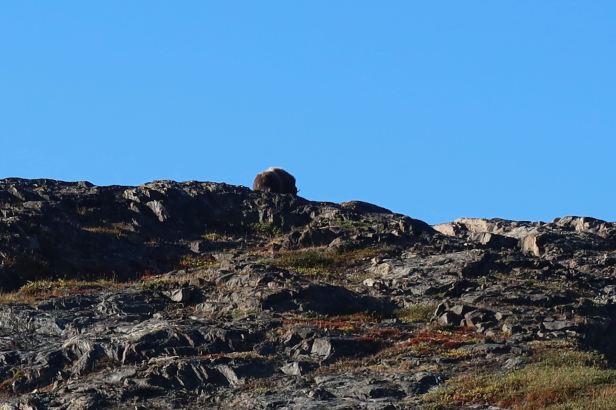
Finally, Sven guided us back to the Plancius, which had repositioned itself during our cruise. To get there we had to navigate through a large field of what is called brash ice. We later learned that, just as the Plancius was dropping anchor, the top of a nearby iceberg had suddenly crumbled and fallen into the fjord. This created a large wave, so it was lucky that the Zodiacs were not nearby at that moment. We did encounter some, suddenly, very choppy water on our way in though, over a kilometre from the ship. That showed how dangerous an iceberg could be to a small craft. The bridge team actually had film of the disintegration and it was compelling viewing at the recap.
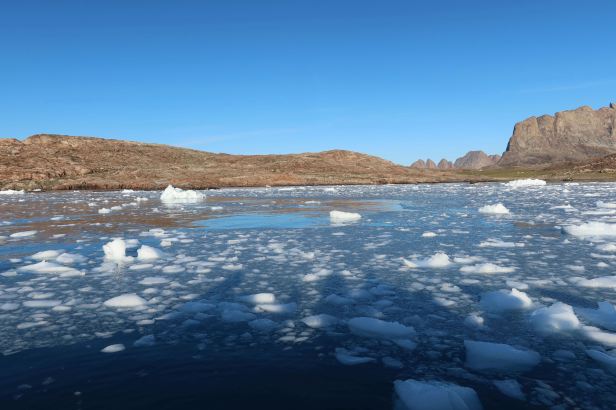
Back on board, it was soon time for the recap. We all agreed it had been a good and informative day. Overnight, we would move South, back down the Sund and hopefully make two landings, or a landing and a cruise at some basalt rock formations and the edge of a glacier, the following day. As we boarded, Sven pointed out the 1976 metre tall peak of a mountain on the horizon. This was Grundtvigskirken, named after the similarity between its silhouette and that of the Grundtvigskirke (Grundtvig’s Church), in Copenhagen, which was designed by the architect Peder Jensen-Klint and built in the 1920s .
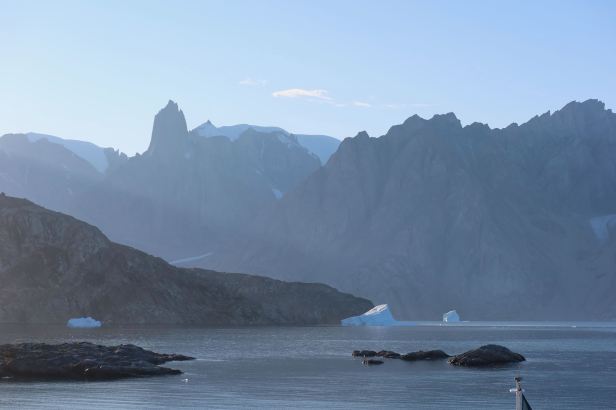
Back on board, still photographically inspired by Koen, we took a few pictures with leading lines ….
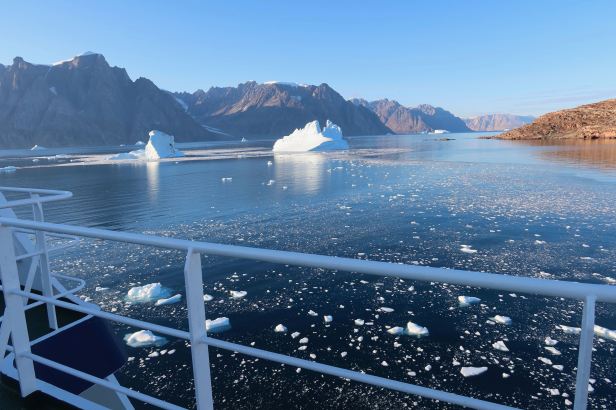
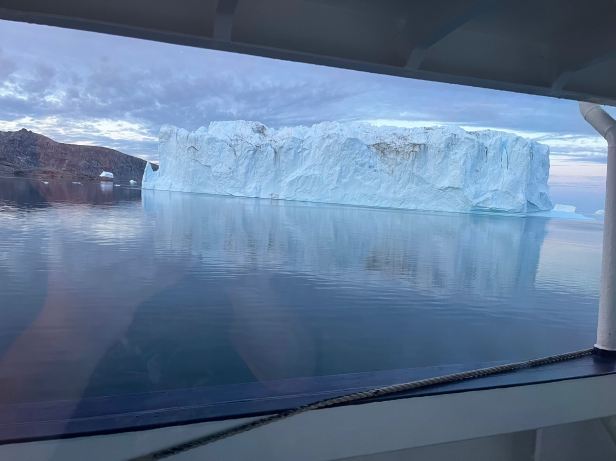
Dinner was as good as we had come to expect. We did not have a “gang” and we felt we probably would not get one. There were large groups of Canadians, Germans and Chinese who seemed to know each other and a lot of the people there on their own were probably on their own for a reason. We sat where we could, but there was a distinct lack of banter.
It seemed that, at 04:13 the next morning, there would be a partial lunar eclipse. The alarm was set, so I needed to go to bed.

